
Clostridium difficile
MORPHOLOGY:
- Gram-positive, rod-shaped, spore-forming bacteria.
- Anaerobic
In the presence of oxygen on an inanimate surface:
- Vegetative form of C. difficile can survive up to 24 hours
- Spores can survive up to 2 years on inanimate surfaces
- Inhabits the microflora of intestines of humans
- Spores are subterminal
- Ideal condition for growth is around 37ºC (98.6 ºF)
- Human perfect host
- Moves via peritrichous flagella.
- Shows fecal-oral transmission
- Asymptomatic fecal carriage is very common in healthy neonates.
RISK FACTORS:
- Prolong antibiotic therapy
- Important antibiotics associated with C. difficile infection:
- Clindamycin, ampicillin, and cephalosporins (cefotaxime, ceftriaxone, cefuroxime, and ceftazidime)
- Fluoroquinolones (ciprofloxacin, levofloxacin, and moxifloxacin)
- Less risk: Ticarcillin/clavulanate and piperacillin/tazobactam.
- Pantoprazole increases the risk
- Associated with use of rectal thermometer
- Old age
- Enteral tube feeding
VIRULENCE :
- Two major toxins -toxins A and B
- Glucosylate the GTP binding proteins
- Disrupt cell cytoskeleton
- Fiud is leaked leading to whitish yellow plaque formation over, colon known as Pseudomembranous colitis.
Other virrulence factor are:
- Fimbriae
- Ability to associate with gut cells/mucus
- Production of a capsule
- Secretion of a range of hydrolytic enzyme
- Production of other toxins (such as an actin-specific ADP-ribosyltransferase by some strains)
SIGNS & SYMPTOMS:
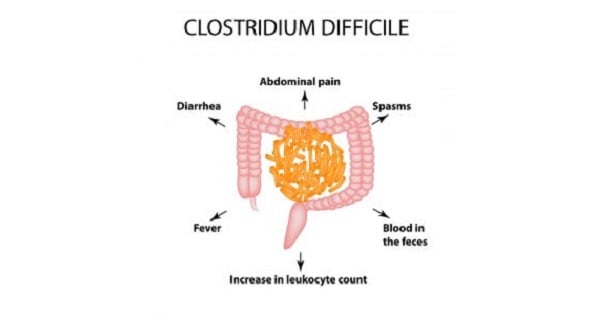
- Watery diarrhea (at least three bowel movements per day for two or more days)
- fever, loss of appetite, nausea, abdominal pain/tenderness .
- May cause crohn’s disease
- More severe cases of Clostiridium difficile infection present with ulcerative colitis which can be severe enough to result in the need for a bowel resection.
- Signs and symptoms of colitis can include the above list as well as dehydration and bloody stool.
Complication
- Toxic megacolon
- Sepsis.
Infants
- Don’t develop symptomatic CDAD
- They lack receptors for mucosal toxin
DIAGNOSIS:
- The cytotoxin assay is the standard test for identification
- A fresh stool sample is needed and no prep is required.
- Other tests include endoscopy and anaerobic cultures.
- 3 unformed stools per 24h for 2days
- Toxin A or B detected in the stoo
- Pseudo membranes seen in colonoscopy
- There is also a disctinct odor when the feces contains Clostridium difficile.
CONTROL & TREATMENT:
- The first step that should be taken is to stop administering currently prescribed antibiotics to the patient.
- In mild cases of Clostridium difficile infection, Metronidazole is administered.
- In severe cases, treatment can begin with the administration of Vancomycin but can also require surgical intervention.
- Alternative drugs are fusidic acid, teicoplanin, and bacitracin.
Exam Question
MORPHOLOGY:
- Gram-positive, rod-shaped, spore-forming bacteria.
- Anaerobic
- Inhabits the microflora of intestines of humans
- Spores are subterminal
RISK FACTORS:
- Prolong antibiotic therapy
- Pantoprazole increases the risk
- Associated with use of rectal thermometer
VIRULENCE :
- Two major toxins -toxins A and B
- Fiud is leaked leading to whitish yellow plaque formation over, colon known as Pseudomembranous colitis.
SIGNS & SYMPTOMS:
- Watery diarrhea (at least three bowel movements per day for two or more days)
- fever, loss of appetite, nausea, abdominal pain/tenderness .
- May cause crohn’s disease
DIAGNOSIS:
- 3 unformed stools per 24h for 2days
- Toxin A or B detected in the stool
- Pseudo membranes seen in colonoscopy
- There is also a disctinct odor when the feces contains Clostridium difficile.
CONTROL & TREATMENT:
- In mild cases of Clostridium difficile infection, Metronidazole is administered.
- In severe cases, treatment can begin with the administration of Vancomycin but can also require surgical intervention.
Don’t Forget to Solve all the previous Year Question asked on Clostridium difficile
