
Contusion/Bruise-Types
Contusion/Bruisre
- Contusion is an infiltration or extravasion of blood into the tissue due to rupture of vessels by the application of blunt force.
- Its subcutaneous without discontinuity of skin.

Examples:-
- Stick,stone or fist.
Features of contusion
- Varies in sizes-Haematoma.
- Superficial contusions are slightly raised over the skin.
- May not be present at site of the impact.
- Superficial contusions appear soon with red colour.
- Deeper contusion appear late,can be detected by infra red photography.
- Contusions over bony prominences are less visible externally.
Types of contusion
1. Petechial haemorrhages
- This term is used to describe very small ‘pinpoint’ (i.e. less than about 2mm) extravasations of blood
- Most often seen on the skin, conjunctivae and mucous/ serous membranes, arising at the level of the capillaries
2. Intradermal bruises
- Where an extravasation of blood arises within the deeper dermis, allowing extension of blood into subcutaneous tissues, the ‘outline’ of the bruise seen at the skin surface is usually ‘blurred’ or indistinct.
- If the bleeding occurs more superficially, however, the result is a so-called ‘intradermal bruise’, where the components of the bruise are more easily deliniated (punctiform, sharply defined and ‘bright red in colour’).
- A ‘negative image’ of the profile of the impacting instrument is produced i.e. a ‘patterned injury’

- The finding of a ‘patterned’ injury is of considerable forensic interest – careful documentation
- Examples of situations in which an intradermal bruise may be produced;
- tyre marks in a road traffic collision
- a punch to the face by a woolen-gloved fist
- a ‘stamp‘ by a shoe/ trainer etc
- an impact by a whip
3.Tramline bruises
- When a person is struck with a cylindrical object, such as an iron bar, baseball bat, or police asp etc, the bruise pattern formed is quite distinct.
- The skin surface is indented and blood vessels at the edges are ruptured.
- Blood is squeezed out of any vessels along the point of contact, but the vessels remain relatively intact (particularly if the supporting tissues are lax).
- When the impacting object is removed, blood flows back into the undamaged vessels, but leaks from the damaged ones.
- The resulting bruise is termed a ‘tramline bruise’ because it appears as a pale linear central area lined on either side by linear bruising

4. Fingertip/pad bruises
- Where an assailant has forcefully gripped a person, for example around the neck (e.g. during attempted manual strangulation) or arms etc, one may see small discoid or ovoid bruises in a cluster.
- These may be discrete, but are often blurred or may ‘merge’ with one another,
- Sites to look for these bruises include,
- The neck
- The arms
- The face and trunk in children
- The inner thighs in suspected sexual assault
5. Others
- ‘Defensive’ bruises on the upper arms or forearms, where a victim has attempted to ward off their attacker’s blows to protect vital organs/ body parts
- Bruising around the mouth or lips, which may corroborate a history of having had a hand forcibly placed over their mouth to silence the victim
- Bruising on the shoulder prominences, which may corroborate a history of having been forcibly pushed up against a wall etc during an assault
6.Migratory or Ectopic or Percolated contusions: injury at one site, contusion at a remote site due to gravitation of blood
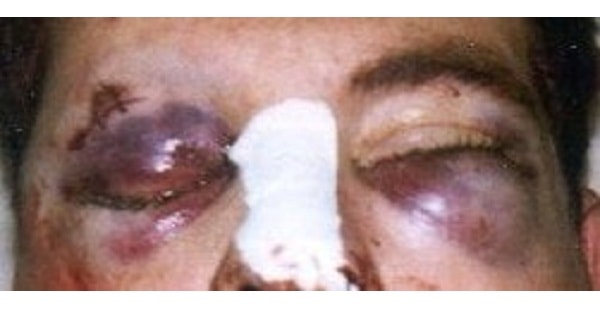
- Fracture of floor of anterior cranial fossa – bruising around eye (black eye or spectacle hematoma)
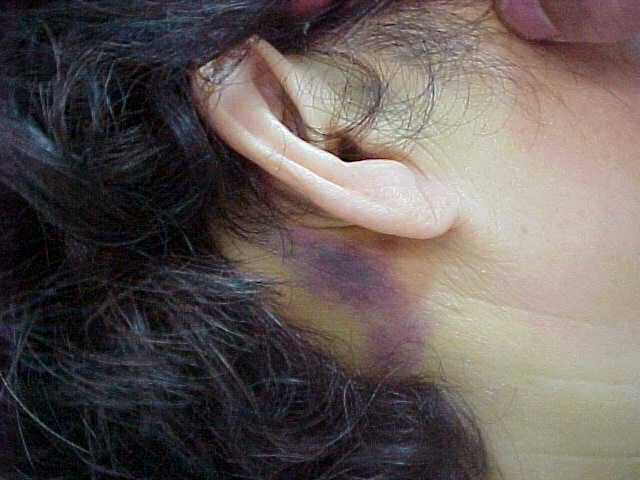
- Fracture of floor of middle cranial fossa – bruising over mastoid (battle’s sign)
- Fracture of jaw – bruising in the neck
- Fracture of pelvis – bruising over thigh
- Fracture femur – bruise in lower thigh or above knee
- Calf injury -bruise in ankle.
- Battle’s sign (named after William Henry Battle) – bruising visible behind and below the ear at the mastoid process, caused by the gravitational accumulation of blood from a basilar skull fracture,
- ‘Racoon/ panda eyes’ – Bruising of the lax soft tissues around the eyes caused by skull base fractures

Exam Important
Types of contusion
1. Petechial haemorrhages
2. Intradermal bruises
- A ‘negative image’ of the profile of the impacting instrument is produced i.e. a ‘patterned injury
- E.g tyre marks in a road traffic collision
3.Tramline bruises
- Appears as a pale linear central area lined on either side by linear bruising
4. Fingertip/pad bruises
- Where an assailant has forcefully gripped a person, for example around the neck (e.g. during attempted manual strangulation) or arms etc, one may see small discoid or ovoid bruises in a cluster.
6.Migratory or Ectopic or Percolated contusions: injury at one site, contusion at a remote site due to gravitation of blood
- Fracture of floor of anterior cranial fossa – bruising around eye (black eye or spectacle hematoma)
- Battle’s sign (named after William Henry Battle) – bruising visible behind and below the ear at the mastoid process, caused by the gravitational accumulation of blood from a basilar skull fracture
- ‘Racoon/ panda eyes’ – Bruising of the lax soft tissues around the eyes caused by skull base fractures
Don’t Forget to Solve all the previous Year Question asked on Contusion/Bruise-Types

