
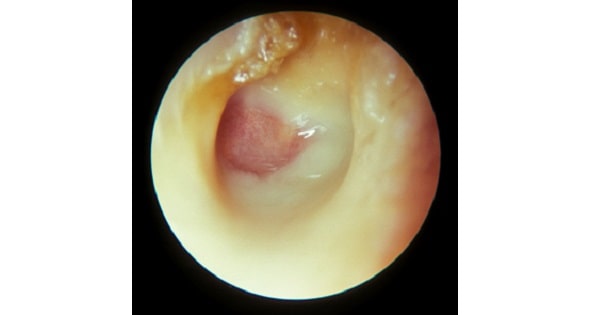
Csom
CHRONIC SUPPURATIVE OTITIS MEDIA
- CSOM can be classified according to the degree of involvement of the structures of the middle ear
TUBOTYMPANIC TYPE OF CSOM(SAFE OR BENIGN TYPE)
- It involves the anterior inferior part of middle ear cleft (eustachian tube and mesotympanum).
- Tubotympanic type is also called safe or benign type as there is no risk of serious complicatiions.
Etiology:
- Residue of an Acute Otits Media during childhood.
- Acute necrotizing Otits Media
- Repeated infections from the Eustachian Tube
- Large sized traumatic perforation.
Involvement of disease
- Perforation-usually in the form of central perforation situated exclusively in the pars tensa.
- In long standing disease,erosion of ossicles,particularly of long process of Incus may occur.
- Polyp or granulations may be seen if few cases.
- Cholesteatoma is not seen.
Clinical features:
- Discharge:Mucoid,copius and non-foul smelling.It becomes profus during an upper respiratory tract infection.
- Deafness-is conductive in type.Degree varies with the position and size of perforation and involvement of ossicles.
- Round window shielding effect — patient hears better in the presence of discharge than when the ear is dry.
Treatment:
- Conservative management is the treatment of choice.
- Aural toilet,Antibiotic Ear drops,treatment of focii of infection like tonsilitis,sinusitis.
- Removal of polyp or granulation tissue-if present in the middle ear.
- Myringoplasty in case of persistent perforation,Tympanoplast-in case of persistent perforation with ossicular involvement.
ATTICO-ANTRAL TYPE OF CSOM(UNSAFE OR DANGEROUS TYPE)
- It involves postero-superior part of middle ear cleft (attic, antrum and mastoid).
- Risk of intracranial extension of infection, and thus the risk of complication, is very high, therefore it is called dangerous or unsafe ear.
- It is associated with Cholesteatoma.
- Cholesteatoma is a sac lined by keratinizing stratified squamous epithelium in the middle ear cleft .
Cause of Cholesteatoma:
- Congenital
Acquired:
- Primary:Retaction pockets.
- Secondary:Migration,Metaplasia
Clinical Features:
- Ear Discharge-scanty,foul smelling,painless and sometimes blood stained.
- Deafness-It is of conductive type but if complications like labyrinthitis intervene, SNHL may also be seen.
- Otalgia is not seen in case of cholesteatoma.
- Complications;may cause symptoms of headache,vertigo,facial palsy or ear ache.
Involvement of disease
- Perforation is situated either in pars flaccida or marginally in the posterior superior quadrant of the pars tensa.
- Perforation of tympanic membrane with destruction of tympanic annulus is called Marginal perforation.
- Cholesteatoma is visible with the perforation and the greyish white or pearly sheets of keratin are easily recognised.
- Polyps and Granulations may be seen.
- Ossicles may be affected.
Treatment:
- Surgery is the treatment of Choice.
- Tympanomastoid exploration is required which may be Atticotomy,Modified radical mastoidectomy or Radical Mastoidectomy in rare cases or combined approach tympanoplasty
- Modified Radical Mastoidectomy is the treatment of choice.
- In case of symptoms suggestive of complications like Vertigo,Facial palsy,Immediate Mastoid exploration is required.
MICROBIOLOGY OF CSOM
- Pus culture in CSOM may show multiple organisms.
- Most commonly isolated organisms are gram negative bacilli, i.e., Pseudomonas, proteus, E.coli.
- These organisms are not commonly found in the respiratory tract, while commonly found in the skin of external ear.
Exam Question
- Most common organism cultured in CSOM is Pseudomonas seruginosa.
- Treatment of choice in a patient of CSOM has choleastatoma and presenting with vertigo or Facial Palsy is immediate Mastoid Exploration.
- Perforation of pars flaccida is associated with cholesteatoma.
- Perforation of tympanic membrane with destruction of tympanic annulus is called Marginal perforation.
- Treatment of choice for Perforation in pars flaccida of the tympanic membrane with cholesteatoma is Modified Radical Mastoidectomy.
- Cholesteotoma is seen in Attico-antral CSOM.
- Ossicle M/C involved in CSOM is Long process of Incus.
- CSOM is caused by multiple bacteria.
- Conservative management is the treatment of choice in central,safe tympanic membrane perforation.
- Treatment of choice in case of Attico-antral Cholesteatoma is Modified radical Mastoidectomy/Tympano-mastoid exploration.
- Cholesteatoma is associated with scanty,foul smelling,painless discharge.
- 7 th cranial nerve is most commonly involved in CSOM.
Don’t Forget to Solve all the previous Year Question asked on Csom
