
Dopamine
DOPAMINE
INTRODUCTION:
- Dopamine belongs to family of catecholamines.
- Major neurotransmitter in substantia nigra.
- Generates slow IPSP in ANS.
- Significant role in learning, goal-directed behavior, regulation of hormones & motor control.
DOPAMINE RECEPTORS:
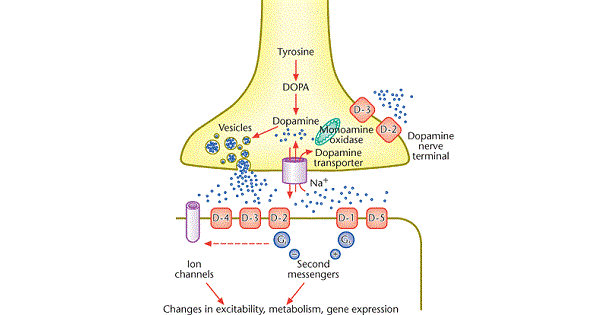
- Metabotropic G-protein coupled receptors
D1 – like family:
- Includes subtypes D1 & D5.
- Activation is coupled to Gs.
- Activates adenylyl cylcase resulting in increased cAMP concentration.
D2 – like family:
- Includes D2, D3 & D4.
- Activation is coupled to Gi.
- Inhibits adenylyl cyclase leading to decreased cAMP concentration.
- Also open K channels & closes Ca influx.
- Dopamine receptor with inhibitory action is D2.
|
Subtypes |
Location |
Function |
|
D1 |
Putamen, nucleus accumbens i.e nigrostrial pathway |
Inhibition causes extrapyrimidal disorders |
|
D2 |
Striatum,substantia nigra , pituitary |
Control behaviour,voluntary, prolactin release |
|
D3 |
Midbrain, mucleus accumbens & hypothalamus |
|
|
D4 |
Frontal cortex, medulla and midbrain i.e mesocortical pathway
|
Anti-psychotic drugs act through DopamineD4 receptor blockade. |
|
D5 |
Hypothalamus & hippocampus |
DOPAMINERGIC PATHWAYS:
- Mesolimbic Pathway.
- Mesocortical Pathway.
- Nigrostriatal Pathway:
- Efferent fiber bundle of substantia nigra transmits dopamine to Corpus striatum.
- Tuberoinfundibular Pathway.
- Incertohypothalamic Pathway.
- Medullary Periventricular.
- Retinal.
DRUGS MODIFYING DOPAMINERGIC TRANSMISSION:
|
Mechanism |
Drug |
Effect |
Use |
|
Synthesis |
L-DOPA |
↑ Synthesis |
Parkinson’s disease |
|
2 methyl-p- tyrosine |
Inhibits tyrosine hydroxylase |
expts |
|
|
Carbidopa , Benserazide |
Inhibit dopa decarboxylase |
Parkinsonism |
|
|
Storage |
Reserpine, Tetrabenzine |
Disrupt storage |
Tranquilizer |
|
MAO inhibitors |
Enhance storage |
||
|
Release |
Amphetamine, Tyramine, Mazindole |
Release dopamine on receptors |
Anorectic, CNS stimulant |
|
Inactivation of uptake |
Amphetamine, Cocaine, |
CNS stimulant
Anorectic |
|
|
Benztropine Benzhexol |
Parkinson’s disease |
||
|
Inactivation of metabolism |
Iproniazid, Tranylcypromine, |
Nonselective MAO inhibitors |
|
|
Selegiline |
MAO inhibitors |
Parkinson’s disease |
USES:
Schizophrenia:
- Defective dopamine neurotransmission – relative excess of central dopaminergic activity.
- An increase in DA function in mesolimbic system and decreased function in mesocortical DA systems (D1 predominates).
- Behavior similar to behavioral effects of psychostimulants.
Parkinson’s Disease
- Parkinson’s sufferers have low levels of dopamine.
- L-dopa raises DA activity.
- People with Parkinson’s develop schizophrenic symptoms if they take too much L-dopa.
- Treatment strategy includes –
- Increasing dopamine levels, nerve grafting with dopamine containing cells and deep brain stimulation.
- Bromocriptine,Ropinerole & Pramipexole are dopaminergic agonists used for parkinsonism.
Other motor disorders:
- Huntington’s disease
- Tourrette’s syndrome
- D2 Blockers – Chlorpromazine & Haloperidol.
Attention deficit hyperactivity disorder
- Altered dopamine neurotransmission is implicated in attention deficit hyperactivity disorder (ADHD).
- Most effective therapeutic agents for ADHD are psychostimulants.
- Methylphenidate & Amphetamine
- Increase both dopamine & norepinephrine levels in brain.
Addiction:
- Psychostimulants such as Cocaine & Amphetamine.
- By altering dopamine activity in brain.
- Inhibits prolactin secretion by acting on D2 receptors.
Role in renal system:
- Dopamine at 1-2 Microgram/ Kg/ min produces renal vasodilatation by acting on D1 receptors.
- Preferred in treatment of shock with oliguric renal failure.
- Effectiveness attributed to renal vasodilatory effect.
- Selectively activates dopamine specific receptors in the renal and splanchnic circulation.
- Increase renal blood flow.
- Increases GFR.
- Increases urinary Na excretion.
- Effect of dopamine on kidney is blocked by Haloperidol.
- Heart and Vasculature:
- Causes vasoconstriction.
- At low concentrations, circulating DA primarily stimulates vascular D1 receptors, causing vasodilation and reducing cardiac afterload.
- Activates adrenergic receptors to further increase cardiac contractility.
- The net result is a decrease in blood pressure and an increase in cardiac contractility.
- Drug most useful in cardiogenic shock.
- Anti-insulin
- Analgesic.
- Role in apoptosis.
- Memory.
- Immune.
Exam Question
- The strategy for therapy for dopamine deficiency in the substantia nigra of individuals with Parkinson’s disease is indicated by provision of metabolites in the tyrosine pathway.
- Neurotransmitter related to schizophrenia pathology is dopamine.
- The efferent fiber bundle of the substantia nigra transmits dopamine to Corpus striatum.
- Dopamine is the major neurotransmitter in substantia nigra.
- Slow IPSP in autonomic is generated by dopamine.
- Adrenaline, noradrenaline and dopamine act through seven pass receptor.
- Dopamine shows positive ionotropic effect.
- Dopamine improves renal perfusion.
- Dopamine causes vasoconstriction.
- Effect of dopamine on kidney is blocked by Haloperidol.
- Dopamine is preferred in treatment of shock because of renal vasodilatory effect.
- Prolactin secretion will be inhibited by dopamine.
- Bromocriptine,Ropinerole & Pramipexole are dopaminergic agonists used for parkinsonism.
- Dopamine neurotransmitter is depleted in Parkinson’s disease
- Drug most useful in cardiogenic shock is dopamine.
- Dopamine is preferred over dobutamne in treatment of renal shock because of renal vasodilatory effect.
- Anti-psychotic drugs act through Dopamine D4 receptor blockade.
- Dopamine at 1-2 Microgram/ Kg/ min produces renal vasodilatation.
- Dopamine receptor with inhibitory action is D2.
