


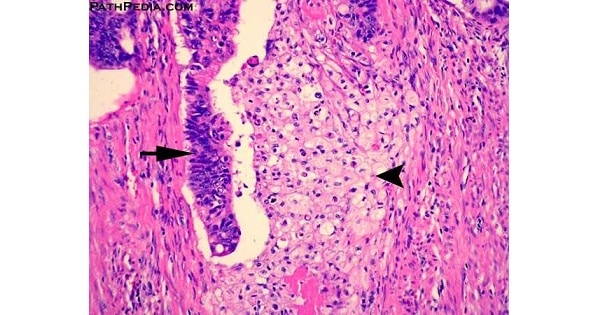
Endometrial Carcinoma
CLASSIFICATION:
Endometrial carcinomas can be classified into two pathogenetic groups:
Type I:
- These cancers occur most commonly in pre- and peri-menopausal women, often with a history of unopposed estrogen exposure and/or endometrial hyperplasia.
- They are often minimally invasive into the underlying uterine wall, are of the low-grade endometrioid type, and carry a good prognosis.
Type II:
- These cancers occur in older, post-menopausal women, and are not associated with increased exposure to estrogen.
- They are typically of the high-grade endometrioid, papillary serous or clear cell types, and carry a generally poor prognosis
RISK FACTORS:
- High levels of estrogen
- Endometrial hyperplasia( Complex hyperplasia with atypia histological pattern)
- Polycystic ovary syndrome
- Nulliparity
- Infertility
- Early menarche
- Persistent anovulation
- Diabetes mellitus
- Hypertension
- Obesity,
- Family History,
- Use of Hormone Replacement Therapy
- Late menopause
- Endometrial polyps or other benign growths of the uterine lining
- Tamoxifen
- Hyperplasia
- Pelvic radiation therapy
- Breast cancer
- Ovarian cancer
CLINICAL FEATURES:
- A Pap smear may be either normal or show abnormal cellular changes.
- Most common cause of postmenopausal vaginal bleeding
- Endometrial curettage is the traditional diagnostic method.
- If endometrial curettage does not yield sufficient diagnostic material, a dilation and curettage (D and C) is necessary for diagnosing the cancer.
- Endometrial biopsy or aspiration may assist the diagnosis.
- Transvaginal ultrasound to evaluate the endometrial thickness in women with postmenopausal
- The most malignant endometrial carcinoma is Clear cell carcinoma
PATHOLOGY:
- The most common finding is a well-differentiated endometrioid adenocarcinoma, which is composed of numerous, small, crowded glands with varying degrees of nuclear atypia, mitotic activity, and stratification.
FURTHER EVALUATION:
- Colonoscopy is recommended due to the etiologic factors common to both endometrial cancer and colon cancer.
- D and C is useful in the diagnosis
STAGING:
Endometrial carcinoma is surgically staged using the FIGO cancer staging system.
- Stage IA: tumor is limited to the endometrium
- Stage IB: invasion of less than half the myometrium
- Stage IC: invasion of more than half the myometrium
- Stage IIA: endocervical glandular involvement only
- Stage IIB: cervical stromal invasion
- Stage IIIA: tumor invades serosa or adnexa, or malignant peritoneal cytology
- Stage IIIB: vaginal metastasis
- Stage IIIC: metastasis to pelvic or para-aortic lymph nodes
- Stage IVA: invasion of the bladder or bowel
- Stage IVB: distant metastasis, including intraabdominal or inguinal lymph nodes (bleeding PV and enlarged inguinal nodes)


TREATMENT:
- Abdominal hysterectomy is recommended over vaginal hysterectomy because it affords the opportunity to examine and obtain washings of the abdominal cavity to detect any further evidence of cancer.
- Fractional curettage can be done in endometrial carcinoma
- Penetration into half of myometrium, Clear cell Ca & Fundal involvement are indications of direct lymph node dissections in endometrial carcinoma
- Treatment for stage IV is Radiotherapy, Chemotherapy and hormonal therapy
Exam Question
- Fractional curettage can be done in endometrial carcinoma
- Persistent anovulation not treated leads to Endometrial Carcinoma
- Poly cystic ovarian disease is associated with Endometrial carcinoma
- Obesity, Family History, Use of Hormone Replacement Therapy are known risk factors for development of endometrial carcinoma
- Endometrial carcinoma is Predisposed by diabetes mellitus, hypertension and obesity
- Bleeding PV and enlarged inguinal nodes is seen in satage IV of endometrial carcinoma
- Penetration into half of myometrium, Clear cell Ca & Fundal involvement are indications of direct lymph node dissections in endometrial carcinoma
- The most malignant endometrial carcinoma is Clear cell carcinoma
- Stage IV endometrial carcinoma, treatment is Radiotherapy, Chemotherapy and hormonal therapy
- D and C is useful in the diagnosis of endometrial carcinoma
- Most common cause of postmenopausal vaginal bleeding is endometrial carcinoma
- Use of tamoxifen for breast cancer can cause endometrial carcinoma
- The risk of endometrial carcinoma is the highest with the Complex hyperplasia with atypia histological pattern of endometrial hyperplasia
- In Endometrial carcinoma, PTEN is the tumor suppressor gene
Don’t Forget to Solve all the previous Year Question asked on Endometrial Carcinoma