


FIBROUS DYSPLASIA
FIBROUS DYSPLASIA
- This is a disorder in which the normal bone is replaced by fibrous tissue – hence its name.
- The mass of fibrous tissue thus formed grows inside the bone and erodes the cortices of the bone from within.
- A thin layer of sub-periosteal bone forms around the mass, so that the bone appears expanded.
CLINICAL FEATURES
- It may affect only one bone (monostotic), or many bones (polyostotic).
- Often in the polyostotic variety, the bones of a single limb are affected.
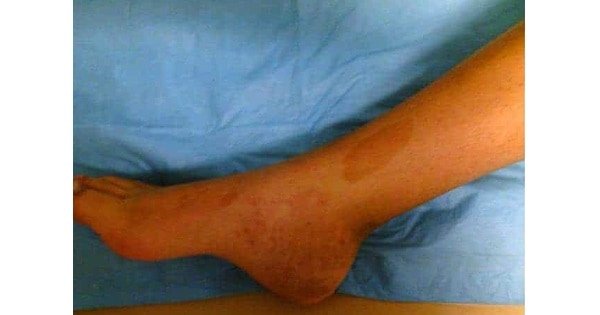
- A polyostotic fibrous dysplasia in girls may have precocious puberty and cutaneous pigmentation (Albright’s syndrome).
- The disease commonly occurs in children and adolescents.
- Pain, deformity and pathological fracture are the common presenting symptoms.
- The bones commonly affected are the upper-ends of femur and tibia, and ribs.

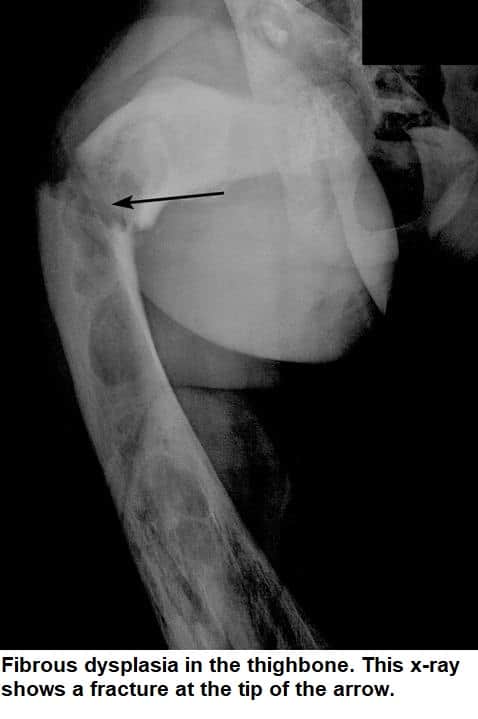
- Benign bone process in which there is a failure to produce mature lamellar bone.
- Is characterized by multiple, gradual bone deformities; a risk of endocrinopathy and a tendency toward pain in the lesions
- Cafe-au-lait spots are common signs in multifocal disease.
- Precocious puberty may occur as early as the 1st year of life.
- Associated with McCune-Albright syndrome (the triad of polyostotic fibrous dysplasia, cafe-au-lait spots, and precocious puberty) is an age-related risk factor.


X ray:
- Long lesion in a long bone
- Ground glass appearance
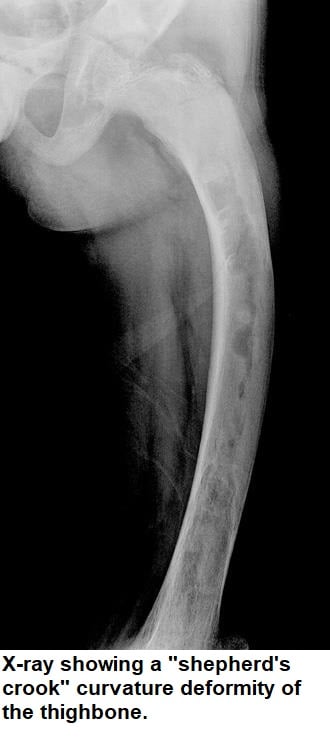
- Shepherd’s crook appearance of the proximal femur
- The lesion is usually multiloculated, expanding the cortex of the bone


- Serum alkaline phosphatase is often elevated.
- Diagnosis is confirmed by biopsy.
- Treatment is curettage and bone grafting.
Exam Important
- Monostotic fibrous dysplasia most commonly affects the femur particularly the femoral neck as well as the tibia and ribs.
- Polyostotic fibrous dysplasia most commonly affects the maxilla and other craniofacial bones, ribs, and metaphyseal or diaphyseal portions of the femur or tibia.
- Characteristic radiological feature of fibrous dysplasia Ground glass appearance.
- Shepherd crook deformity is seen in Fibrous dysplasia.
Fibrous dysplasia associated with McCuneAlbright syndrome which includes:
- Polystotic fibrous dysplasia (maxilla most commonly involved).
- Cafe au lait pigmentation with rough border (coast line of Maine).
- Precocious puberty (most common presentation).
- Serum alkaline phosphatase is elevated in Fibrous dysplasia.
Don’t Forget to Solve all the previous Year Question asked on FIBROUS DYSPLASIA

