

FRACTURE SHAFT OF FEMUR
FRACTURE SHAFT OF FEMUR
- One of the major long bone fractures.
- The narrowest portion of the shaft is known as isthmus.
- The bone is highly vascular.
- Surrounded all round by strong muscles of the thigh.
- Heavy blood loss up to 1.5 liters can occur.
Patient may go in for hypovolemic shock.

Mechanism of Injury
- May occur in a road accident.
The force causing the fracture may be:
- Indirect (twisting or bending force) or
- Direct (traffic accidents)
PATHOANATOMY
- The fracture may occur at any site.
- Common in the upper, middle and lower thirds of the shaft.
- Types of Fracture Femur
- Transverse fracture
- Oblique fracture
- Spiral fracture
- Comminuted fracture
- Segmental fracture
Clinical features:
- History of severe violence.
Classic signs of fracture in the region of the thigh:
- Pain
- swelling
- Deformity
- abnormal mobility etc
- Diagnosis is not difficult.
Radiological examination:
- X-rays done for a femoral shaft fracture must include the whole femur.
- In addition, an X-ray of the pelvis should be done.
- X-rays help in identifying the type and level of fracture
- As well as the diameter of the medullary canal.
Investigations
- Hb%,
- PCV and
- blood grouping and cross-matching is a must
TREATMENT
Conservative methods:
1. Traction
- Treated by traction, with or without a splint.
- Usually a Thomas splint is used.
2. Hip spica
- This is a plaster cast incorporating part of the trunk and the limb.
- It may be a single spica or one-and-a-half.

Operative methods:
Intra-medullary nailing is the preferred method.

- The fracture may be reduced by closed or open methods.
- Closed Interlock nailing
- Plating (fixing with a thick strip of metal)
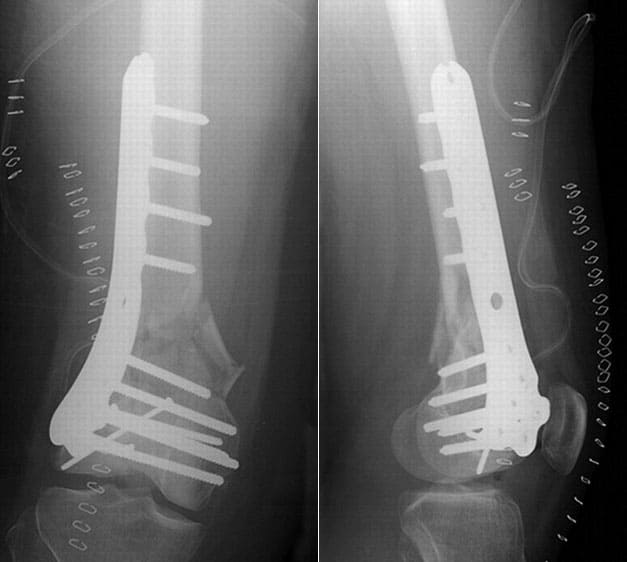
DECIDING TREATMENT PLAN
- In children, treatment is mostly by non-operative methods.
- The technique of traction varies in different age groups.
1. From birth to 2 years:
Treated by Gallow’s traction.

2. From 2 years to 16 years:
- Conservative treatment.
- Different methods of traction are used (Russel traction).
- In older children (more than 10 yrs. of age), TENS (Titanium Elastic Nail System) nails are used.
COMPLICATIONS
EARLY COMPLICATIONS:
- Shock
- Fat embolism
- Injury to femoral artery
- Injury to sciatic nerve
- Infection
LATE COMPLICATIONS:
- Delayed union
- Non-union
- Malunion
- Knee stiffness
Exam Important
- Thomas splint is used for immobilizing fractures of Femur.
- Fracture shaft of femur in adult unites by 3 to 4 months.
- Fracture shaft of femur in children of less than 2 years old is treated by Gallow’s traction.
- Best way to treat a fracture neck of femur in a child is Hip Spica in abduction and internal rotation.
- Treatment of shaft femur fracture in a 3 years old boy by Russel traction.
- Best treatment of 3 weeks old, fracture shaft femur with nonunion is Bone graft with internal fixation.
- Treatment of Non-union of # shaft femur Bone grafting with internal fixation with K-Nail.
- Treatment of choice for old non-united fracture of shaft of femur is Compression plating with bone grafting.
- Intramedullary fixation is ideal in a case of fracture of shaft of femur when there is A transverse fracture.
- Fracture of femur at the level of isthmus is best treated by Intramedullary nail fixation.
Don’t Forget to Solve all the previous Year Question asked on FRACTURE SHAFT OF FEMUR

