

Haemophilus influenzae
Habitat
- Mucous membrane of the upper respiratory tract of humans.
- Found in the nasopharynx of approx. 75% of healthy peoples.
Morphology

- Slender, short, gram-negative rods or coccobacillus
- Non-Motile, No flagella or pilli
- Capsules are present and important in pathogenicity.
- Encapsulated form are coccobacilli.
- Non-Capsulated are pleomorphic, long, thread, filamentous
- Fastidious Microorganism
- It is the first free-living organisms to have its entire genome sequenced; 1,830,140 bp of DNA and 1740 Genes.
Cultural characteristics
|
Culture |
Characteristics |
|
On Blood Agar |
|
|
On Chocolate Agar |
|
|
Levinthal’s Broth or Filde’s Broth |
|
- Facultative anaerobes and aerobic, grow also in 5% CO2.
- Optimum Temperature: 35-37oC, Min: 20-25oC, Optimum pH: 7.6
- Killed at 55oC for 30 minutes of heating
- Fastidious,requires 2 accessory growth factors:
- X-Factor
- V-Factor
X-Factor(Hemin)
- A head stable growth promoting substances present in Red Blood Cells
- Hemin, plays a role as an enzyme in respiration.
V-Factor(NAD)
- A heat labile vitamin like substances.
- V-Factor is involved in oxidation-reduction process in the growing bacterial cell.
- Heating blood agar to about 75oC, until it acquires a chocolate agar, releases V-Factor from Red cells and also inactivates NADase activity.
- Satellitism
- On blood agar colonies of S Aureus release V-Factor during growth
- Which defuses into the surrounding medium
- Enhancing the growth of H. influenzae.
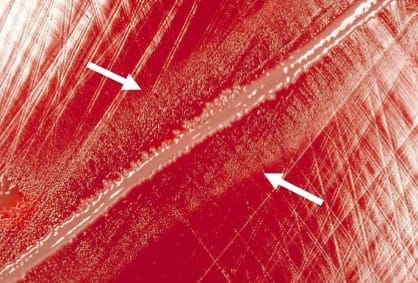
- Influenzae requires pantothenic acid, thiamine and uracil.
Biochemical reaction
|
Test |
Reaction |
|
Catalase |
+ |
|
Oxidase |
+ |
|
Haemolysis |
– |
|
Fermentation: Glucose |
+ |
|
Fructose |
– |
|
Galactose |
+ |
|
Lactose |
– |
|
Mannose |
– |
|
Sucrose |
– |
|
Trehalose |
– |
|
Xylose |
+ |
Antigenic Properties
- Capsular polysaccharide
- Major antigenic determinant
- based on which, it is typed into six capsular types a to f
- While noncapsulated strains are nontypable
- Isolates from acute invasive infections belong to ‘b” mainly.
- Type b capsule has unique structure containing pentose sugar (ribose and ribitol) in the form of Polyribosyl ribitol phosphate (PRP)
- Hib PRP is used in vaccine
- Outer membrane protein (OMP)
- Lipo-oligosaccharide
- Serotyping of H. influenzae ie done by agglutination or quelling reaction
Mechanism
Encapsulated organisms → penetrate the epithelium of the nasopharynx → invade the blood capillaries → infection.
- Capsule resists phagocytosis and complement-mediated lysis.
- Maybe opportunistic
- Transmitted by direct contact, inhalation of the respiratory tract droplets.
Pathogenicity
Haemophilus influenza b (Hib)
- Major cause of childhood infectious disease.
- Meningitis:
- M.C invasive disease of H influenza
- children age 5 months to 5 years.
- MC Complication of its meningitis – Subdural effusion
- Primary bacteremia
- Post-splenectomy infection(rare)
- Pneumonia
- Acute epiglottitis
- Arthritis.
- Acute bacterial rhinitis:
- MC cause of bacterial rhinitis
Non-Capsulated influenzae (Nc-hi)
- Causes otitis media, conjunctivitis and sinusitis
- Causes chronic bronchitis in adults
Diagnosis
- Meningitis
- CSF gram’s stain and culture on iso Vitale X-enriched chocolate agar
- If culture negative – Detection of PRP
- Respiratory tract infection
- Suggested by the predominance of gram-negative coccobacilli among abundant polymorphonuclear leukocytes in sputum.
Treatment
- DOC for H. influenzae meningitis is –> Third generation cephalosporin.
- Ceftriaxone or cefotaxime
- Also in other invasive infection
Vaccination
- Hib conjugate vaccine
- First dose: 2 months
- Rest of primary series: 2-6 months
- Booster Dose: 12-15 months
Exam Important
Habitat
- Mucous membrane of the upper respiratory tract of humans.
Morphology
- Slender, short, gram-negative rods or coccobacillus
- Capsules are present and important in pathogenicity.
Cultural characteristics
- Requires 2 accessory growth factors:
- A head stable growth promoting substances present in Red Blood Cells (X-Factor)
- A heat labile vitamin like substances (V-Factor).
Antigenic Properties
- Major surface antigen
- Capsular polysaccharideOuter membrane protein (OMP)
- Major antigenic determinant
- Based on which, it is typed into six capsular types a to f
- While noncapsulated strains are nontypable
- Isolates from acute invasive infections belong to ‘b” mainly.
- Lipo-oligosaccharide
- Serotyping of H. influenzae ie done by agglutination or quelling reaction
Pathogenicity
Haemophilus influenza b (Hib)
- Major cause of childhood infectious disease.
- Meningitis: Primary bacteremia
- M.C invasive disease of H influenza
- children age 5 months to 5 years.
- MC Complication of its meningitis – Subdural effusion
- Post-splenectomy infection(rare)
- Pneumonia
- Acute epiglottitis
- Arthritis.
- Acute bacterial rhinitis:
- MC cause of bacterial rhinitis
Non-Capsulated influenzae (Nc-hi)
- Causes otitis media, conjunctivitis and sinusitis
- Causes chronic bronchitis in adults
Treatment
- DOC for H. influenzae meningitis Cs –> Third generation cephalosporin.
- Ceftriaxone or cefotaxime
Don’t Forget to Solve all the previous Year Question asked on Haemophilus influenzae

