


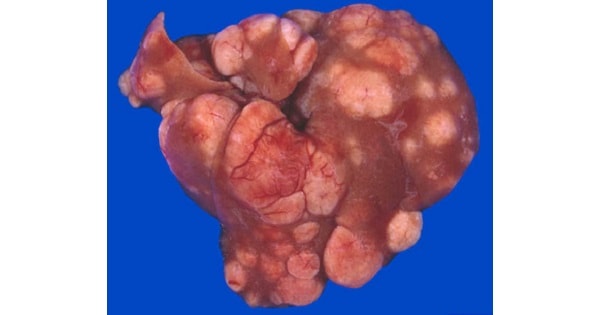
Hepatocellular Carcinoma
INTRODUCTION:
- Hepatocellular Carcinoma is a primary cancer meaning it originated in the Liver(as opposed to Liver metastases,or secondary Liver Cancers which have spread to Liver from other organs)
- It is commonly associated with Cirrhosis and Hepatitis.
- Male to Female ratio is 4:1 for HCC.
- High incidence in East Africa and South east Asia
- Its worldwide incidence parallels the prevalence of hepatitis B
- Fibrolameller type is having good prognosis
ETIOLOGY:
Common Cause:
- Cirrhosis from any cause
- Hepatitis B or C chronic infection
- Ethanol chronic consumption.
- Aflatoxin B1 or other mycotoxins
Unusual Cause:
- Primary Biliary Cirrhosis
- Hemochromatosis
- Alpha 1 Antitrypsin deficiency
- Hemochromatosis
- Wilson’s Disease
SYMPTOMS:
- Abdominal Pain
- Weight Loss
- Weakness
- Abdominal Fullness and swelling
- Jaundice
- Nausea
- Hepatomegaly (50 to 90% of patients)
- Ascites(30 to 60%)
- Abdominal Bruits
- Splenomegaly
- Spider Angioma
- Obstructive Jaundice
- Paraneoplastic Syndromes
PARANEOPLASTIC SYNDROME:
- Erythrocytosis
- Persistent fever
- Hypoglycemia
- Hypercalcemia
- Hypercholesterolemia
DIAGNOSIS:
Diagnosis of HCC should be bases on followings:
- History & P/E
- IMAGING(CT,MRI)
- LIVER BIOPSY(For Confirmation)
- Elevated Serum AFP(more than 400ng/ml)
In patient with higher suspicion of HCC the best method of diagnosis involves:
- CT scan of the abdomen using IV Contrast agent and three phase scanning:
- Before contrast administration
- Immediately after contrast administration
- After Delay
Biopsy is not needed if following criteria are met on CT:
- Hypervascularity in the arterial phase scans
- Washout or deenhancement in the Portal and delayed phase studies
- Pseudocapsule and Mosaic Pattern
- Liver Biopsy is not needed if these criteria are met on CT
Mallory hyaline
- An alternative to a CT imaging study would be the MRI. MRI’s are more expensive and not as available because fewer facilities have MRI machines
- On CT, HCC can have three distinct patterns of growth:
- A single large tumor
- Multiple tumors
- Poorly defined tumor with an infiltrative growth pattern
Tumor marker for primary hepatocellular carcinoma :
- Alpha feto protein
- PIVKA-2
- Neurotensin
- Vit B12 binding globulin
PATHOLOGY:
On CT, HCC can have three distinct patterns of growth:
- A single large tumor
- Multiple tumors
- Poorly defined tumor with an infiltrative growth pattern
- Macroscopically,the tumour usually appears as single mass in the absence of Cirrhosis,or as a single/ multiple nodules in the presence of cirrhosis
- It takes its blood supply from the hepatic artery and tends to spread by invasion into the portal vein and its radicles.
- Lymph node metastases are common but Lung and bone metastases are rare.
- Microscopically,the tumour resembles hepatocytes when well differentiated and can be difficult to distinguish from normal Liver.
TREATMENT:
|
MANAGEMENT |
INDICATION |
PROGNOSIS |
Recurrence |
|
HEPATIC RESECTION |
Non Cirrhotic HCC |
5 year survival is about 50% |
50% recurrence rate at 5 years |
|
LIVER TRANSPLANTATION |
Cirrhotic HCC Unresectable case |
5 year survival is about 75% |
Unfortunately Hepatitis B & C may also occur in transplanted Liver |
|
PERCUTANEOUS ABLATION(ETHANOL) |
TUMOURS OF 3 cm or small |
80% cure rate |
50% at 3 years |
|
CHEMOEMBOLIZATION |
Cirrhotic Patients with unresectable HCC and good Liver Functions at 2 years DOXORUBICIN is used |
No survival benefit Beyond 4 years |
- SORAFENIB(multitargeted oral tyrosine kinase inhibitor)
- SUNITINIB,DOXORUBICIN,CISPLATIN,FLURO -URACIL are commonly used chemotherapeutic agents.
- Unfortunately HCC is relatively chemotherapy resistant
RADIOTHERAPY:
- The yttrium 90 microspheres are directly injected into the hepatic artery branches that supply the tumor.
- The main indications are inoperable HCC118 and colorectal cancer hepatic metastases for which systemic chemotherapy has failed
COMPLICATIONS:
- Gastrointestinal Bleeding
- Liver Failure
- Distant Metastases
- Malignant portal vein thrombosis
- Tumor marker for primary hepatocellular carcinoma are Alpha feto protein, PIVKA-2, Neurotensin,Vit B12 binding globulin
- Yttrium 90 microspheres are used in treatment of hepatocellular carcinoma
- Liver transplantation offers the only chance of cure in those with unresectable case of hepatocellular carcinoma
- High incidence in East Africa and South east Asia with worldwide incidence parallels the prevalence of hepatitis B of hepatocellular carcinoma
- Hepatomegaly ,Raised a- fetoprotein levels, Raised alkaline phosphatase are seen in hepatocellular carcinoma
- Sorafenib a tyrosine kinase inhibitor is used to treat hepatocellular carcinoma
- Transarterial chemoembolization (TACE) is used in the treatment of unresectable hepatocellular carcinoma without portal vein thrombosis. The drug commonly used for TACE is Doxorubicin
- Hepatocellular carcinoma has propensity to invade the portal or hepatic vein
- Radiofrequency ablation ,Percutaneous Ethanol Injection and Resection are curative treatment modalities for hepatocellular carcinoma
- Most common cause of malignant portal vein thrombosis is Hepatocellular carcinoma
- Mallory hyaline is seen in Hepatocellular carcinoma
- Liver biopsy is diagnostic for Hepatocellular carcinoma
- Raised titre of HBV and HCV antibodies is seen in Hepatocellular carcinoma
- Fibrolameller type is having good prognosis in hepatocellular carcinoma
- The most unlikely clinical feature of Hepatocellular carcinoma is jaundice
- In hepatocellular carcinoma, risk factor most important is Cirrhosis