
Herpes Simplex Virus
MORPHOLOGY:
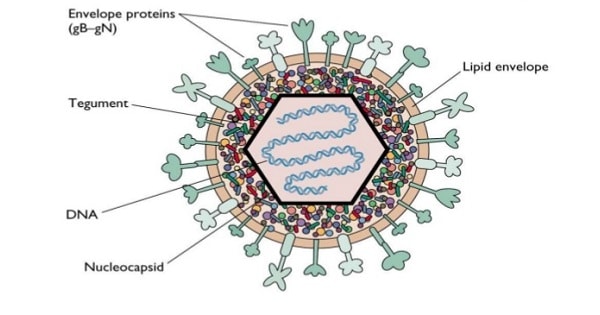
Herpes viruses have a unique four-layered structure:
- Core containing large double-stranded DNA genome
- Enclosed by an icosapentahedral capsid ,composed of capsomers.
- The capsid is surrounded by an amorphous protein coat ,tegument.
- It is encased in a glycoprotein-bearing lipid bilayer envelope.
PATHOGENESIS
- Source of infection
- Saliva
- Skin lesion
- Respiratory secretion.
The initial infection
- inapparent
- occurs through a break in the skin or mucous membranes, such as in the eye, throat, or genitals.
- The virus replicates initially in epithelial cells
- Produce characteristic vesicle on an erythematous base.
- It then ascends sensory nerves to the dorsal root ganglia,
- initial period of replication
- establishes latency.
- During reactivated infection
- Virus spreads distally from the ganglion
- Initiate new cutaneous and/or mucosal lesions.
- In clearance of virus from lesion, CD8 + T cell responses important.
HSV includes
- HSV-1
- HSV-2
- HSV 1 and 2 have only about 50 percent genomic homology.
- However, they share most other characteristics.
- Distinguished by
- restriction endonuclease analysis
- nucleic acid hybridization (DNA sequencing)
HSV 1
- Cause lesion in and around mouth
- Transmission
- Direct contact or droplet spread
- Replicate
- poorly in chick embryofibroblast cell
- Relatively sensitive to
- antiviral agents
- Less neurovirulent
- Infectivity is less temperature sensitive
- Site of latency
- trigeminal ganglia
- On chick embryo CAM,
- form smaller pock
HSV 2
- Cause lesion around
- genital area
- Transmission
- sexually
- Replicate well
- Resistant
- More neurovirulent
- More temperature sensitive
- Sacral ganglia
- Form larger pock
CLINICAL MANIFESTATION:
- Mucocutaneous manifestations
- Face most common site
- gingivostomatitis
- herpes genitalis
- herpetic keratitis
- dermal whitlows.
- Herpes Gladiatorum
Encephalitis
- Herpes Simplex Virus is the commonest cause of sporadic encephalitis
Neonatal herpes simplex virus infection and herpes simplex virus encephalitis shows:
- fever
- followed by headache
- confusion
- focal seizures
- Alterations in behaviour
- Olfactory hallucinationand right hemiparesis.
- Mollaret meningitis is also caused by herpes simplex-2
Meningitis
- Mollaret’s Meningitis
Eye Infection
- Type 1 herpes simplex virus is usually
- Follicular conjunctivitis
- Decreased corneal sensations
- dendritic and geographical ulcer
- Accompanied by stromal keratitis in more severe infection.
Genital lesions
- Type 2
- Bilateral lesion
- women: Cervix and Urethre
- Males: Penis
- Latent infection often persists at the initial site despite high antibody titers.
- Recurrent disease triggered by
- temperature change
- emotional distress
- hormonal factors.
DIAGNOSIS:
MRI
- shows bilateral frontotemporal hyperintense lesion in herpes encephalitis
CT
- Temporoparietal areas of low absorption, mass effect and control enhancement
EEG
- Periodic temporal lobe spikes on a background of slow or low amplitude activity on EEG
- Herpes simplex virus produces small white shiny non-necrotic pocks on chick embryo chorioallontoic membrane.
TREATMENT:
- Acyclovir is effective for Herpes simplex (thymidine kinase enzyme)
- Valaciclovir and famciclovir are all licensed therapeutics.
- Ganciclovir is used to treat cytomegalovirus retinitis.
- B virus appears to respond to either of these drugs.
- Acyclovir treats herpes simplex encephalitis
Exam Question
MORPHOLOGY:
- Core containing large double-stranded DNA genome
PATHOGENESIS
- The initial infection
- inapparent
- occurs through a break in the skin or mucous membranes, such as in the eye, throat, or genitals.
HSV includes
- HSV-1
- HSV-2
- HSV 1 and 2 have only about 50 percent genomic homology.
- However, they share most other characteristics.
- HSV 1 On chick embryo CAM,form smaller pock
- HSV 2 Form larger pock
CLINICAL MANIFESTATION:
- Mucocutaneous manifestations
- Face most common site
- gingivostomatitis
- herpes genitalis
- herpetic keratitis
- dermal whitlows.
- Herpes Gladiatorum
Encephalitis
- Herpes Simplex Virus is the commonest cause of sporadic encephalitis
Neonatal herpes simplex virus infection and herpes simplex virus encephalitis shows:
- fever
- followed by headache
- confusion
- focal seizures
- Alterations in behaviour
- Olfactory hallucinationand right hemiparesis.
- Mollaret meningitis is also caused by herpes simplex-2
Meningitis
- Mollaret’s Meningitis
Eye Infection
- Type 1 herpes simplex virus is usually
- Follicular conjunctivitis
- Decreased corneal sensations
- dendritic and geographical ulcer
- Accompanied by stromal keratitis in more severe infection.
Genital lesions
- Type 2
- Bilateral lesion
- women: Cervix and Urethre
- Males: Penis
- Latent infection often persists at the initial site despite high antibody titers.
- Recurrent disease triggered by
- temperature change
- emotional distress
- hormonal factors.
DIAGNOSIS:
MRI
- shows bilateral frontotemporal hyperintense lesion in herpes encephalitist
EEGmembrane.
- Periodic temporal lobe spikes on a background of slow or low amplitude activity on EEG
- Herpes simplex virus produces small white shiny non-necrotic pocks on chick embryo chorioallontoic
TREATMENT:
- Acyclovir is effective for Herpes simplex (thymidine kinase enzyme)
- Valaciclovir and famciclovir are all licensed therapeutics.
- Acyclovir treats herpes simplex encephalitis
Don’t Forget to Solve all the previous Year Question asked on Herpes Simplex Virus
