

Histamine & Histaminic receptors
INTRODUCTION:
- Histamine is formed from the amino acid Histadine in a decarboxylation reaction with the enzyme histadine decarboxylase
- Occurs primarily in mast cells and basophils
MOA &RECEPTORS:
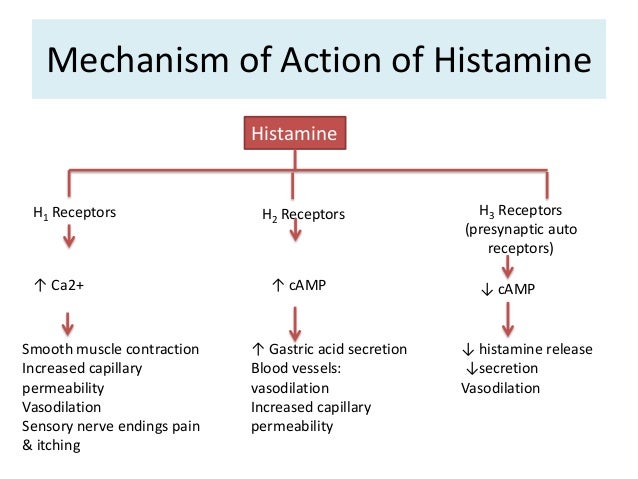
- Histamine exerts its actions by combining with specific cellular receptors located on cells.
- The four histamine receptors that have been discovered are designated H1 through H4.
- Type Location Function H1 Found on smooth muscles, endothelium, and central nervous system tissue Causes vasodilation, bronchoconstriction
| TYPE | LOCATION | FUNCTIONS |
| H1 | Smooth muscles, endothelium, and CNS |
|
| H2 | Parietal cells |
|
| H3 | CNS & to a lesser extent on PNS |
|
| H4 | Basophils & Bone marrow, Onthymus, Small intestine, Spleen, & colon. |
|
PHARMACOLOGICAL ACTIONS:
Blood vessels:
- Histamine causes marked dilatation of smaller blood vessels, including arterioles, capillaries and venules.
Heart:
- Primarily H2 responses but a H1 mediated negative dromotropic (slowing of A-V conduction)
Visceral smooth muscle:
- Bronchoconstriction;
- Abdominal cramps and colic by increasing intestinal contractions
Glands:
- Histamine causes marked increase in gastric secretion—primarily of acid but also of pepsin
Sensory nerve endings:
- Itching occurs when histamine is injected i.v. or intracutaneously.
- Higher concentrations injected more deeply cause pain.
Autonomic ganglia and adrenalmedulla:
- These are stimulated and release of Adr occurs, which can cause a secondary rise in BP
CNS:
- Histamine does not penetrate bloodbrain barrier—no central effects are seen on i.v. injection.
GIT:
- Increase Gastric secretion
- Skin:
Triple response (Lewis triple response)
When a pointed object is stroked very firmly over the skin, a characteristic 3 part response develops. Its feature are 😕
- Red reaction (red line) is due to transient capillary engorgement (vasodilation) caused by histamine released from damaged tissue. Histamine relaxes precapillary sphincter thus leads to capillary dilatation.
- Flush or flare is spreading of redness beyond the injury (red line). It is due to arteriolar dilation mediated by axon reflex (may be an indirect effect of histamine).
- Wheal is local edema and elevation of skin due to increased permeability of capillaries and post capillary venules with consequent extravasation of fluid. Capillary permeability is increased due to histamine and other mediators.
Exam Question
- Histamine causes Arteriolar dilatation, Increased permeability of venules & Constriction of large arteries
- Histamine is found in Mast cells
- Histamine Increases gastric acid secretion
- The role of histamine in acute inflammation mediates increase in Related to arousal and blood pressure,vascular permeability, chemotaxis, Release of pain causing substances
- HCL secretion is stimulated by Histamine
- Increased permeability in acute inflammation is due to Histamine
- Vasoactive amines, involved in inflammation are Histamine
- H1 blockers are useful as Anti-allergic
- Pulmonary vasodilatation is caused by Histamine
- Triple response is due to Histamine
Don’t Forget to Solve all the previous Year Question asked on Histamine & Histaminic receptors
