


Hodgkin’s lymphoma
HODGKIN’S LYMPHOMA
- Hodgkin’s lymphoma is a malignant neoplasm of lymphoreticular system.
- It can involve lymph nodes, spleen and liver.
- Common in males.
- Classic diagnostic feature is the presence of Reed- Sternberg (RS) cells or Dorothy- Reed Sternberg cells.
- Classic markers for Hodgkin’s disease is CD 15 & CD 30.


Classification –
I) Rye classification-
- Lymphocyte- predominance type
- Nodular- sclerosis type (most common)
- Mixed- cellularity type
- Lymphocyte- depletion type
II) According to WHO classification into 2 types-
- Nodular lymphocyte- predominant HD
- Classsic HD
Etiology-
- EBV
- HIV cases
Pathology-
- Commonly involves left supraclavicular region.
- Nodes are enlarged without matting.
- Axial lymphatic system is almost always affected in Hodgkin’s disease.
Morphological features-
- Diagnosis of HD is by RS cells.
- RS cells have different subtypes-
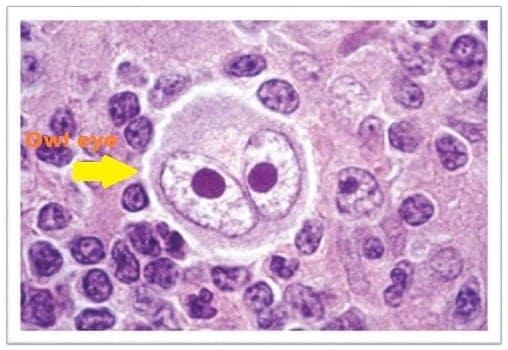
1. Classic RS cell
- Characteristic bilobed nucleus.
- Nucleus contains inclusion like nucleolus with clear halo (owl- eye appearance)

2. Lacunar RS cells-
- It has pericellular space or lacuna.
- Found in nodular sclerosis.


3. Polyploid type (popcorn or lymphocytic histocytic type- LH) RS cells-
- Seen in lymphocyte predominance type of HD.
- Lobulated nucleus in the shape of popcorn.


4. Pleomorphic RS cells-
- Feature of lymphocyte depletion type.


Clinical features-
- Most commonly in patients present as painless, movable and firm lymphadenopathy.
- Cervical & mediastinal lymph nodes are involved most frequently.
- Splenomegaly & liver enlargement.
- Most common is low- grade fever with might sweat, weight loss, fatigue, malaise, weakness.


Lab findings-
- ical features shows mixed cellularity and neoplastic and non neoplastic cells seen.
Staging


Treatment-
1. Stage I/ II classical Hodgkin’s disease-
- Chemotherapy + field radiotherapy
2. Stage I/ II classical Hodgkin’s disease-
a) ABVD 4 to 6 cycles
- Doxorubicin
- Bleomycin
- Vinblastine
- Dacarbazine
b) MOPP regimen-
- Mechlorethamine
- Oncovin
- Procarbazine
- Prednisolone
3. Stage III/ IV classical HL-
- 6 cycles of ABVD chemotherapy cures.
Exam Important
- It can involve lymph nodes, spleen and liver.
- Common in males.
- Classic diagnostic feature is the presence of Reed- Sternberg (RS) cells or Dorothy- Reed Sternberg cells.
- Nodular- sclerosis type (most common)
Pathology-
- Commonly involves left supraclavicular region.
1. Classic RS cell
- Characteristic bilobed nucleus.
- Nucleus contains inclusion like nucleolus with clear halo (owl- eye appearance)
2. Lacunar RS cells-
- It has pericellular space or lacuna.
- Found in nodular sclerosis.

3. Polyploid type (popcorn or lymphocytic histocytic type- LH) RS cells-
- Seen in lymphocyte predominance type of HD.
- Lobulated nucleus in the shape of popcorn.

4. Pleomorphic RS cells-
- Feature of lymphocyte depletion type.
Clinical features-
- Cervical & mediastinal lymph nodes are involved most frequently.
Treatment-
1. Stage I/ II classical Hodgkin’s disease-
- Chemotherapy + field radiotherapy
2. Stage I/ II classical Hodgkin’s disease-
a) ABVD 4 to 6 cycles
- Doxorubicin
- Bleomycin
- Vinblastine
- Dacarbazine
b) MOPP regimen-
- Mechlorethamine
- Oncovin
- Procarbazine
- Prednisolone
3. Stage III/ IV classical HL-
- 6 cycles of ABVD chemotherapy cures.
Don’t Forget to Solve all the previous Year Question asked on Hodgkin’s lymphoma

