
Important Factors & Features Of Smooth Muscle Contraction
IMPORTANT FACTORS & FEATURES OF SMOOTH MUSCLE CONTRACTION
SMOOTH MUSCLE CONTRACTION – IMPORTANT FACTORS & FEATURES
IMPORTANT FEATURES:
- Smooth muscle contraction almost similar to skeletal muscle contraction.
- Both involve “Cross bridging of myosin & actin followed by actin sliding over myosin.
- Typical features specific to smooth muscle include,
1. Slow cycling of cross-bridges:
- In smooth muscle contraction process, myosin head attachment to actin filaments is slow & sustained.
- Due to relatively low ratio between of myosin to actin.
- Also due to low myosin kinase, phosphatase, & ATPase enzymatic activities.
- Hence, smooth muscle contraction is slow & sustained.
2. Low energy is required to sustain smooth muscle contraction:
- Only 1/10 to 1/300 as much energy is required to sustain
3. Maximum contraction force is greater in smooth muscle:
- In smooth muscle – 4-6 kg/cm2
- In skeletal muscle – 3-4 kg/cm2
- Occurs as result of prolonged cross-bridge cycling.
4. “Latch mechanism”:
- Mechanism facilitates prolonged holding of smooth muscle contraction with minimal energy expenditure.
- Due to low/nil cross-bridge cycling rate.
5. Plasticity:
- Smooth muscle usually defies the usual length-tension relationship valid for skeletal muscle.
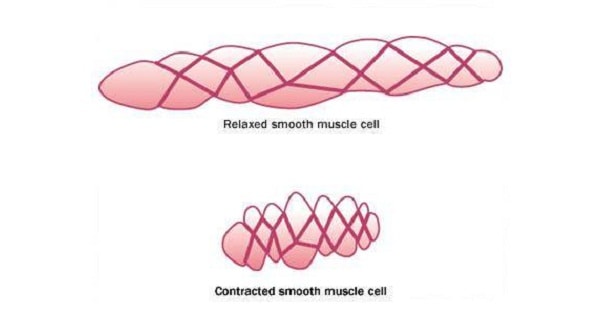
6. Percentage of shortening:
- Smooth muscle usually shortens to one-third (33%) of its initial length.
- Contrastly, skeletal muscle shortens to 70-75% of its initial length.
IMPORTANT FACTORS AFFECTING SMOOTH MUSCLE CONTRACTION
1. Stretch:
- Stretch of visceral smooth muscle leads to,
- Spike potential development
- Contraction.
- Increased tension, even in absence of nervous innervation.
- All these responses to stretch serves as an in-built regulatory mechanism, preventing over-stretching.
2. Neural control:
- Most visceral smooth muscle has dual autonomic antagonistic innervation (sympathetic & parasympathetic).
3. Local factors:
- Local factors causing smooth muscle relaxation in arterioles & pre-capillary sphincters include,
- Lack of oxygen.
- Excess of carbon dioxide.
- Lower pH
4. Hormones:
- Certain hormones influence the smooth muscle activities including,
- Norepinephrine
- Epinephrine
- Angiotensin-Il
- Vasopressin
- Oxytocin
- Serotonin
- Histamine
- Adenosine
Exam Important
SMOOTH MUSCLE CONTRACTION – IMPORTANT FACTORS & FEATURES
IMPORTANT FEATURES OF SMOOTH MUSCLE CONTRACTION
1. Slow cycling of cross-bridges:
- Hence, smooth muscle contraction is slow & sustained.
2. Low energy is required to sustain smooth muscle contraction.
3. Maximum contraction force is greater in smooth muscle.
4. “Latch mechanism”:
- Mechanism facilitates prolonged holding of smooth muscle contraction with minimal energy expenditure.
- Due to low/nil cross-bridge cycling rate.
5. Plasticity:
- Smooth muscle usually defies the usual length-tension relationship valid for skeletal muscle.
6. Percentage of shortening.
IMPORTANT FACTORS AFFECTING SMOOTH MUSCLE CONTRACTION
1. Stretch
- Stretch of visceral smooth muscle leads to,
- Spike potential development
- Contraction.
- Increased tension, even in absence of nervous innervation.
2. Neural control
3. Local factors:
- Local factors causing smooth muscle relaxation in arterioles & pre-capillary sphincters include,
- Lack of oxygen.
- Excess of carbon dioxide.
- Lower pH
4. Hormones
Don’t Forget to Solve all the previous Year Question asked on Important Factors & Features Of Smooth Muscle Contraction

