
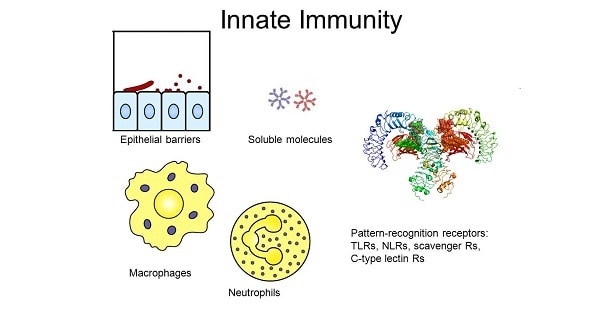
Innate Immunity
Introduction
The innate immune response is the body’s first line of defense (possesses by virtue of his genetic and constitutional makeup)that can be activated immediately once a pathogen attacks. The innate immune system is always general, or nonspecific, meaning anything that is identified as foreign or non-self is a target for the innate immune response.
Innate (Native⁄naturalImmunity) includes:
- Physical Barriers (inside and outside) such as skin, gastrointestinal tract, respiratory tract & genito-urinary tracts.
- General Immune Responses – such as inflammation, complement, and non-specific cellular responses.
- Defense Mechanisms – such as secretions, mucous, bile, gastric acid, saliva, tears, and sweat.
Explanation:
- It is present since birth and is found both in invertebrates and vertebrates.
- It is not affected by prior contact with microorganisms or immunization i.e antigen exposure is not required for its development.
- There is no immunological memory.
- It is nonspecific, it is active against a wide range of infectious agents.
- Sometimes the innate immunity itself is able to control the infection on its own but sometimes the defense is breached, then the adaptive immunity is called into action.
- Conserved antigenic patterns in bacteria such as unmethylated CpG DNA, flagellin, lipid and carbohydrate structures in the bacterial cell wall serve as danger signals to activate innate immunity, resulting in local inflammation and the influx of the macrophages, neutrophils, and dendritic cells.
Important components of the innate Immune system.
- Cells Macrophages, Dendritic cells, NK cells, NK-T cells, Neutrophils, Eosinophils, mast cells, basophils, epithelial cells.
- Complement components -> Classical and alternative pathway.
- Antimicrobial peptides Defensins, Cathelin, probiotics.
- Pattern recognition receptors.
- Cytokines.
- Natural killer cells/NK cells are a type of cytotoxic lymphocyte that constitutes a major component of the innate immune system. they play a major role in the rejection of tumors and cells infected by viruses. They kill cells by releasing small cytoplasmic granules of proteins called perforin and granzyme that cause the target cell to die by apoptosis.
- Neutrophils and monocytes (the precursors of tissue macrophages) migrate from the blood into inflammatory sites during innate immune responses. Macrophages and neutrophils are phagocytic cells that engulf a microbial pathogen after it has been identified by the innate immune system.
Principles of innate immunity:
The macrophages and neutrophils of the innate immune system provide the first line of defense against many common microorganisms and are essential for the control of common bacterial infections. However, they cannot always eliminate infectious organisms, and there are some pathogens that they cannot recognize. The lymphocytes of the adaptive immune system have evolved to provide a more versatile means of defense which, in addition, provides increased protection against subsequent reinfection with the same pathogen.

Exam Important
Important components of the innate Immune system.
- Cells Macrophages, Dendritic cells, NK cells, NK-T cells, Neutrophils, Eosinophils, mast cells, basophils, epithelial cells.
- Complement components → Classical and alternative pathway.
- Antimicrobial peptides Defensins, Cathelin, probiotics.
- Pattern recognition receptors.
- Cytokines.
- Natural killer cells/NK cells are a type of cytotoxic lymphocyte that constitutes a major component of the innate immune system. they play a major role in the rejection of tumors and cells infected by viruses. They kill cells by releasing small cytoplasmic granules of proteins called perforin and granzyme that cause the target cell to die by apoptosis.
- Neutrophils and monocytes (the precursors of tissue macrophages) migrate from the blood into inflammatory sites during innate immune responses. Macrophages and neutrophils are phagocytic cells that engulf a microbial pathogen after it has been identified by the innate immune system.
- Conserved antigenic patterns in bacteria such as unmethylated CpG DNA, flagellin, lipid and carbohydrate structures in the bacterial cell wall serve as danger signals to activate innate immunity, resulting in local inflammation and the influx of the macrophages, neutrophils, and dendritic cells.

