
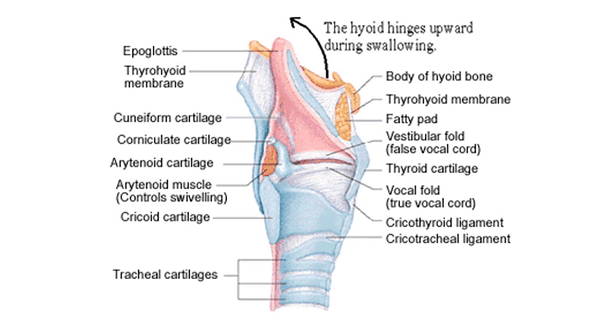
LARYNGEAL JOINTS & SPACES
LARYNGEAL JOINTS:
- 2 pairs of synovial joints
- Between the major cartilages of the larynx:
- The cricothyroid and
- The cricoarytenoid.
- CRICOTHYROID JOINT:
- The joints between the inferior cornua of the thyroid cartilage and the sides of the cricoid cartilage are synovial.
- The primary movement at the joint is rotation around a transverse axis which passes transversely through both cricothyroid joints.
- The effect of these movements is to lengthen the vocal folds, provided the arytenoid cartilages are stabilized at the cricoarytenoid joint.
- This may also increase vocal fold tension
2. CRICOARYTENOID JOINT
- The crico-arytenoid joints between articular facets on the superolateral surfaces of the cricoid cartilage and the bases of the arytenoid cartilages enable the arytenoid cartilages to slide away or towards each other and to rotate so that the vocal processes pivot either towards or away from the midline.
- These movements abduct and adduct the vocal ligaments
3. ARYTINOCORNICULATE JOINT
- Synovial or cartilaginous joints link the arytenoid and corniculate cartilages
LARYNGEAL SPACES:
Internal laryngeal spaces :
- Vestibule,
- Ventricles,
- Reinke’s space
Subglottic or infraglottic spaces
- External laryngeal spaces
- Paraglottic space
- Pre-epiglottic Space
Internal Spaces (Laryngeal Cavity):
- VESTIBULE
- Pyramid -shaped space extends from the laryngeal inlet or aditus to the vestibular folds (false vocal cords).
- Bounded ventrally by the posteroinferior surface of the epiglottis, dorsally by the corniculate cartilages and apices of the arytenoids, and laterally by the aryepiglottic folds and the piriform recesses.
2. Laryngeal Ventricles
- Sinuses (of Morgagni), are diverticula of the interval between the false and true vocal cords.
- It is lined internally by mucosa and covered externally by a very thin layer of elastic tissue and the thin thyroarytenoid muscle.
- The anterior end of the ventricle may possess an additional external expansion, the laryngeal saccule.
- The saccule is a diverticulum of mucous membrane.
- This extends upward deep to the internal face of the thyroid cartilage.
- water can in the larynx (saccules) are present in it.
3. Reinke’s space:
- Under the epithelium of vocal cords is a potential space with scanty subepithelial connective tissues. It is known as Reinke’s space.
- It is bounded above and below by the arcuate lines, in front by anterior commissure, and behind by vocal process of arytenoid (in true vocal cord).
- Oedema of this space causes fusiform swelling of the membranous cords (Reinke’s oedema).
Subglottic (Infraglottic) Space :
- The distal part of the laryngeal cavity.
- Extends from the glottis to the inferior border of the cricoid cartilage.
- The subglottic space begins below the curve formed by the vocal fold to the lower end of cricoid cartilage
External Spaces:
Supraglottic laryngeal area is subdivided into:
- Paired Lateral Paraglottic Spaces ( Tucker’s space):Bounded laterally by the thyroid cartilage,inferomedially by the conus elasticus & medially by the ventricle and the quadrangular membrane
- One midline Pre-Epiglottic Space( Boayer’s space )
- Bounded superiorly by the hyoepiglottic ligament, anteriorly by the thyrohyoid membrane and ligament, and Posteroinferiorly by the epiglottis and thyroepiglottic ligament.
- The pre-epiglottic space forms an inverted pyramid.
- Continuous with the superior portion of the paraglottic space.
- Con
- tains abundant fat, blood vessels, lymphatics,and mucosal glands.
Exam Important
- The anatomical location of Reinke’s space of larynx is in True vocal cord
- Water can in the larynx (saccules) are present in laryngeal ventricle
- Vestibule,Ventricles,Reinke’s space,External laryngeal spaces, Paraglottic space, Pre-epiglottic Space, Tucker’s space & Boayer’s space Are the spaces found in larynx.
Don’t Forget to Solve all the previous Year Question asked on LARYNGEAL JOINTS & SPACES

