

MULTIPLE ENDOCRINE NEOPLASIA (MEN)
MULTIPLE ENDOCRINE NEOPLASIA (MEN SYNDROME)
- MEN are inherited syndrome characterised by combination of benign and malignant tumors in multiple endocrine glands (hyperplasia, adenoma, carcinomas).
- It is inheritance is autosomal dominant.
- These tumours occur at younger age.
- They are multifocal.
- They are asymptomatic (endocrine hyperplasia)
- More aggressive and recurs.
- There are 2 main types-
- MEN Type 1
- MEN Type 2
- Multiple endocrine organ neoplasia (MEON) includes-
- Hyperthyroidism jaw tumours syndrome
- Carney complex
- Von- Hippel – Lindau disease
- Neurofibromatosis- 1
- Cowden’s syndrome
- McCune Albright syndrome
MEN Type- 1 (Wermer’s syndrome)
- MEN type 1 (menin) gene is inherited in an autosomal dominant pattern.
- Seen in 5th decade.
- Gene is located on 11q13 and is tumour suppressor gene.
- MC site of gastrinoma in MEN- 1 is duodenum
- Hypoglycemia
- Sporadic
- Characterised by triad of tumours-
a) Parathyroid (90%)
- Adenoma
- Patient present with subperiosteal bone resorption
b) Pancreatic islets-
- Gastrinoma (60%)- enteropancreatic tumour
- Insulinoma (pancreatic tumour)
- Gulcagonoma
- VIPoma
- Associated with Zollinger- Ellison syndrome
c) Anterior Pitutary-
- Prolactinoma (60%)- microadenomas
- Hypercalcemia
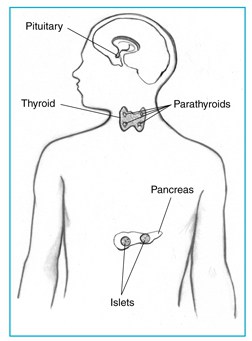
MEN Type 2-
- Has 2 major syndromes-
a) MEN type 2A (Sipple syndrome)
- Autosomal dominant
- It is characterised by medullary carcinoma of thyroid, pheochromocytoma and hyperparathyroidism.
- It is caused by mutation of the RET proto-oncogene in codon 634.
- Mapped to chromosome 10.
- Mutated codon- cysteine codon
- Type 2A has 3 variants-
- MEN 2A with familial medullary carcinoma thyroid (1st feature of type 2A)
- MEN 2A with cutaneous lichen amyloidosis
- MEN 2A with Hirschsprung disease

b) MEN Type 2B (Gorlin’s syndrome)
- Autosomal dominant
- Characterised by-
- MCT
- Pheochromocytoma
- Mucosal neuroma
- Intestinal ganglioneuromatosis
- Marfanoid
- Megacolon
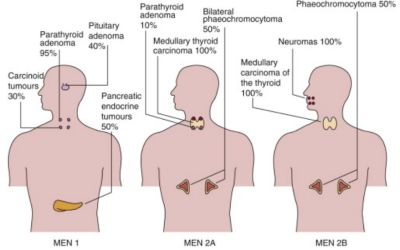
MEN Type 4-
- Autosomal dominant
- Associated cyclin dependent inhibitor gene (CDKNIB)
- It is located on chromosome 12
- Characterised by-
a) Hyperparathyroidism
b) Pancreatic NE tumour
TREATMENT-
- Surgery is the TOC.
Exam Important
- Multiple endocrine organ neoplasia (MEON) includes-
- Hyperthyroidism jaw tumours syndrome
- Carney complex
- Von- Hippel – Lindau disease
- Neurofibromatosis- 1
- Cowden’s syndrome
- McCune Albright syndrome
MEN Type- 1 (Wermer’s syndrome)
- MEN type 1 (menin) gene is inherited in an autosomal dominant pattern.
- Seen in 5th decade.
- Gene is located on 11q13 and is tumour suppressor gene.
- MC site of gastrinoma in MEN- 1 is duodenum
- Hypoglycemia
- Sporadic
- Characterised by triad of tumours-
a) Parathyroid (90%)
- Adenoma
- Patient present with subperiosteal bone resorption
b) Pancreatic islets-
- Gastrinoma (60%)- enteropancreatic tumour
- Insulinoma (pancreatic tumour)
- Gulcagonoma
- VIPoma
- Associated with Zollinger- Ellison syndrome
c) Anterior Pitutary-
- Prolactinoma (60%)- microadenomas
- Hypercalcemia
MEN Type 2-
- Has 2 major syndromes-
a) MEN type 2A (Sipple syndrome)
- Autosomal dominant
- It is characterised by medullary carcinoma of thyroid, pheochromocytoma and hyperparathyroidism.
- It is caused by mutation of the RET proto-oncogene in codon 634.
- Mapped to chromosome 10.
- Mutated codon- cysteine codon
- Type 2A has 3 variants-
a) MEN 2A with familial medullary carcinoma thyroid (1st feature of type 2A)
b) MEN 2A with cutaneous lichen amyloidosis
c) MEN 2A with Hirschsprung disease
b) MEN Type 2B (Gorlin’s syndrome)
- Autosomal dominant
- Characterised by-
a) MCT
b) Pheochromocytoma
c) Mucosal neuroma
d) Intestinal ganglioneuromatosis
e) Marfanoid
f) Megacolon
MEN Type 4-
- Autosomal dominant
- Associated cyclin dependent inhibitor gene (CDKNIB)
- It is located on chromosome 12
- Characterised by-
a) Hyperparathyroidism
b) Pancreatic NE tumour
Don’t Forget to Solve all the previous Year Question asked on MULTIPLE ENDOCRINE NEOPLASIA (MEN)

