

Myopia
MYOPIA
- Also called short-sightedness.
- It is a type of refractive error in which parallel rays of light coming from infinty are focussed in front of retina when accomodation is at rest.
- Short-sightedness implies that patient has difficulty seeing object far away (distinct object), such as road signs or a blackboard at school, while objects near to eye can be seen properly.
- The patient sequeezes his eye in order to reduce the inherent accomodative tone (by relaxing ciliary muscles) which helps him see better.
- Symptoms are headache, eye strain & sometimes lacrimation.
- Black spots floating in front of eye & flashes of light may also be seen.
Pathophysiology of myopia
- In myopia the image is formed in front of the retina.
- Patient can see near objects more clearly but are unable to see objects properly that are far from him.
- This is because myopic eyes have problem in focusing the light on retina from an object that is far & the light is focused in front of the retina.
- If objects is placed near to the eye, the point at which light focuses properly will shift backward on the retina.
- Far point & near point come nearer.
Examination findings
- On examination following findings are seen:
- Large prominent eyeball & cornea.
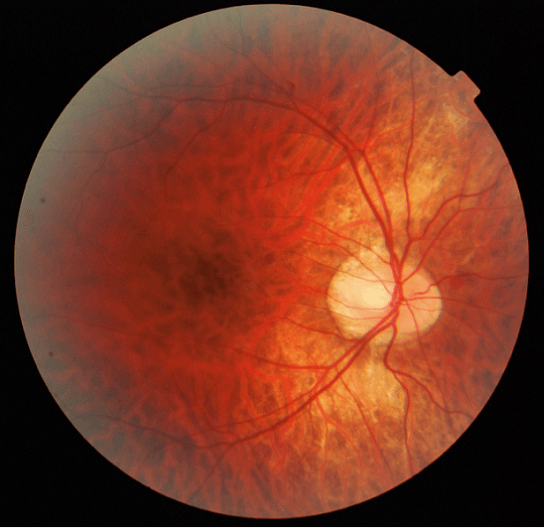
- In early cases of myopia fundus is normal.
Later there may be myopic crescents, Foster’s fusch’s spot at the macula, peripheral retinal (lattice & Snail track) degeneration,vitreous liquefaction & opacities, posterior vitreous detachment (Weiss reflex).
Types of Myopia
- Simple (developmental) myopia: Mild & nonprogressive. Complications are rare.
- Pathological (Progressive or degenerative) myopia: Rapidly progressive & is frequently associated ith complications.
TREATMENT
1. NON SURGICAL
- Most commonly used method for treatment of myopia is correction by concave (divergent or minus) lens.
- These may be spectacles (most commonly used method for low myopia i.e.
2. REFRACTIVE SURGERY:
- Most common procedures are performed with an excimer laser.
- LASIK is the most commonly used procedure.
3. ORTHOKERATOLOGY:
- Non-Surgical procedure where special contact lenses are worn that slowly reshape the cornea over time to correct myopia.
High myopia is defined as myopia>-6D.
- Treatment of choice for high myopia is contact lens.
- LASIK is an alternative.
COMPLICATIONS
- Macular degeneration & retinal detachment are the most common complications.
- Other complications are complicated cataract, strabismus fixus convergence & vitreous & choroidal haemorrhage.
Exam Question
- In senile nuclear cataract Index myopia is seen.
- Maximum correction of myopia can be done by LASIK.
- Retinal detachment is the most common complication of high myopia.
- Haemorrhage at macular spot in high myopia is called Foster-Fuchs fleck.
- Radial keratotomy corrects myopia by causing Flattening of cornea.
- Posterior staphylomas are commonly seen in patients with high myopia.
- Refractive surgery most commonly performed for myopia is LASIK.
Don’t Forget to Solve all the previous Year Question asked on Myopia
