
Pedestrian Injury
Injuries to Pedestrian
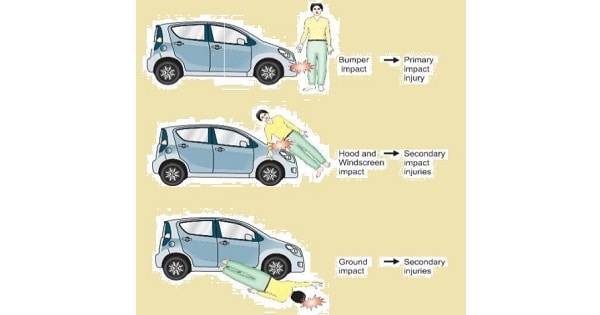
Three types of injuries are seen:
 1. Primary impact injuries:
- Caused by initial strike, i.e., the first part of the vehicle that strikes the victim (usually legs).
- Overall, the most common site is leg 85%, followed by head (50-80%) > arms > pelvis > chest orabdomen > neck and spine
Site and nature of injuries depend on
- The height of the pedestrian and upon the position of the person in relation to the vehicle when struck
- Relative heights of various parts of the vehicle, i.e. bumper, radiator, fenders.
- In a typical case, the victim is struck by the front of the vehicle. An adult usually sustains injuries on the legs and a child on the head.
Bumper fracture
- Bumper’s fracture is the comminuted, depressed fracture of the lateral tibial condyle.
- Anterior cruciate ligament may be injured.
- The fracture is usually spiral or wedge shaped.
- The base of the triangular fragment of bone indicates the site of the impact and the apex points in the direction in which the vehicle was travelling.
- If the pedestrian is hit from the side, there may be unilateral fracture of the nearest leg.
- If the pedestrian is facing the vehicle. he may sustain intra-abdominal injuries and/or injuries to the chest wall and thoracic contents.
- Sometimes the pelvis is fractured.
2. Secondary impact injuries:
- After the primary impact, the victim is then again thrown back over the vehicle, causing further injuries.
3. Secondary injuries:
- Then the victim is thrown on the ground causing secondary injuries.
- These are found on parts opposite to primary impact or on head.
- Injuries due to contact with ground include abrasion and bruises over the face, hand, hips and legs, and laceration over the bony prominence
4. Rolling/Runover (degloving injuries) : Caused by wheel of vehicle or rolling over the victim. Children are oftenly involved.
Exam Important
1. Primary impact injuries:
- Overall, the most common site is leg 85%, followed by head (50-80%) > arms > pelvis > chest orabdomen > neck and spine
Bumper fracture
- Bumper’s fracture is the comminuted, depressed fracture of the lateral tibial condyle.
- Anterior cruciate ligament may be injured.
2. Secondary impact injuries:
- After the primary impact, the victim is then again thrown back over the vehicle, causing further injuries.
3. Secondary injuries:
- Injuries due to contact with ground include abrasion and bruises over the face, hand, hips and legs, and laceration over the bony prominence
4. Rolling/Runover (degloving injuries) : Caused by wheel of vehicle or rolling over the victim. Children are oftenly involved.
Don’t Forget to Solve all the previous Year Question asked on Pedestrian Injury

