
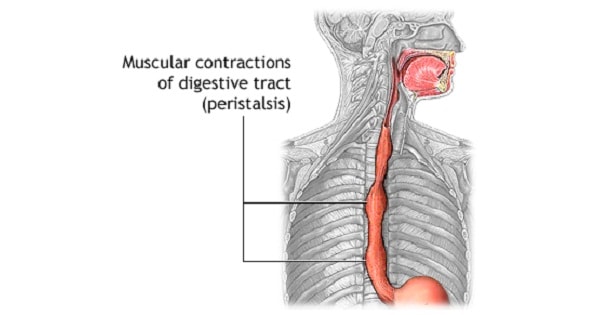
Peristalsis
PERISTALSIS
- Stretching of gut wall causes a wave of contraction & relaxation viz. an area of circular contraction behind stretch & an area of relaxation in front.
- Stimulus for peristalsis – Distention of gut.
- Local stretch reflex –
- Reflex contraction of gut wall to stretch.
- Present throughout GIT (from esophagus to rectum).
- Peristalsis, segmental contraction, haustrations & migrating motor complex are all normal bowel movements.
Mechanism of action:
- Consists of contraction ring in one segment & its receptive relaxation in immediate next segment.
- Results in propulsion of contents from contracted to relaxed segment.
- Cycle repeats, resulting in wave of contraction traveling distally resulting in content propulsion.
Activation:
1. Neuronal activation factors:
- Requires an active myenteric plexus.
- Local stretch by chyme releases serotonin activating myenteric plexus.
- Cholinergic plexus neurons passing in retrograde/antegrade direction release smooth muscle contraction substances.
- Activate neurons secreting Nitric Oxide (NO), VIP & ATP, producing relaxation ahead of stimulus.
- VIP, NO & ATP → Producing relaxation ahead of stimulus
- Acetylcholine & substance P → Causing smooth muscle contraction.
2. Hormonal activation factors:
- Gastrin, Cholecystokinin, insulin, motilin & serotonin enhance intestinal motility.
- Secretin & glucagon inhibit small intestinal motility.
Factors influencing:
- Can be increased/decreased by autonomic input to gut.
- Yet occurrence independent of extrinsic innervation.
Peristaltic rush –
- Very intense peristaltic wave
- Not seen in normal individuals
- Occurs when intestine is obstructed
Exam Question
PERISTALSIS
- Stimulus for peristalsis – Distention of gut
- Local stretch reflex.
Activation:
1. Neuronal activation factors:
- Requires an active myenteric plexus.
- Local stretch by chyme releases serotonin, which activates myenteric plexus.
- Activated neurons secreting Nitric Oxide (NO), VIP & ATP, producing relaxation ahead of stimulus.
- VIP, NO & ATP → Producing relaxation ahead of stimulus
- Acetylcholine & substance P → Causing smooth muscle contraction.
2. Hormonal activation factors:
- Gastrin, Cholecystokinin, insulin, motilin & serotonin enhance intestinal motility.
- Secretin & glucagon inhibit small intestinal motility.
Factors influencing:
- Can be increased/decreased by autonomic input to gut.
- Yet occurrence independent of extrinsic innervation
Peristaltic rush –
- Occurs when intestine is obstructed
Don’t Forget to Solve all the previous Year Question asked on Peristalsis
