
Prion
INTRODUCTION:
- Prions are most resistant organisms to antiseptics & sterilization.
- Prions are best killed by Sodium hydroxide
- Prions are Encoded by viral genome
- Prion protein diseases is Commonly manifested as dementia
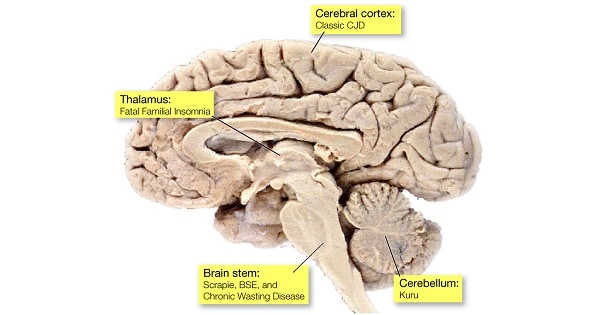
- Prion diseases/transmissible spongiform encephaloathies (TSEs)
- Family of rare progressive neurodegenerative disorders
- Loss of structure or function of neurons, including death of neurons.
- Affect both humans and animals,known as “mad cow disease” in cattle
- “Creutzfeldt -Jakob disease” (CJD) in humans.
- Incubation periods range from months to year.
- Course of illness lasting for months or years with remissions and exacerbations.
- Predilection for central nervous system.
- Genetic predisposition.
- Invariable fatal termination.
Classification of Slow Virus diseases
Group A
- Infection of sheep caused by lentiviruses e.g. visna maedi
Group B = Subacute Spongioform viral encephalopathies/Prion
- Comprise prion (infectious protein) diseases of the CNS
- Scrapie
- latrogenic Creutzfeldt -Jakob disease ;
- Infection from prion contaminated human growth hormone, duramater graft, corneal transplant
- Kuru (human):Infection through ritualistic cannibalism
- Variant (CJD):Infection from bovine prion (Eating BSE infected beef)
- Familial CJD:Germline mutation in PRNP
- Sporadic CJD:Somatic mutation or spontaneous convention of PRPc into PRPsc
- Fatal familial insomnia:Germline mutation in PRNP
- Gestmann Strausster Scheinker:Germline mutation in PRNP
- Bovine spongiform encephalopathy
- Transmissible mink encephalopathy
Pathology
- Progressive vacuolation in the dendritic and axonal process of neurons
- Extensive astroglial hypertrophy and proliferations
- Spongiform degeneration in the grey matter.
- There is no sign of any inflammation or immune response.
Mechanism
|
Normal individual |
|
PRPc protein |
|
protein rich in alpha-helix less beta sheets |
|
Completely hydrolyzed by protease |
|
No accumulation |
|
Patient with prion disease |
|
PRPsc protein(Primary structure same as PRP) |
|
More B sheets, little alpha helix |
|
Resistance to protease |
|
Accumulation |
- Prions propagate by transmitting a misfolded protein state
- Alteration in the conformation of the protein
- Normal α-helix structure is converted to β-sheet structure.
- Acts as a template to guide the misfolding of more protein into prion form.
- Aggregations of these abnormal isoforms form highly structured amyloid fibers,
- This altered structure is extremely stable, insoluble and accumulates in infected tissue
- Causing tissue damage and cell death
Group C
Subacute sclerosingpanencephalitis (SSPE)
- Delayed sequel to infection with defective measles virus
- Characterized by slow progressive demyelination in CNS
- Virus not isolated by routine culture
- Only by co-cultivation of infected brain cells with susceptible cells of non-neural origin. .
- Antibody is regularly found in CSF and is pathognomonic. .
- SSPE also seen in RubeIIa infection
Progressive multifocal leukoencephalopathy (pML)
- Caused by JC virus(papovavirus)
- Affect elderly persons whose immune process is impaired .
CLINICAL FEATURES:
- Prion protein diseases is Commonly manifested as dementia
- Often mood disturbance e.g. aggression or loss of interest and personality changes persist into the illness.
- Anxiety and depression
- Swallowing Problems
- Communication Problems
- Memory/Cognitive Deficit
- Seizures
- Double vision and difficulty moving eyes to follow objects,cortical blindness
- Hallucinations
- Movement
- Ataxia
- Myoclonus and difficulties coordinating hand movements leading to apparent clumsiness.
- Tremors and rigidity
DIAGNOSIS:
- Virtually no way to detect PrPSc reliably except by examining postmortem brain tissue
- Brain is spongy in form due to death of neurons .
- Newer immunological and molecular genetic techniques are being used.
Brain biopsy
- In humans, the diagnosis of CJD can be established by brain biopsy if PrPsc is detected.
- Spongioform degeneration and astrocytic gliosis
- Lack of inflammatory response
- Presence of Amyloid plaques
Exam Question
INTRODUCTION:
- Prions are most resistant organisms to antiseptics & sterilization.
- Prions are best killed by Sodium hydroxide
- Prions are Encoded by viral genome
- Prion protein diseases is Commonly manifested as dementia
- Prion diseases/transmissible spongiform encephaloathies (TSEs)
- Family of rare progressive neurodegenerative disorders
- Affect both humans and animals,known as “mad cow disease” in cattle
- “Creutzfeldt -Jakob disease” (CJD) in humans.
Classification
Group A
- Infection of sheep caused by lentiviruses e.g. visna maedi
Group B = Subacute Spongioform viral encephalopathies/Prion
- Comprise prion (infectious protein) diseases of the CNS
- Scrapie
- latrogenic Creutzfeldt -Jakob disease ;
- Infection from prion contaminated human growth hormone, duramater graft, corneal transplant
- Kuru (human):Infection through ritualistic cannibalism
- Variant (CJD):Infection from bovine prion (Eating BSE infected beef)
- Familial CJD:Germline mutation in PRNP
- Sporadic CJD:Somatic mutation or spontaneous convention of PRPc into PRPsc
- Fatal familial insomnia:Germline mutation in PRNP
- Gestmann Strausster Scheinker:Germline mutation in PRNP
- Bovine spongiform encephalopathy
- Transmissible mink encephalopathy
Mechanism
|
Patient with prion disease |
|
PRPsc protein(Primary structure same as PRP) |
|
More B sheets, little alpha helix |
|
Resistance to protease |
|
Accumulation |
- Prions propagate by transmitting a misfolded protein state
- Alteration in the conformation of the protein
- Normal α-helix structure is converted to β-sheet structure.
- Acts as a template to guide the misfolding of more protein into prion form.
Group C
Subacute sclerosingpanencephalitis (SSPE)
- Delayed sequel to infection with defective measles virus
- SSPE also seen in RubeIIa infection
Progressive multifocal leukoencephalopathy (pML)
- Caused by JC virus(papovavirus)
- Affect elderly persons whose immune process is impaired .
CLINICAL FEATURES:
- Prion protein diseases is Commonly manifested as dementia
Don’t Forget to Solve all the previous Year Question asked on Prion
