

RECEPTORS – CLASSIFICATION
Receptors – Introduction:
- Binding sites of drug with functional correlation.
Classification of receptors:
- 4 types – Based on signal transduction mechanisms.
- G-protein coupled receptors (metabotropic receptors)
- Inotropic receptors
- Enzymatic receptors
- Intracellular receptors
1. G-protein coupled receptors:
- Also referred as “metabotropic receptors”.
Structure:
- Heptahelical (serpentine) receptors.
- Have seven transmembrane spanning segments.
MOA:
- Drugs bind to receptor –> Inturn activates G-protein (GTP activated protein).
- G-proteins consist of three subunits – α, ß, and γ.
- G-protein is inactive – When all 3 are joined together (along with GDP).
- When GTP replaces GDP –> α-subunit separates from ß-γ subunit –> becomes activated.
- Reunion of α-unit: By intrinsic GTPase activity –> alpha subunit reunites with ß-γ subunits –> cycle continues.
Receptor actions:
Activated α-subunit causes 3 main effects:
- Activation (by Gs) or inhibition (by Gi) of adenyl cyclase enzyme:
- Changes cAMP concentration.
- cAMP concentration acts by activating protein kinases (protein kinase A).
- Protein kinase A produces phosphorylation of their substrates.
- Eg: ß-receptors – By increasing cAMP & Somatostatin – By decreasing cAMP.
- Activation of phospholipase C (by Gq):
- Phospholipase C enzyme converts PIP2 to IP & DAG.
- IP & DAG increases intracellular calcium.
- Eg: α-receptors & vasopressin V1 receptors.
- Stimulation or inhibition of ion channels:
- Eg. M2 receptors of ACh.
Note:
- Cyclic AMP, IP3 & DAG – Act as second messengers.
- Calcium – Acts as third messenger.

2. Inotropic receptors:
- Fastest-acting receptors.
- Drug binds directly to receptor located on an ion channel without G-protein mediation.
- Includes GABA–A, NN, NM, NMDA (glutamate receptors) & 5-HT3 receptors.

2. Enzymatic receptors:
- Have 2 sites –
- Extracellular & intracellular sites
- Drug binds to extracellular site.
- Intracellular site has enzymatic activity (mostly tyrosine kinase).
- TK activated via JAK-STAT pathway.
- Seen with Insulin, GH, Prolactin & cytokines.

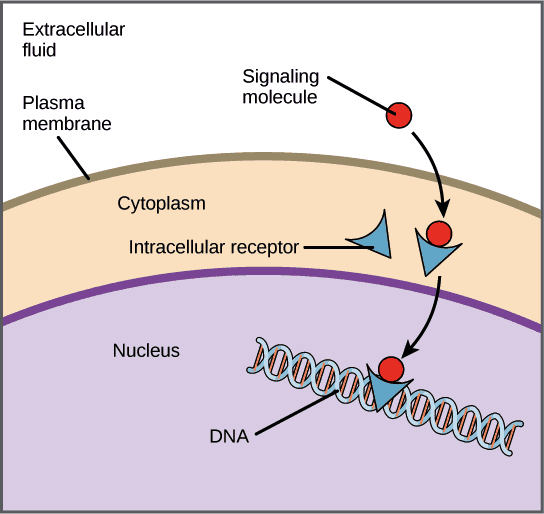
4. Intracellular receptors:
- Slowest acting receptors.
- Present in cytoplasm/nucleus.
- In cytoplasm – Mainly glucocorticoids, mineralocorticoids & vit. D.
- In nucleus – Mainly T3 , T4 , Retinoic acid, PPAR, estrogen, progesterone & testosterone.
- MOA: Both act by nuclear mechanisms – By affecting transcription.
Exam Important
- G-protein coupled receptors are also referred as “metabotropic receptors”.
- G-protein coupled receptors have seven transmembrane spanning segments.
- Phospholipase C enzyme converts PIP2 to IP & DAG.
- Cyclic AMP, IP3 & DAG act as second messengers.
- Calcium acts as third messenger.
- Inotropic receptors are fastest-acting receptors.
- Inotropic receptors are GABA–A, NN, NM, NMDA (glutamate receptors) & 5-HT3 receptors.
- Enzymatic receptors are most prevalent with insulin, GH, Prolactin & cytokines.
- Drug binds to extracellular site of enzymatic type of receptors.
- Intracellular site has enzymatic activity (mostly tyrosine kinase) in enzymatic type of receptors.
- TK is activated via JAK-STAT pathway.
- Intracellular receptors are slowest acting receptors.
- Glucocorticoids, mineralocorticoids & vit. D act mainly via intracellular receptors in cytoplasm.
- T3 , T4 , Retinoic acid, PPAR, estrogen, progesterone & testosterone acts mainly via intracellular receptors in nucleus.
Don’t Forget to Solve all the previous Year Question asked on RECEPTORS – CLASSIFICATION

