
Regulation Of Gfr
REGULATION OF GLOMERULAR FILTRATION RATE
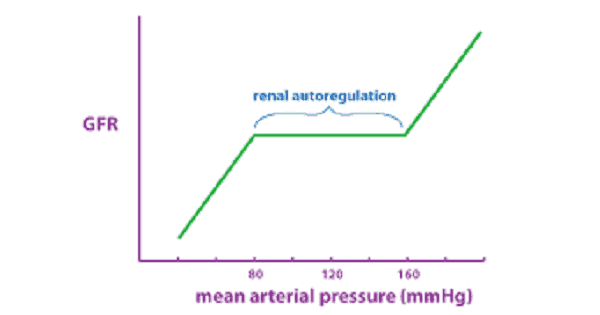
RENAL AUTOREGULATION:
- Property of renal blood flow of being independent of mean systemic arterial pressure is referred as “Autoregulation”.
- GFR & renal blood flow are usually autoregulated.
Need for autoregulation:
- Relative constancy maintained for GFR & renal blood flow levels, given higher renal perfusion rate.
- Precise control of renal excretion of water & solutes.
GFR AUTOREGULATION:
- Well autoregulated in range of 70-180 mm/Hg systemic pressure
- Mechanism:
- Tubuloglomerular feedback.
- Myogenic feedback.
1. Tubuloglomerular feedback:
Two components:
- Afferent arteriole feedback mechanism
- Usually referred as “Tubuloglomerular feedback“
Efferent arteriole feedback mechanism.
Factors:
1. Feedback depends on juxtaglomerular apparatus & its specialized cells.
- 3 cells types involved:
- Macula densa –
- Specialized epithelium of distal tubule in close contact with afferent arteriole.
- Juxtaglomerular cells –
- Modified smooth muscle cells of afferent arteriole.
- Lacis cells
- 2. Also utilizes Na+ – Cl– concentration at macula densa, controlled by renal arteriolar resistance.
Mechanism of action:
1. Afferent arteriolar feedback mechanism:
Steps:
- ↓ed renal arteriole pressure → low NaCl delivery to distal tubule.
- Sensed by macula densa, signaling afferent arteriole.
- Hence, ↓ed afferent arteriole resistance → ↑es glomerular hydrostatic pressure→↑ed GFR.
- Transmitter involved – Adenosine opens calcium channels
2. Efferent arteriolar feedback mechanism:
Steps:
- ↓ed GFR → low NaCl– delivery to distal tubule, sensed by macula densa.
- Signals Juxtaglomerular (JG) cells, secreting Renin → activates “renin-angiotensin system”→ Produces angiotensin II.
- Results in efferent arteriole constriction → ↑es glomerular hydrostatic pressure → ↑ed GFR.
Conclusion:
- ↓ed afferent & efferent arteriole resistance → ↑ed GFR
- Both feedback mechanism GFR according to changes in arterial pressure.
- Afferent acts directly via macula densa.
- Efferent also acts via macula densa, yet involves Renin & angiotensin II.
Functions:
- Ensures relative constant delivery of NaCl– to distal tubule
- Prevents spurious fluctuations renal excretions.
(Note: Tubuloglomerular mechanism & Glomerulotubular balance are different.)
2. Myogenic autoregulation:
- ↑ed afferent arteriole resistance → Afferent arteriole constriction → Normal GFR.
- Arteriole stretching opens “stretch-sensitive Ca2+ channels on arteriolar smooth muscle cells.
- Results in Ca2+ influx → causing constriction.
Exam Question
REGULATION OF GLOMERULAR FILTRATION RATE
- GFR & renal blood flow are usually autoregulated by,
- Tubuloglomerular feedback
- Myogenic feedback,
1. Tubuloglomerular feedback:
- Usually refers, Afferent arteriole feedback mechanism.
1a) Afferent arteriolar feedback mechanism:
- Transmitter involved – Adenosine causing Ca2+ channel opening.
1b) Efferent arteriolar feedback mechanism:
- Activates renin-angiotensin system generating angiotensin I→ efferent arteriole constriction→↑ed GFR.
- Feedback depends on juxtaglomerular apparatus & its specialized cells.
Macula densa – Specialized epithelium of distal tubule in close contact with afferent arteriole
Autoregulation feedback mechanism utilizes Na+ – Cl– concentration at macula densa under control of renal arteriolar resistance.
2. Myogenic autoregulation:
- Arteriole stretching opens “stretch-sensitive Ca2+ channels on arteriolar smooth muscle cells.
- Results in Ca2+ influx → causing constriction.
Don’t Forget to Solve all the previous Year Question asked on Regulation Of Gfr
