
Rickettsiae
Introduction
- This family consist of 3 genera –
- Rickettsia
- Orientia
- Ehrlichia
Morphology
- Gram negative
- Pleomorphic coccobacilli
- Obligate intracellular organisms
- Non motile
- Non capsulated
- Stain bluish purple with Giemsa and Castaneda stains
- Stain deep red with Machiavella and Gimenez stains
- Rickettsiae are unable to grow in cell free media.
- Exception to this rule, R. Quintana
- Growth generally occurs in the cytoplasm of infected cells.
- In case of spotted fever, growth may take place in the nucleus as well.
Ricketsiae are cultivated in –
- Yolk sac of developing chick embryo.
- Mouse fibroblast
- Continous cell lines -4 HeLa, HEP-2, Detroid-6
- Tissue cultures are not satisfactory.
- Guinea pigs and mice are useful for isolation.
|
Disease |
Rickettsial agent |
Insect vector |
Mammalian reservoir |
|
Typhus group |
|
|
|
|
Epidemic typhus |
R. prowazekii |
Louse |
Human |
|
Murine (Endemic)typhus |
R. typhi |
Rat flea |
Rodent |
|
Scrub typhus |
R. tsutsugamushi |
Mite’ |
Rodent |
|
Spotted fever group |
|
|
|
|
Indian tick typhus |
R. conorii |
Tick* |
Rodent , Dogs |
|
Rocky mountain spotted fever |
R. rickettsii |
Tick* |
Rodent , Dogs |
|
Rickettsial pox |
R. akari |
Mite* |
Mice |
|
Others |
|
|
|
|
Q fever |
C. burnetii |
Nil |
Cattle, sheep, goat |
|
Trench fever |
Rochalemaea Quintana |
Louse |
Human |
lmportant Points:
- Most severe
- Rocky mountain spotted fever
- Most mild
- Rickettsia pox
- Symptoms
- fever
- headache
- malaise
- Prostration
- skin rash
- (except in Q fever)
- hepatosplenogy
- Amongst the typhus group, lymphadenopathy is seen only in scrub typhus.
Rash is seen in
- Epidemic typhus
- Endemic typhus
- Scrub typhus
- Rocky Mountain spotted fever
- Indian tick typhus
Lymphadenopathy is seen in
- Scrub typhus
- Rickettsial pox
Eschar is seen in
- Scrub typhus
- Rickettsialpox
- Indian tick typhus
Mortality
- Associated with a high morbidity and mortality.
- 20% of Rocky Mountain Spotted fever
- 30% for epidemic typhus.
- Enter the human body
- Multiply locally and enter the blood.
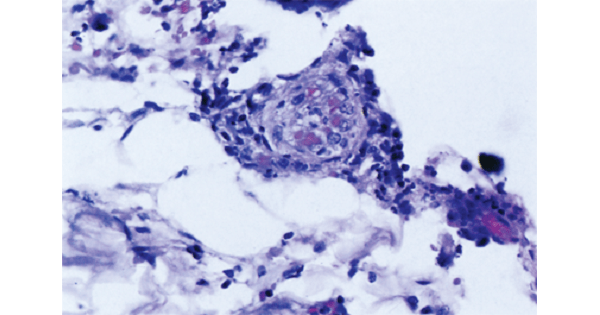
- Become localized chiefly in vascular endothelial cells
- Which enlarge, degenerate and cause thrombus formation
- Partial or complete occlusion of the vascular lumen
- The overall pathological features of the rickettsial diseases are due to the damage of vascular endothelium.
Neil – Mooser or tunica reaction
|
Positive |
R. typhi, R. conori, R.akari |
|
Negative |
R. Prowazekii |
Weil felix reaction
- This reaction is an agglutination test in which sera are tested for agglutinins to 0 antigens of certain nonmotile proteus strains OX -19, OX – 2 and OX – K.
- The basis of the test is the sharing of an alkali – stable carbohydrate antigen by some rickettsiae and by certain strains of proteus, P. vulgaris OX – 19 and OX – 2 and P. mirabilis OX – K.
|
OX 19 |
ln epidemic and endemic typhus |
|
OX-2 |
In rocky mountain spotted fever |
|
OKX |
In scrub typhus |
|
No value |
Q fever, Trench fever, Rickettsial pox |
|
False positive |
Typhoid, liver diseases, Proteus infection Pseudomonas,Borelia,S. typhi |
Morphology
- Gram negative
- Pleomorphic coccobacilli
- Obligate intracellular organisms
- Rickettsiae are unable to grow in cell free media.
- Exception to this rule, R. Quintana
- Can be cultivated in Mouse fibroblast
- Rickettsia tsutsugamushi is a small gram-negative, obligate intracellular organism causing scrub typhus
- Rickettsial pox is caused by Rickettsia akari
- ‘Louse’ is the insect vector for Rickettsia prowazekii.
- Rickettsial pox, caused by Rickettsia akari, is transmitted to humans by the house mouse mite Liponyssoides sanguineus.
- Most severe
- Rocky mountain spotted fever
- Most mild
- Rickettsia pox
- Symptoms
- fever
- headache
- malaise
- Prostration
- hepatosplenogy
Rash is seen in
- Epidemic typhus
- Endemic typhus
- Scrub typhus
- Rocky Mountain spotted fever
- Indian tick typhus
Lymphadenopathy is seen in
- Scrub typhus
- Rickettsial pox
Eschar is seen in
- Scrub typhus
- Rickettsialpox
- Indian tick typhus
Mortality
- 20% of Rocky Mountain Spotted fever
- 30% for epidemic typhus.
- Become localized chiefly in vascular endothelial cells
- The overall pathological features of the rickettsial diseases are due to the damage of vascular endothelium.
Weil felix reaction
- This reaction is an agglutination test in which sera are tested for agglutinins to 0 antigens of certain nonmotile proteus strains OX -19, OX – 2 and OX – K.
|
OX 19 |
ln epidemic and endemic typhus |
|
OX-2 |
In rocky mountain spotted fever |
|
OKX |
In scrub typhus |
|
No value |
Q fever, Trench fever, Rickettsial pox |
|
False positive |
Typhoid, liver diseases, Proteus infection Pseudomonas,Borelia,S. typhi |
