
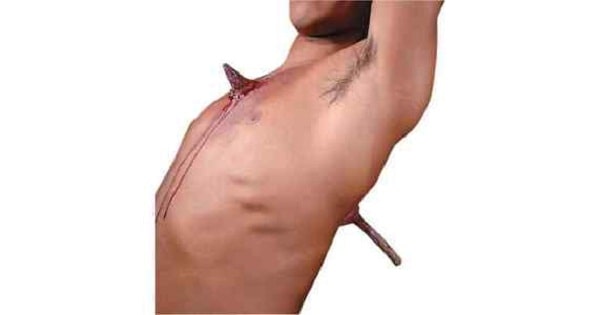
Stab wound
STAB WOUNDS
- Stab or punctured wound is caused by sharp pointed objects, such as, knife, dagger, nail, needle, spear, arrow, screw driver, etc. Penetrating the skin and underlying tissues, i.e., deeper than its length on the skin. They are called penetrating wounds when they enter a cavity of body. When the weapon enters the body on one side and comes out on the other side, perforating or through and through punctured wounds are produced. The wound of entry is larger with inverted edges and the wound of exit is smaller with everted edges, due to tapering of blades.
Characters:
(1) The length of the wound is slightly less than the width of the weapon because of stretching of the skin.
(2) The depth is greater than the dimension of the external injury.
(3) The edge of the wound are clean cut.
(4) Shape:
- If a wound will be triangular or wedge shaped,
- If a double-edged weapon is used, the wound will be elliptical.
- A round object like the spear may produce a circular wound.
- A round blunt pointed object may produce a circular wound with ragged and bruised edges.
- A pointed square weapon may produce a cruciform injury.
(5) The direction is indicated by an undercutting of the external wound, and by the track of injury by the blade. The principal direction should be noted first and the others next.
Complications:
- External haemorrhage is slight but there may be marked internal haemorrhage or injuries to internal organs.
- Infection.
- Air Embolism.
Concealed pnctured wounds: These are punctured wounds caused on concealed parts of the body, such as, axilla, vagina, rectum nostrils, fontanelle, fornix of the upper eye lids, and nape of the neck. Fatal injuries can be caused without leaving any external marks.
Medico-legal Importance:
- The shape of the wound may indicate the class and type of weapon.
- The depth of the wound will indicate the force of penetration,
- Direction and dimension of the wound indicate the relative positions of the assailant and the victim.
- The age of the injury can be determined.
- Position, number and direction of wounds may indicate mode of production i.e. suicide, accident or homicide.
- If a broken fragment of weapon is found it will identify the weapon.
- Stab wounds are mostly suicidal or homicidal.
- Hara-kiri is an unusual form of suicide where the abdomen is boldly punctured by a short sword in a sitting position resulting in one large fatal wound, causing sudden evisceration of internal organs resulting in sudden fall of intraabdominal pressure, followed by collapse, and death.
- Accidental wounds are rare
Don’t Forget to Solve all the previous Year Question asked on Stab wound

