


Structure of RNA
Introduction:
- RNA are unbranched polymeric molecules composed of nucleoside monophosphates joined together by phosphodiester bonds.
- They are considerably smaller than DNA. does not possess thymine except in rare cases.
- single-stranded and does not exhibit the equivalence of adenine with uracil and cytosine with guanine.
“S” is the Svedberg unit, which is related to the molecular weight and shape of the compound.


Messenser RNA (mRNA)
- It carries the information (message) from the nucleus to to ribosome.
- Synthesized in the nucleus as’heterogenous RNA (hn RNA).
- Its nucleotide sequence is complementary i.e adenine for thyamine, guanine for Cytosine, uracil for adenine (as RNA does not contain thymine) and cytosine for guanine.
- 2-5% of total cellular RNA
- 5′ end capped by 7 Methylguanosine triphosphate
- 3′ end nongenetically encoded by polymer of 20-250 adenylate residues.
- m RNA carries genetic information in the form of codons FOR SPECIFIC AMINO ACIDS.
Transfer RNA (tRNAs)
- The smallest (4S) of the three major types of RNA molecules.
- tRNAs make up about 15% of the total RNA in the cell.
- contain a high percentage of unusual bases (for example, dihydro uracil).
- extensive intrachain base-pairing that leads to characteristic secondary and tertiary structure.
- RNA which transfer amino acid from the cytoplasm to the ribosomal protein synthesizing machinery.
- Clover leaf shape in the secondary structure, L shaped tertiary structure.
- Cytoplasmic translation system possess 31tRNA species.
- Mitochondrial translation system possess 22 tRNA species.
t-RNA molecule get folded into a structure that appears like a clover leaf. There are four arms.

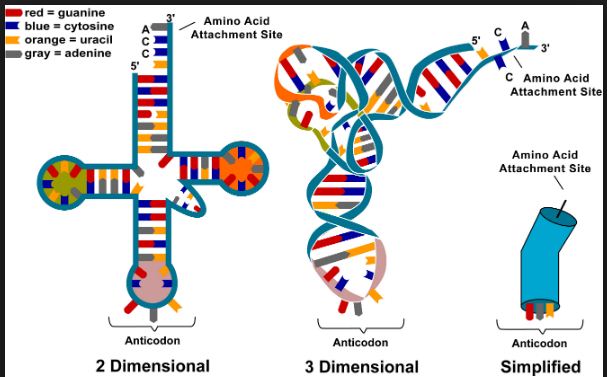
1) Acceptor arm:
- Base paired stem that terminates in the sequence CCA at the 3’ end,
- Attachment site for amino acids.
- CCA tail is added during post-transcriptional modification.
2) D arm: It contains the base dihydrouridine.
3) Anticodon arm: It contains anticodon.
3.1) TΨC arm: It contains both ribothymidine (T) and pseudouridine (Ψ).
Ribosomal RNA (r RNA)
- rRNA is present in ribosomes.
- made up of two subunits 40 ‘S’ and 60 ‘S ¥(eukaryotes).
- The 40 S subunit is made up of 18 S rRNA and about 30 different polypeptides.
- The 60 S subunit is made up of three types of rRNA : 55 rRNA, 5.8 S rRNA and 28S rRNA.
- The Ribosomal RNAs (28 S+I8 S) represent roughly 70%o of total cellular RNA.
- many ribosomes can be associated with mRNA molecule to form an assembly called the polysome.
- Some rRNAs also have ribozymal activity.
- r-RNA is sytrthesized in the nucleolus
Don’t Forget to Solve all the previous Year Question asked on Structure of RNA

