

Supercoiling of DNA
- Supercoiling can be demonstrated by tightly grasping one end of a helical telephone cord while twisting the other end
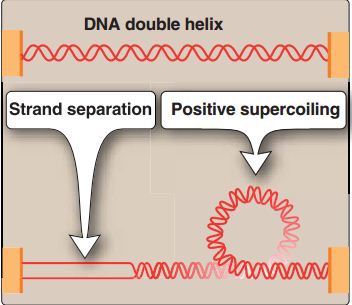
- As the two strands of the double helix are separated, a problem is encountered, namely, the appearance of positive supercoils (also called supertwists).
Functions of Supercoils:
- Supercoiling promotes packing of DNA into compact structures
- Helps to generate regions with broken hydrogen bonds which facilitate DNA strand separation and
- facilitate replication, repair and recombination of the DNA .
- If the cord is twisted in the direction of tightening the coils, the cord will wrap around itself in space to form positive supercoils.
- If the cord is twisted in the direction of loosening the coils, the cord will wrap around itself in the opposite direction to form negative supercoils.
- Enzymes called DNA topoisomerases, which are responsible for removing supercoils in the helix.

Topoisomerase functions:
- Nicking Resealing Enzyme
- Enzymes that can relax or insert supercoils
- Enzymes that relieve torsional strains in the DNA.
Topoisomerases can be of two types: Type I and Type II
Topoisomerase Type I
- These enzymes reversibly cut one strand of the double helix. They have both nuclease (strand-cutting) and ligase (strand-resealing) activities.
- They do not require ATP, but store energy from the phosphodiester bond they cleave, reusing the energy to reseal the strand.
- Each time a transient “nick” is created in one DNA strand.
- Type I topoisomerase relax negative supercoils.
Topoisomerase Type II
- These enzymes bind tightly to the DNA double helix and make transient breaks in both strands.
- The enzyme then causes a second stretch of the DNA double helix to pass through the break and, finally, reseals the break.
- both negative and positive supercoils can be relieved by this ATP-requiring process.
- DNA gyrase, a Type II topoisomerase found in bacteria and plants.
- Type II DNA topoisomerases are also required in both prokaryotes and eukaryotes for the separation of interlocked molecules of DNA.
- Anticancer agents, such as etoposide, target human topoisomerase II
- Bacterial DNA gyrase is a unique target of a group of anti microbial agents called quinolones, for example, ciprofloxacin
Don’t Forget to Solve all the previous Year Question asked on Supercoiling of DNA

