
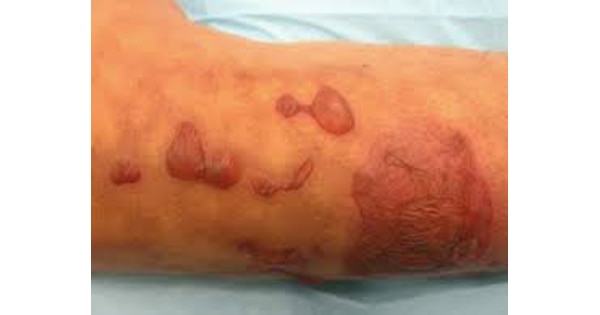
Thermal injuries: chemical, electric and Lightening burns.
Introduction:
Chemical burns:-
- Chemical burns are produced by corrosive acids and alkalis.
- Acids with a pH less than 2 precipitate proteins causing coagulation necrosis.
- Nitric acid gives a yellow-brown scab, sulphuric (vitriol) a black-brown scab,
- Hydrochloric acid (spirit of salt) a white to grey scab, and carbolic acid (phenol or Lysol) gives a light grey to light brown scab.
- Alkalis with a pH above 11.5 cause more tissue damage than acids because they induce liquefactive necrosis, which facilitates ever deeper penetration of the alkali.
- The caustic alkalis, such as sodium hydroxide (caustic soda or lye) and ammonium hydroxide, leave a grey-white mucoid burn.
- Vesicles and blisters, Charring (soot) and singeing are absent, except in cases of mineral acids where they are present.
- The most serious alkali burns of the eye are produced by: Strong liquid ammonia.
Electric burns:-
- High tension electrical burns from overhead electric lines can cause Myoglobinuria and Acute renal failure.
- Electric burns are at times, also referred to as joule burns.
- Regarding high-voltage electrical burns to an extremity. Evaluation for fracture of the other extremities and visceral injury is indicated.
- Ulceration is present, Coagulative necrosis is seen at the site of contact except for hydrogen fluoride which chelate calcium.
- Calcium phosphate of bones may also melt and is radiologically seen as bone pearls (wax dripping), Muscles show Zenker’s degeneration.
- commonest cause of death in electric injury is ventricular fibrillation.
- The skin may get coloured due to metallic pigment :- green (in brass electrode), black (in iron electrode), blue (in copper electrode) and grey (in aluminium electrode).
- In high-voltage (more than 1,000 volts) electrical burns the contact injury of exit often appears as a blow-out type of wound.
- Alternating current (AC) is more dangerous than direct current (DC).
Lightening burns
- Lightening refers to discharge of current between a negatively charged cloud and positively charged article on earth.
- Direct effect of high voltage current.
- Heat, i.e. super heated air causing burns.
- Expanded and displaced air, which acts as a blast wave
- Sledge hammer blow by compressed air pushed before.
- The characteristic finding in lightening burns is filigree burns.
Exam Important
- Chemical burns are produced by corrosive acids and alkalis.
- Acids with a pH less than 2 precipitate proteins causing coagulation necrosis.
- Nitric acid gives a yellow-brown scab, sulphuric (vitriol) a black-brown scab,
- Hydrochloric acid (spirit of salt) a white to grey scab, and carbolic acid (phenol or Lysol) gives a light grey to light brown scab.
- Alkalis with a pH above 11.5 cause more tissue damage than acids because they induce liquefactive necrosis, which facilitates ever deeper penetration of the alkali.
- The caustic alkalis, such as sodium hydroxide (caustic soda or lye) and ammonium hydroxide, leave a grey-white mucoid burn.
- Vesicles and blisters, Charring (soot) and singeing are absent, except in cases of mineral acids where they are present.
- The most serious alkali burns of the eye are produced by: Strong liquid ammonia.
- High tension electrical burns from overhead electric lines can cause Myoglobinuria and Acute renal failure.
- Electric burns are at times, also referred to as joule burns.
- Regarding high-voltage electrical burns to an extremity. Evaluation for fracture of the other extremities and visceral injury is indicated.
- Ulceration is present, Coagulative necrosis is seen at the site of contact except for hydrogen fluoride which chelate calcium.
- Calcium phosphate of bones may also melt and is radiologically seen as bone pearls (wax dripping), Muscles show Zenker’s degeneration.
- commonest cause of death in electric injury is ventricular fibrillation.
- The skin may get coloured due to metallic pigment :- green (in brass electrode), black (in iron electrode), blue (in copper electrode) and grey (in aluminium electrode).
- In high-voltage (more than 1,000 volts) electrical burns the contact injury of exit often appears as a blow-out type of wound.
- Alternating current (AC) is more dangerous than direct current (DC)
Don’t Forget to Solve all the previous Year Question asked on Thermal injuries: chemical, electric and Lightening burns.

