

Thyroid Carcinoma
CAUSES AND RISK FACTORS:
- Chronic Iodine deficiency ↑ risk for Follicular carcinoma.
Gender:
- Female > Males.
Age:
- More common at young adults.
- MTC usually diagnosed after 60.
Race:
- White race > Black race.
Genetics:
- Abnormal RET oncogene may cause MTC.
- MEN 2A, 2B Syndrome.
Family History:
- Hx of goiters increase risk for Papillary Ca.
- Gardner’s Syndrome and FAP increase risk for Papillary Ca.
Radiation Exposure:
- Radiation therapy to Head or Neck.
- Exposure to Radioactive Iodine during childhood, or other radioactive substances (Chernobyl) ↑ risk for particularly Papillary carcinoma.
PRESENTATION:
- Solitary or Multiple thyroid nodules
- Neck Nodes
- Hoarse voice of recent onset
- Mediastinal adenopathy
- Bone or lung metastasis
IMPORTANT HISTORY
- Radiation to neck / chest
- MEN syndrome
- Family history
- Diarrhoea
- Adrenal tumour
- Recent change in a pre-existing goitre
- Size change/nodularity
- Vocal cord palsy
EVALUATION:
- Thyroid profile
- Serum Thyroglobulin
- Serum Calcitonin
- Thyroid scan
- Hot/warm/cold nodule 20% malignant
- Serum Ca++
DIAGNOSIS:
- Imaging
- U/S
- C.T
- MRI
- Scintigraphy (I-123)
- Staging of follicular and papillary Ca
- Characterizing funtioning nodules
Laboratory:
- TSH
- T3, T4
- Serum Thyroglobulin
- Serum Thyroid Antibodies
- FNAC
- Most patients are Euthyroid.
- Hyperfunctioning nodule à 1% chance of malignancy.
- Serum Tg cannot differentiate between benign and Malignant nodules
Tg is used for:
- F/U after total thyroidectomy
- Serial F/U for non-operative treatment
- Serum Calcitonin à patients with MTC, or with family hx of MTC (MEN2)
PAPILLARY CARCINOMA:
- Most common Thyroid carcinoma (80%)
- Related to radiation exposure in I-sufficient areas.
- Female:male ratio is 2:1
- Mean age of presentation is 30 to 40 yrs.
- Slow growing painless mass. Euthyroid-status.
- LN metastases is common, may be the presenting symptom (Lateral Aberrant Thyroid).
- Distant metastases is uncommon at initial presentation.
- Develop in 20% of cases. (Lungs, liver, bones,brain)
- FNA biopsy is diagnostic.
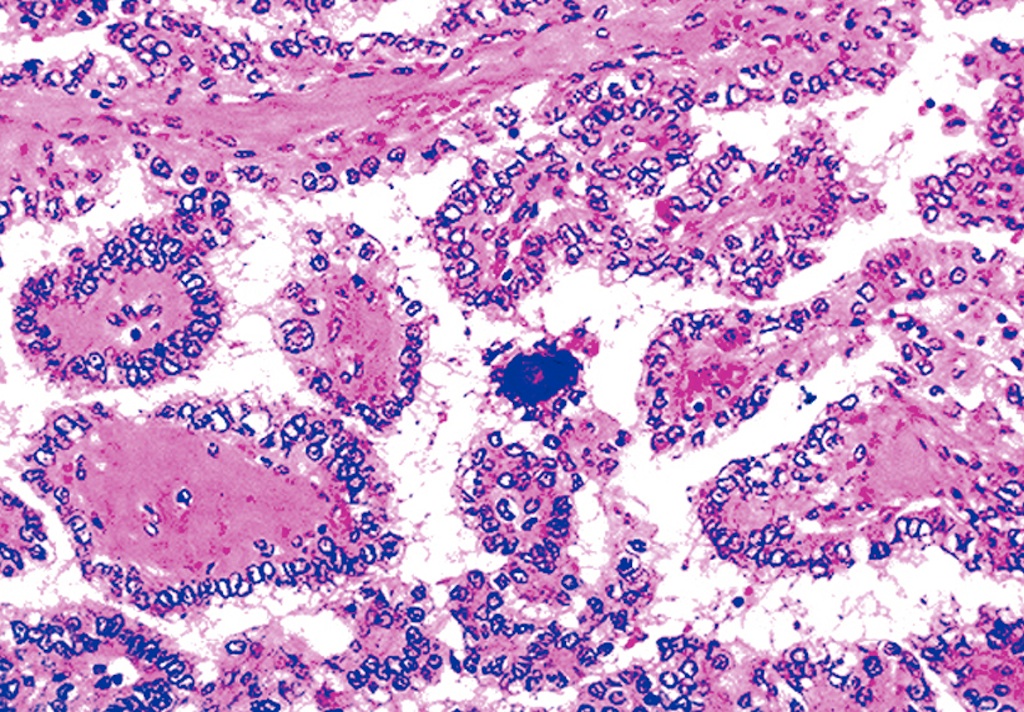
 FOLLICULAR CARCINOMA:
- Account for 10% of all thyroid cancers.
- More common in I-deficient areas.
- Female:male ratio is 3:1
- Mean age at presentation is 50 yrs.
- Solitary thyroid nodule, rapid increase in size and long-standing goiter.
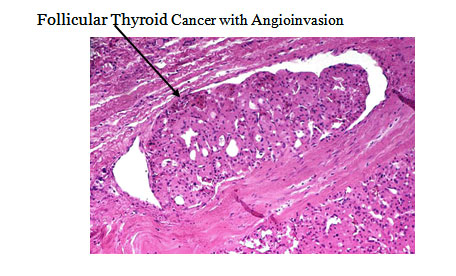
- Cervical LN metastasis is uncommon at presentation (5%), distant metastasis may be present.
- Hyperfunctioning < 1%. (S&S of Thyrotoxicosis)
- FNA biopsy cannot differentiate between benign and malignant follicular tumors.
- Pre-operative diagnosis of malignancy is difficult unless there is distant metastasis.
- Large follicular tumor > 4 cm in old individual à CA.
MEDULLARY CARCINOMA:
- 5% of all thyroid malignancies.
- Arise from Parafollicular cells, concentrated in superolateral aspect of thyroid lobes.
- Most cases are sporadic, 25% are inherited (Germline mutation in RET oncogene).
- Female:Male ratio is 1.5:1
- Most patients present between 50 and 60 yrs.
- Neck mass + palpable cervical LN (15-20%).
- Local pain or aching is common.
MTC secrets a range of compounds:
- Calcitonin, CEA, CGRP, PG A2 and F2α, Seritonin.
- May develop flushing and diarrhoea, Cushing’s syndome (ectopic ACTH).
Diagnosis
- Hx and P/E (Family hx of similar tumors).
- ↑ Serum Calcitonin, ↑ CEA
- FNAC
Screen patient for:
- RET point mutation.
- Coexisting Pheochromocytoma (24-hour urinary level of VMA, catecholamine, metanephrine).
- Hyperparathyroidism (Serum calcium).

ANAPLASTIC CARCINOMA:
- 1% of all thyroid malignancies.
- Women > Men.
- Majority present at 7th – 8th decade of life.
- Long-standing neck mass, rapidly enlarging in size.
- May be painful, with dyphonia, dyspnea, dysphagia.
- LN are usually involved at presentation.
- ± Distant metastasis.

PROGNOSIS:
|
Tumor |
Prognosis |
|
Papillary Ca. |
74-93% long-term survival rate |
|
Follicular Ca. |
43-94% long-term survival rate |
|
Hurthle Cell Ca. |
20% mortality rate at 10 years |
|
Medullary Ca. |
80% 10-year survival rate 45% with LN involvement |
|
Anaplastic Tumor |
Median survival of 4 to 5 months at time of diagnosis |
Exam Question
- Thyroid carcinoma associated with hypocalcemia is Medullary carcinoma
- FNAC cannot distinguish between a Follicular Adenoma and a Follicular Carcinoma
- In Medullary carcinoma thyroid Patients should be screened for RET point mutation on chromosome 10
- Medullary carcinoma thyroid Secretes calcitonin
- Medullary carcinoma thyroid Contains amyloid
- Papillary carcinoma of thyroid have Excellent prognosis
- Amyloid deposition is seen in Medullary carcinoma thyroid
- Total thyroidectomy is done in Medullary carcinoma thyroid
- Parafollicular cells involved in Medullary carcinoma thyroid
- Medullary carcinoma thyroid is TSH dependent
- Radionuclide scan is is initial investigation of choice for a patient presenting with solitary nodule of thyroid
- Percentage of cold thyroid nodules likely to be malignant are 20%
- Psammoma bodies are seen in Seminaoma
- Medullary thyroid carcinoma is associated with MEN II
- Multiple,round figures in histopathological picture of a patient suffering from carcinoma is due to a mineral deposition can be diagnosed to have Adenocarcinoma of Lung, Meningioma or papillary thyroid carcinoma.
- Medullary thyroid carcinoma is classically associated with calcitonin induced amyloid deposition
Don’t Forget to Solve all the previous Year Question asked on Thyroid Carcinoma
