


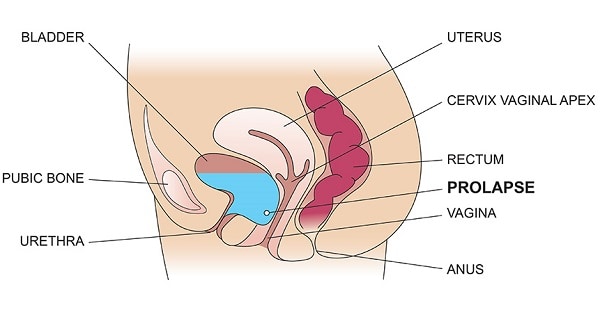
Vaginal Prolapse
INTRODUCTION:
- The network of muscles, ligaments, and skin in and around a woman’s vagina acts as a complex support structure that holds pelvic organs, and tissues in place.
- This support network includes the skin and muscles of the vaginal walls (a network of tissues called the fascia).
- Various parts of this support system may eventually weaken or break, causing a common condition called vaginal prolapse.
RISK FACTORS:
- Childbirth (especially large babies)
- Menopause
- Hysterectomy
- Advanced age
- Obesity
- Dysfunction of the nerves and tissues
- Abnormalities of the connective tissue
- Strenuous physical activity
- Prior pelvic surgery
TYPES:
- Anterior vaginal wall prolapse: Urethrocele, Cystocele(base of bladder), Cystourethrocele
- Posterior vaginal wall prolapse:Rectocele, Enterocele
- Apical vaginal prolapse: Uterovaginal , Vaginal prolapse
SYMPTOMS:
- The most common type of genital prolapse is Cystocele
- The symptoms that result from vaginal prolapse commonly affect sexual function as well as bodily functions such as urination and defecation.
- Pelvic pressure and discomfort are also common symptoms.
- Pressure in the vagina or pelvis
- Painful intercourse (dyspareunia)
- A mass at the opening of the vagina
- A decrease in pain or pressure when the woman lies down
- Recurrent urinary tract infections
- Difficulty emptying bowel
- Difficulty emptying bladder
- Constipation
- Urinary stress incontinence
- Pain that increases during long periods of standing
- Protrusion of tissue at the back wall of the vagina
- Protrusion of tissue at the front wall of the vagina
- Enlarged, wide, and gaping vaginal opening
INVESTIGATION:
- Q-tip test:Predictive factor of success of anti-incontinence surgery.
- Bladder function test:This tests the ability of the bladder to store and evacuate urine (i.e. urinate) and to dispose of it.
- Pelvic floor strength:assesses the strength of the muscles and ligaments that support the vaginal walls, uterus, rectum, urethra, and bladder.
Imaging technique:
- MRI
- Ultrasound
- Cystourethroscopy
TREATMENT:
Nonsurgical options:
- Most appropriate for women who are not sexually active, cannot undergo surgery because of medical reasons, or experience few or no symptoms associated with the condition.
- Estrogen replacement therapy
Surgical repair:
- For young nulliparous women with 2° or 3° uterovaginal prolapse
- Abdominal sling operation (e.g. Purandare, Shirodkar, Khanna and Mnatre sling operation)
- For a parous women in early weeks of pregnancy.
- Ring pessary in the first trimester of pregnancy.
- For a parous women in pregnancy with 2° or 3° prolapse at 28 weeks.
- Ring pessary till child birth and few weeks after and then Fothergill’s repair.
- For < 40years multipara, desirous of retaining menstrual function and reproductive function with 2° or 3° prolapse.
- Fothergill’s repair with tubal ligation
- For women > 40 years completed family size
- Mayoward’s vaginal hysterectomy (with ant. Colporrhaphy and posterior colpoperineorrhaphy) with pelvic floor repair.
For elderly menopause patient with advanced prolapse
- Lefort’s repair
- For enterocele
- Moscowitz repair
- For vault prolapse
- Right transvaginal sacrospinous colpopexy (in obese and elderly, not fit for abdominal surgery).
- Transabdominal sacral colpopexy using Mersilene mesh extraperitoneally (in patient fit for abdominal surgery).
- Congenital prolapse of uterus / Nulliparous prolapse without cystocele :
- Purandare’s cervicopexy.
- Fothergill’s repair(treatment of choice uterovaginal prolapse)
Other therapy:
- Electrical stimulation
- Biofeedback
Exam Question
- Shirodkar’s abdominal sling is the treament of choice for nulliparous woman who has 3rd degree uterovaginal prolapse without any cystocele or rectocele.
- Urinary incontinence in uterovaginal prolapse is mostly is due to Stress incontience
- Treatment of choice in a multiparous female with 2nd degree uterovaginal prolapse is Fothergill’s operation with tubal ligation
- Cystocele is formed by base of the bladder
- The most common type of genital prolapse is Cystocele
Don’t Forget to Solve all the previous Year Question asked on Vaginal Prolapse