
Vitreous Hemorrhage
VITREOUS HEMORRHAGE
- It is the extravasation of blood into the areas in and around the vitreous humor of the eye.
- The vitreous humor is the clear gel that fills the space between the lens and the retina of the eye.
- Most common complication after lens extraction persistent hyperplastic primary vitreous is Vitreous hemorrhage
ETIOLOGY:
1. Diabetic Retinopathy
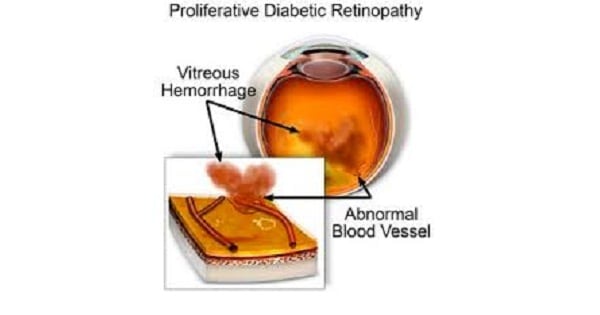
- The most common cause found in adults is diabetic retinopathy.
- Abnormal blood vessels can form in the back of the eye of a person with diabetes.
- These new blood vessels are weaker and prone to breaking and causing hemorrhage.
2. Trauma
- Trauma is the leading cause of vitreous hemorrhage in young people, and accounts for 12-18.8% of cases in adults.
3. Retinal Tear/Detachment
- A tear in the retina can allow fluids from the eye to leak in behind the retina, which causes retinal detachment.
- When this occurs, blood from the retinal blood vessels can bleed into the vitreous.
4. Posterior Vitreous Detachment
- As one gets older, pockets of fluid can develop in the vitreous.
- When these pockets develop near the back of the eye, the vitreous can pull away from the retina and possibly tear it.
5. Other Causes
- Proliferative sickle cell retinopathy
- Macroaneurysm
- Age-related macular degeneration
- Terson syndrome
- Retinal neovascularization as a result of branch or central retinal vein occlusion
Symptoms/Diagnosis
- Blurry vision
- In a young patient presenting with recurrent vitreous hemorrhage, diagnosis is Eale’s disease
- Floaters– faint cobweb-like apparitions floating through the field of vision
- Reddish tint to vision
- Vitreous hemorrhage produces Sudden painless loss of vision
- Photopsia-brief flashes of light in the peripheral vision
- Small vitreous hemorrhage often manifests itself as “floaters”.
- A moderate case will often result in dark streaks in the vision, while dense vitreous hemorrhage can significantly inhibit vision.
 Treatments
- The treatment method used depends on the cause of the hemorrhage.
- In most cases, the patient is advised to rest with their head elevated 30-45° and sometimes to put patches over the eyes to limit movement prior to treatment in order to allow the blood to settle.
- The patient is also advised to avoid taking medications that cause blood thinning (such as aspirin or similar medications).
- Retinal tears are closed by Laser treatment or cryotherapy, and detached retinas are reattached surgically.
- In cases of vitreous hemorrhage due to detached retina, long standing vitreous hemorrhage with a duration of more than 2-3 months, or cases associated with rubeosis iridis or glaucoma, a vitrectomy may be necessary to remove the standing blood in the vitreous
Exam Question
- The most common cause of vitreous hemorrhage in adults is Diabetes
- Causes of floaters in DM is vitreous hemorrhage
- In a young patient presenting with recurrent vitreous hemorrhage, diagnosis is Eale’s disease
- Trauma is the most common cause of vitreous hemorrhage in young individuals
- Vitreous hemorrhage is caused commonly by Retinal vein occlusion
- No treatment is given immediately in vitreous hemorrhage in eye
- Vitreous hemorrhage produces Sudden painless loss of vision
- Most common complication after lens extraction persistent hyperplastic primary vitreous is Vitreous hemorrhage
- A 40-year old male with diabetes presents with vitreous hemorrhage may be due to Neovascularization at disc
Don’t Forget to Solve all the previous Year Question asked on Vitreous Hemorrhage
