Question
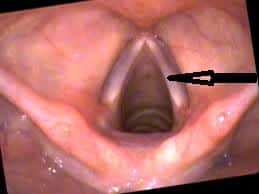
Cadaver like position of this structure as shown in image is seen in?
| A. |
Superior laryngeal nerve palsy
|
| B. |
Recurrent with Superior laryngeal nerve palsy
|
| C. |
External laryngeal nerve palsy
|
| D. |
Internal laryngeal nerve palsy
|
Show Answer
|
Correct Answer � B
Explanation
|
|
Ans;B.) Recurrent with Superior laryngeal nerve palsy
This structure is Vocal cord
Position of Vocal cords in Laryngeal Paralysis
RECURRENT LARYNGEAL NERVE (ABDUCTOR) PARALYSIS
- Recurrent laryngeal nerve injury is the most common cause of vocal cord paralysis.
- Supplies all the muscles (posterior Cricoarytenoid, interarytenoid, lateral Cricoarytenoid, and Thyroarytenoid muscles) except for Cricothyroid.
- The cricothyroid muscle is an adductor & therefore this will leave both the cords in median or paramedian position
PARALYSIS OF SUPERIOR LARYNGEAL NERVE
- Ipsilateral anesthesia of larynx above the vocal cord.
- At rest, the vocal fold on paralyzed side is slightly shortened and bowed, and may be depressed below level of normal side.
PARALYSIS OF RLN AND SLN
- Vocal cord lies in cadaveric position, 3.5mm from midline
POSITION OF VOCAL CORDS
|
Position of cord
|
Location from midline
|
Defect
|
|
Median
|
midline
|
RLN palsy
|
|
Paramedian
|
1.5 mm
|
RLN palsy
|
|
Intermediate(Cadaveric)
|
3.5 mm
|
Both RLN and superior laryngeal nerve palsy
|