Question
A young mother brings her recently born infant into your office and complains that the infant gags and chokes after swallowing milk. A physical examination indicates excessive saliva and mucus around the mouth and nose, abdominal distention, pneumonitis, and radiographs indicate air in the infant’s stomach. What is the most likely cause?
| A. |
Hypertrophic pyloric stenosis
|
| B. |
Tracheoesophageal fistula
|
| C. |
Congenital lobar emphysema
|
| D. |
Respiratory distress syndrome
|
Show Answer
|
Correct Answer � B
Explanation
|
|
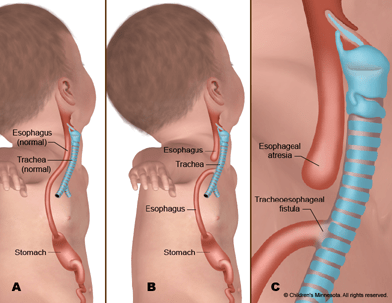
Answer B) Tracheoesophageal fistula
Tracheoesophageal Fistula
-
Tracheoesophageal fistula is an abnormal communication between the trachea and esophagus that results from an improper division of the foregut by the tracheoesophageal septum.
-
It is generally associated with esophageal atresia and polyhydramnios.
-
Tracheoesophageal fistula (TEF) represents one of the most common congenital anomalies seen in major pediatric surgical centers. Infants with TEF classically present with respiratory distress, feeding difficulties, choking, and risk for aspiration.
-
TEF is most commonly associated with other congenital anomalies, particularly cardiac defects.
-
Esophageal atresia (EA) is a related congenital malformation with a similar presentation to TEF and can occur with or without the presence of a fistula.