Question
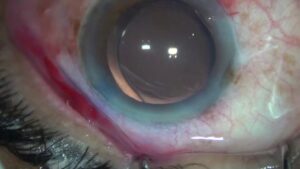
A 65-year-old man with a long history of diabetes mellitus presents with a gradual, painless decrease in vision and reports seeing colored halos around lights. Slit-lamp examination shows a greyish-white opacity of the lens with clear cortex still visible and preserved iris shadows. What is the most likely diagnosis, and which management is indicated?
| A. |
Sunflower cataract/ snow flake cataract- control sugar levels
|
| B. |
Zonular cataract- lens extraction
|
| C. |
Immature senile cataract- Phacoemulsification & IMSC
|
| D. |
Rossette cataract- ECCE
|
Show Answer
|
Correct Answer » C
Explanation
|
|
– The slit lamp likely shows an immature senile cataract with partial lens opacification & preserved red reflex.
– Gradual vision ↓ → hallmark of senile cataract.
– Colored haloes → caused by light diffraction in water-laden lens fibers, common in immature cortical cataract.
– Elderly age (65 years) & diabetes mellitus (DM) ↑ risk of nuclear sclerosis & cortical cataracts.
Immature Senile Cataract (ISC):
– Lens partly opaque; still has red reflex; vision ↓ gradually.
Management:
– Phacoemulsification: Lens ultrasound emulsification.
– IMSC: Intraocular lens (IOL) implantation done simultaneously.
Snowflake cataract (diabetic): Presents with discrete subcapsular opacities (“snowflakes”) and is not managed by cataract extraction until visually significant. glycemic control alone does not reverse an established immature cataract .
Zonular (lamellar) congenital cataract: Typically diagnosed in infancy or childhood with a spoke-like lamellar opacity around the fetal nucleus; not applicable to a 65-year-old .
Rosette-shaped cataract: Occurs after blunt ocular trauma and shows petaloid (“rosette”) opacities; no history of trauma here