Question
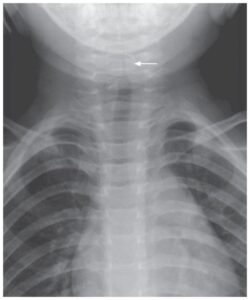
A 3-year-old child presented with fever & biphasic stridor. There is a history of prior URI. There is no dysphagia. What is the diagnosis on the basis of radiographs given below
| A. |
Acute laryngotracheobronchitis
|
| B. |
Acute epiglottitis
|
| C. |
Laryngomalacia
|
| D. |
Foreign body glottis
|
Show Answer
|
Correct Answer » A
Explanation
|
|
Subglottic narrowing (Steeple Sign): The tracheal air column tapers smoothly just below the level of the vocal cords, resembling a church steeple.
Location: Midline, at the level of C4–C5 (just below the thyroid cartilage), exactly where laryngeal inflammation and edema occur in croup.
– Croup: Also known as acute laryngotracheobronchitis. Common in ages 6 months to 3 years. Presents with URI symptoms that progress to a “barking” cough & biphasic stridor. Mild to moderate fever may occur. AP neck X-ray shows “steeple sign,” indicating subglottic narrowing.
– Acute epiglottitis: Rapid onset, severe throat pain, drooling, high fever, breathing difficulty. Key: Dysphagia, “thumb sign” on lateral X-ray (swollen epiglottis). Not present here.
– Laryngomalacia: Most common cause of chronic stridor in infants; stridor is inspiratory. Generally appears shortly after birth.
– Foreign body in the glottis: Sudden choking, coughing, stridor if aspiration occurs. History usually shows a sudden onset—not indicated here.