
Question
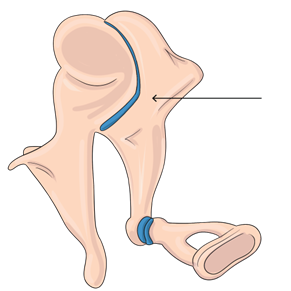
| A. | Ball and socket joint |
| B. |
Saddle joint |
| C. |
Pivot joint |
| D. |
Gliding joint |

|
Correct Answer � B Explanation |
 |
The joint between the malleus and incus in the middle ear is a saddle joint. This joint type allows for limited movement in two planes and plays a critical role in the transmission of sound vibrations from the eardrum to the inner ear.
Incus and stapes joint type is ball-and-socket synovial joint.
Saddle synovial joint:
Examples include:
- Joint between malleus and incus.
- Sternoclavicular joint.
- 1st carpometacarpal joint.
- Calcaneocuboid joint.
Incorrect Options:
Ball and socket joint: allows for a wide range of motion in multiple directions. The rounded head of one bone fits into the concave socket of another, facilitating movements like flexion, extension, abduction, adduction, and rotation.
Example: Glenoid fossa and head of humerus
Pivot Joint: allows rotation around a central axis. In the case of the atlantoaxial joint, the first cervical vertebra (atlas) rotates around the odontoid process of the second cervical vertebra (axis).
Example: Atlantoaxial joint
Gliding Joint: (also known as plane joints) have flat surfaces that glide or slide past each other. They allow for limited movement in various directions, such as sliding or twisting.
Example: acromioclavicular joint
