Question
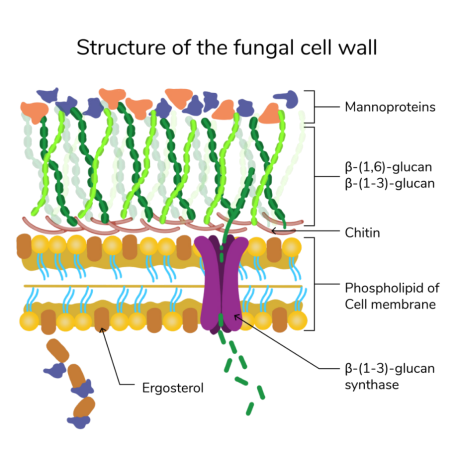
Which of the subsequent constituents of the fungal cellular wall is absent in cases of mucormycosis?
| A. |
Mannoproteins
|
| B. |
Beta 1,3, glucan
|
| C. |
Chitin
|
| D. |
Ergosterol
|
Show Answer
|
Correct Answer » B
Explanation
|
|
Clinical Reasoning for the Correct Answer:
– Beta-1,3-glucan is a major structural polysaccharide present in the cell walls of most pathogenic fungi (e.g., Candida, Aspergillus), but it is notably absent or very minimal in the cell walls of Mucorales (the cause of mucormycosis).
– This absence explains why certain antifungal drugs (e.g., echinocandins, which target beta-glucan synthesis) are ineffective against mucormycosis.
Why Option A (Mannoproteins) is Incorrect:
– Mannoproteins are present in cell walls of most fungi, including Mucorales, contributing to antigenicity and structural support.
– Mucorales do contain mannoproteins, so this is not the absent component.
Why Option B (Beta-1,3-glucan) is Correct:
– Mucorales lack significant amounts of beta-1,3-glucan in their cell wall.
– This absence is a key diagnostic and therapeutic discriminator; echinocandins (beta-glucan inhibitors) are not effective against mucormycosis.
Why Option C (Chitin) is Incorrect:
– Chitin is a universal basic component of fungal cell walls, present in Mucorales for structural integrity.
– Chitin is not absent in mucormycosis.
Why Option D (Ergosterol) is Incorrect:
– Ergosterol is a key sterol in fungal cell membranes (not the wall) in almost all pathogenic fungi, including Mucorales.
– Ergosterol presence is why amphotericin B is effective against mucormycosis.