
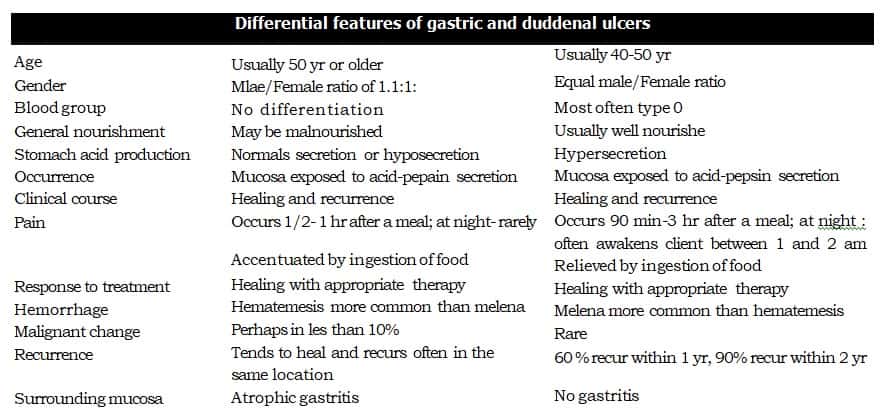
PEPTIC ULCER (GASTRIC AND DUODENAL ULCER)
Most important factors causing peptic ulcer
- H pylori infection
- NSAID use
| Benign gastric ulcer | Malignant gastric ulcer |
|
v Cushing ulcer – due to intracranial injury/increased ICP/after neurosurgical operations
v Curling ulcer – after burn injury (>35%); in the body and fundus; not in antrum and duodenum
v Cameron ulcers – linear gastric erosions in hiatal hernias
v Kissing ulcers – both anterior and posterior duodenal ulcers are present
Medical treatment: Proton pump inhibitors or H2 blockers; H.pylori eradication
Surgeries for Duodenal ulcer
- Highly Selective Vagotomy or Parietal cell Vagotomy or Proximal gastric Vagotomy
- Procedure of choice
- Nerves of Latarjet are preserved (and hence gastric motility)
- Lowest mortality rate and side effects
- Minimal chances of dumping syndrome
- Gastrectomy – highest mortality
- Vagotomy and Antrectomy – lowest recurrence & highest morbidity
- Gastroenterostomy alone – highest recurrence
- Billroth II gastrectomy
v Duodenal blow out following Billroth II gastrectomy occurs on 4th day (2-7days)
Surgery for gastric ulcer
- Partial gastrectomy with Billroth I gastroduodenal anastomosis
- Type IV ulcer – subtotal gastrectomy
Sequelae of peptic ulcer surgery
- Recurrent ulceration
- Small stomach syndrome
- Follows most ulcer operations, does not occur following Highly selective vagotomy
- Due to loss of receptive relaxation
- Gets better with time
- Revisional surgery is not necessary
- Bile vomiting (Afferent loop syndrome)
- Following gastrectomy, best treatment is Roux-en-Y diversion
- In patients with gastroenterostomy, small Pyloroplasty may be performed
- Dumping syndrome (Post cibal syndrome)
- More common after partial gastrectomy with the Billroth II reconstruction.
- Much less common following the Billroth I gastrectomy or after vagotomy and drainage procedures
- Efferent loop obstruction
- More than 50% of cases occur within the first postoperative month
- Alkaline reflux gastritis
- Although the diagnosis can be made by taking a careful history HIDA scans usually demonstrate biliary secretion into the stomach and even into the esophagus.
- Most patients had gastric resection and Billroth II anastomosis
- Post vagotomy diarrhea
- Patient managed as for early dumping
- Octreotide not effective
Exam Important
Most important factors causing peptic ulcer
- H pylori infection
- NSAID use
- Sequelae of peptic ulcer surgery
-
- Recurrent ulceration
- Small stomach syndrome
- Follows most ulcer operations, does not occur following Highly selective vagotomy
- Due to loss of receptive relaxation
- Gets better with time
- Revisional surgery is not necessary
- Bile vomiting (Afferent loop syndrome)
- Following gastrectomy, best treatment is Roux-en-Y diversion
- In patients with gastroenterostomy, small Pyloroplasty may be performed
- Dumping syndrome (Post cibal syndrome)
- More common after partial gastrectomy with the Billroth II reconstruction.
- Much less common following the Billroth I gastrectomy or after vagotomy and drainage procedures
- Efferent loop obstruction
- More than 50% of cases occur within the first postoperative month
- Alkaline reflux gastritis
- Although the diagnosis can be made by taking a careful history HIDA scans usually demonstrate biliary secretion into the stomach and even into the esophagus.
- Most patients had gastric resection and Billroth II anastomosis
- Post vagotomy diarrhea
- Patient managed as for early dumping
- Octreotide not effective
Don’t Forget to Solve all the previous Year Question asked on PEPTIC ULCER (GASTRIC AND DUODENAL ULCER)
Click Here to Start Quiz
Click Here to Start Quiz

