
POLYMERASE CHAIN REACTION (PCR)
POLYMERASE CHAIN REACTION (PCR)
- Karry Mullis invented this ingenious method in 1989, & awarded Nobel prize in 1993.
- millions of copies of a particular sequence of DNA can be produced within a few hours.
- PCR is a method of enzymatic amplification of a target sequence of DNA.
- It is sensitive, selective (specific) and extremely rapidmeans of amplifiing any desired sequence of double stranded DNA.
- DNA to be amplified is replicated by DNA polymerase of Thermus aquaticus (Taq) because it is thermostable.
- Primers are amplified to produce desired sequence of DNA.
- Two DNA primers of about 20-30 nucleotides with complementary sequence of the flanking region can be synthesized.
Steps in PCR:
- PCR uses DNA polyme rase.
- Each cycle doubles the amout of DNA in the sample, leading to exponential increase.
- Thus amplification after’n’number of cycle in (2)n, twenty cycles provide an amplification of 106 (million) and 30 cycles of 10, (billion).
Step 1: Separation (Denaturation):DNA strands are separated (melted) by heating at 95°C for 15 seconds to 2 minutes
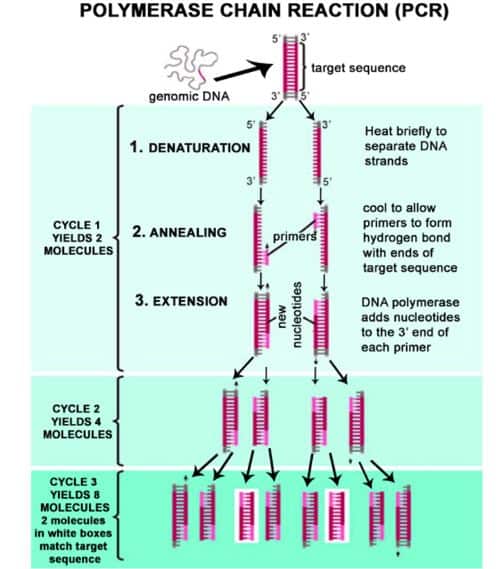
Step 2: Priming (Annealing): The primers are annealed by cooling to 50°C for 0.5 to 2 minutes. The primers hybridise with their complementary single stranded DNA produced in the first step.
Step 3: Polymerization: New DNA strands are synthesized by Taq polymerase.This enzyme is derived from bacteria Thermus acquaticus that are found in hot springs. Therefore the enzyme is not denatured at high temperature. The polymerase reaction is allowed to take place at 72°C for 30 seconds in presence of dNTPs (all four deoxy ribonucleotide triphosphates) and DNA polymerase.
- As Taq polymerase is not denatured on heating and therefore does not have to be added at each successive cycle.
- Both strands of DNA are now duplicated
- The steps of 1,2 and 3 are repeated, Thus, 20 cycles provide for 1 million times amplifications. These cycles are generally repeated by auto-mated instrument, called Tempcycler.
Thus following is required in PCR:-
- target double standard DNA,
- two specific primrers
- a thermostable DNA polymerase
- Taq polymerase,
- dNTP
APPLICATION OF PCR:
Detection of infectious diseases:
- AIDS, Tuberculosis, CMV, H1N1, etc.
- Lyme Disease-joint inflammation from tick bites.
- Detect 3 sexually transmitted diseases in one swab-herpes, papillomarvirus, chlamydia.
- PCR can diagnosis even one bacteria or virus present in the specimen.
- Latent viruses can also be diagnosed.
Detection of Variations and Mutations in Genes
- Detects people with inherited disorders and carriers
- Track presence or absence of DNA abnormalities, characteristic to cancer.
- Prenatal diagnosis of genetic disorders.
- PCR combined with RE and Southern blotting is used for mutation detection.
PCR and the Law
- DNA fingerprinting can multiply small amounts of DNA
- found in blood samples, hair, semen, and other
- body fluids “contain only very few tubercle bacilli ,cytomegalo virus and HIV
Various types of PCR:
- Multipler PCR
- Reverse Tanscriptase PCR: DNA polymerase derived from thermus thermophillus organism has got additional reverse transcriptase activity and hence is preferred for reverse transcriptase type of PCR.
- Realtime PCR: a fluorescent dye known as “SYBR green is used to tag the primer, this helps in quantitative detection of PCR material.
- Invert PCR
- Nested PCR.
Exam Important
- PCR is a method of enzymatic amplification of a target sequence of DNA.
- It is sensitive, selective (specific) and extremely rapidmeans of amplifiing any desired sequence of double stranded DNA.
- the DNA to be amplified is replicated by DNA polymerase of Thermus aquaticus (Taq). Taq polyrnerase is used because it is thermostable.
- Each cycle doubles the amout of DNA in the sample, leading to exponential increase.
- In Chain extension:- DNA polymerase and deoxyribonucleotides are added. to the mixture.
- Taq polymerase is not denatured on heating and therefore does not have to be added at each successive cycle.
- DNA polymerase derived from thermus thermophillus organism has got additional reverse transcriptase activity and hence is preferred for rsverse transcriptase tnte of PCR.
Click Here to Start Quiz

