Abrasion
‘Patterned’ abrasion is variety of:
| A |
Linear abrasion |
|
| B |
Pressure abrasion |
|
| C |
Sliding abrasion |
|
| D |
Superficial bruise |
‘Patterned’ abrasion is variety of:
| A |
Linear abrasion |
|
| B |
Pressure abrasion |
|
| C |
Sliding abrasion |
|
| D |
Superficial bruise |
B i.e. Pressure abrasion
Brush burn and friction burn are types of graze (sliding scrapping or grinding abrasion)Q. And patterned abrasions are any imprint or pressure abrasion which reproduce the pattern of causing itQ. Every pattern abrasion is imprint /pressure abrasion but reverse is not true.
Antemortem Abrasions can be confused with:
| A |
Eczema |
|
| B |
Ant bite marks |
|
| C |
Chemical burn |
|
| D |
Joule burn |
Antemortem Abrasions can be confused with:
| A |
Eczema |
|
| B |
Ant bite marks |
|
| C |
Chemical burn |
|
| D |
Joule burn |
B i.e. Ant bite marks
Postmortem ant bites (erosions produced by ants) may produce localized marks which simulate ante mortem abrasionsQ.
Hanging results in which type of abrasions:
September 2011
| A |
Scratch |
|
| B |
Graze |
|
| C |
Linear |
|
| D |
Pressure |
Hanging results in which type of abrasions:
September 2011
| A |
Scratch |
|
| B |
Graze |
|
| C |
Linear |
|
| D |
Pressure |
Ans. D: Pressure

The commonest type of abrasion seen in road traffic accidents is:
Karnataka 07
| A |
Scratch abrasions |
|
| B |
Graze abrasions |
|
| C |
Contact abrasions |
|
| D |
Imprint abrasions |
The commonest type of abrasion seen in road traffic accidents is:
Karnataka 07
| A |
Scratch abrasions |
|
| B |
Graze abrasions |
|
| C |
Contact abrasions |
|
| D |
Imprint abrasions |
Ans. Graze abrasions
Graze abrasions mimic:
Al 09
| A |
Eczema |
|
| B |
Pressure sore |
|
| C |
Burns |
|
| D |
Scalds |
Graze abrasions mimic:
Al 09
| A |
Eczema |
|
| B |
Pressure sore |
|
| C |
Burns |
|
| D |
Scalds |
Ans. Burns
Brush burn is:
AP 09
| A |
Graze abrasion |
|
| B |
Imprint abrasion |
|
| C |
Electric burn |
|
| D |
Arborescent burn |
Brush burn is:
AP 09
| A |
Graze abrasion |
|
| B |
Imprint abrasion |
|
| C |
Electric burn |
|
| D |
Arborescent burn |
Ans. Graze abrasion
An auto rickshaw ran over a child’s thigh, there is a mark of the tyre tracks, it is an example of:
AIIMS 10
| A |
Patterned bruise |
|
| B |
Patterned abrasion |
|
| C |
Pressure abrasion |
|
| D |
Graze abrasion |
An auto rickshaw ran over a child’s thigh, there is a mark of the tyre tracks, it is an example of:
AIIMS 10
| A |
Patterned bruise |
|
| B |
Patterned abrasion |
|
| C |
Pressure abrasion |
|
| D |
Graze abrasion |
Ans. Patterned abrasion
Bite mark is an example of:
FMGE 11
| A |
Pressure abrasion |
|
| B |
Graze abrasion |
|
| C |
Scratch abrasion |
|
| D |
Pattern abrasion |
Bite mark is an example of:
FMGE 11
| A |
Pressure abrasion |
|
| B |
Graze abrasion |
|
| C |
Scratch abrasion |
|
| D |
Pattern abrasion |
Ans. Pattern abrasion
Scab or crust of abrasion appears brown in:
PGI 11
| A |
12-24 h |
|
| B |
2-3 days |
|
| C |
4-5 days |
|
| D |
5-7 days |
Scab or crust of abrasion appears brown in:
PGI 11
| A |
12-24 h |
|
| B |
2-3 days |
|
| C |
4-5 days |
|
| D |
5-7 days |
Ans. 2-3 days
Crescent shaped abrasion is seen in injury with:
AFMC 12
| A |
Wood cane |
|
| B |
Nail scratch |
|
| C |
Bicycle chain |
|
| D |
Ligature |
Crescent shaped abrasion is seen in injury with:
AFMC 12
| A |
Wood cane |
|
| B |
Nail scratch |
|
| C |
Bicycle chain |
|
| D |
Ligature |
Ans. Nail scratch
Extensive abrasions are found on the body of a pedestrian. The cause is:
AI 09
| A |
Primary impact injury |
|
| B |
Secondary impact injury |
|
| C |
Secondary injury |
|
| D |
Postmortem artifact |
Extensive abrasions are found on the body of a pedestrian. The cause is:
AI 09
| A |
Primary impact injury |
|
| B |
Secondary impact injury |
|
| C |
Secondary injury |
|
| D |
Postmortem artifact |
Ans. Secondary injury
Which of the following is not abrasion‑
| A |
Graze |
|
| B |
Scratches |
|
| C |
Impact |
|
| D |
Avulsion |
Which of the following is not abrasion‑
| A |
Graze |
|
| B |
Scratches |
|
| C |
Impact |
|
| D |
Avulsion |
Ans. is d i.e., Avulsion
Types of abrasion are : ‑
1) Scratches (linear abrasion) : It is an abrasion with legnth but no significant width produced by a sharp object e.g., pin, needles, knife, thorn and nail etc. Point scratch is a very superficial incision produced by a sharp or pointed object not sharp enough to incise but pointed enough to produce scratch.
2) Grazes (Sliding abrasion/scraping abrasion/grinding abrasion) : It is the most common type of abrasion, produced when a broad surface of skin slides against rough surface, e.g., during vehicular accidents. Injury is due to friction. The surface of injury show irregular parallel lines, i.e., furrows or grooves. A violent lateral graze, due to rubbing of skin (as in dragging) is known as brush burn (Gravel rash). Friction burn (Scuff or brush abrasion) occur due to tangential contact with a smooth surface or when the skin is covered by clothing. It is an extensive superficial, reddened excoriated area without bleeding and with little or no linear mark.
3) Pressure abrasions (crushing or friction abrasions) : Though it is called friction abrasion, it results from pressure of the object on the body with no or little friction (it is a misnomer). It is caused by crushing of superficial epidermis due to inward directed movement of object at around 90° to skin. Example are ligature marks in hanging/strangulation, teeth bites and nail marks.
4) Impact abrasion (Imprint or contact abrasion) : It is caused by impact (but not pressure) with a rough object, when the force is applied at or near 90° to skin surface. It is depressed below surface unless associated with contusion (bruise).
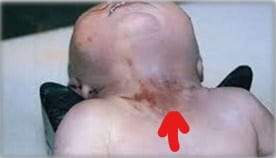
Marks over the neck shown in the photograph are a which type of type of iniury?

| A |
Contusion |
|
| B |
Pressure abrasion |
|
| C |
Graze abrasion |
|
| D |
Linear abrasion |
Marks over the neck shown in the photograph are a which type of type of iniury?
| A |
Contusion |
|
| B |
Pressure abrasion |
|
| C |
Graze abrasion |
|
| D |
Linear abrasion |
Ans:B.)Pressure abrasion
This is teeth bite injury
Abrasion
It is a destruction of the skin, which usually involves the superficial layers of the epidermis only.
Types : Abrasions are of four types.
- Scratches
- A scratch (linear abrasion) is an abrasion with length but no significant width, or a very superficial incision, depending on the agent.
- They are caused by a sharp or pointed object, not sharp enough to incise, but pointed enough to scratch.
- Grazes (sliding, scraping or grinding abrasions)
- They are the most common type. They occur when there is movement between the skin and some rough surface in contact with it. They show uneven, longitudinal parallel lines (grooves or furrows) with the epithelium heaped up at the ends of these lines, which indicate the direction in which the force was applied.
- These abrasions are commonly seen in a road accident.
- Pressure abrasions (crushing or friction abrasions)
- They are caused by crushing of the superficial layers of the epidermis and are associated with a bruise of the surrounding area.
- The ligature mark in cases of hanging and strangulation and the teethbite marks are the examples.
- Impact abrasions (contact or imprint abrasions)
- They are caused by impact with a rough object, when the force is applied at or near a right angle to the skin surface. The abrasion is slightly depressed below the surface
- When a person is knocked down by a motor car, the pattern of the radiator grille, a headlamp rim or the tread of the tyre may be seen on the skin, which may contain road dirt, paint flakes, grease, etc
- Impact abrasions and pressure abrasions reproduce the pattern of the object causing it and are called patterned abrasions.
Identify the type of injury shown in the photograph below ?

| A |
Graze abrasion. |
|
| B |
Imprint abrasion. |
|
| C |
Electric burn. |
|
| D |
Arborescent burn. |
Identify the type of injury shown in the photograph below ?
| A |
Graze abrasion. |
|
| B |
Imprint abrasion. |
|
| C |
Electric burn. |
|
| D |
Arborescent burn. |
Ans:A.)Graze Abrasion.
Abrasion
- A wound consisting of superficial damage to the skin.
- Types:
- Scratch abrasion
- Synonym: linear abrasion
- Sharp or pointed object not sharp enough to cause incised wound, but pointed enough to scratch
- E.g. thorn, fingernails, tip of knife
- Clean area at the start of the wound and tags at the end
- Helps in determining the direction of force
- Graze abrasion
- Synonyms: grinding or sliding abrasions, brush burns
- Most common type – Commonly seen in road traffic accidents
- Occurs when the skin is rubbed (friction) against some rough surface
- Uneven, longitudinal parallel lines of abrasion are seen
- Epithelium heaped up at the end of these lines which indicates the direction of force
- Pressure abrasion
- Synonym: crushing abrasion
- Sustained pressure of a rough object at 90° – crushing of the superficial layers of the skin
- No force on impact, but sustained pressure after the object comes in contact with body surface
- E.g. Ligature mark in hanging and strangulation
- Impact abrasions
- Synonym: Contact abrasion or Imprint abrasion
- There is a moment of forceful impact, after that no contact of the object with body
- E.g: radiator grill mark, tyre tread marks seen in RTA
- Impact abrasions and Pressure abrasions – Patterned abrasions (as the pattern of the object causing the abrasion is reproduced on the body surface)
In the picture shown below, ligature mark is an example of ?
| A |
Contusion. |
|
| B |
Pressure abrasion. |
|
| C |
Laceration. |
|
| D |
Burn. |
In the picture shown below, ligature mark is an example of ?
| A |
Contusion. |
|
| B |
Pressure abrasion. |
|
| C |
Laceration. |
|
| D |
Burn. |
e.g. Ligature mark in hanging and strangulation and teeth marks.
In a condition as shown in the picture below, ligature marks are example of ?

| A |
Contussion. |
|
| B |
Printed abrasion. |
|
| C |
Laceration. |
|
| D |
Bruise. |
In a condition as shown in the picture below, ligature marks are example of ?
| A |
Contussion. |
|
| B |
Printed abrasion. |
|
| C |
Laceration. |
|
| D |
Bruise. |
Ans:B.)Printed Abrasion.
In a case of hanging neck ligature marks are example of printed abrasion.
Abrasion
- A wound consisting of superficial damage to the skin.
- Scratch abrasion
- Synonym: linear abrasion
- Sharp or pointed object not sharp enough to cause incised wound, but pointed enough to scratch
- E.g. thorn, fingernails, tip of knife
- Clean area at the start of the wound and tags at the end
- Helps in determining the direction of force
- Graze abrasion
- Synonyms: grinding or sliding abrasions, brush burns
- Most common type – Commonly seen in road traffic accidents
- Occurs when the skin is rubbed (friction) against some rough surface
- Uneven, longitudinal parallel lines of abrasion are seen
- Epithelium heaped up at the end of these lines which indicates the direction of force
- Pressure abrasion
- Synonym: crushing abrasion
- Sustained pressure of a rough object at 90° – crushing of the superficial layers of the skin
- No force on impact, but sustained pressure after the object comes in contact with body surface
- E.g. Ligature mark in hanging and strangulation
- Impact abrasions
- Synonym: Contact abrasion or Imprint abrasion
- There is a moment of forceful impact, after that no contact of the object with body
- E.g: radiator grill mark, tyre tread marks seen in RTA
- Impact abrasions and Pressure abrasions – Patterned abrasions (as the pattern of the object causing the abrasion is reproduced on the body surface)
Graze is a type of ‑
| A |
Bruise |
|
| B |
Contusion |
|
| C |
Laceration |
|
| D |
Abrasion |
Graze is a type of ‑
| A |
Bruise |
|
| B |
Contusion |
|
| C |
Laceration |
|
| D |
Abrasion |
Ans. is ‘d’ i.e., Abrasion
Abrasion
- It is a destruction of the skin, which involves the superficial layers of the epidermis only. They are of 4 types:
- Scratches- its a abrasion with length but no significant width or a a very superficial incision.
- Grazes-most common. They occur when there is movement between the skin and some rough surface in contact with it.
- Pressure or friction abrasion- they are caused by crushing of the superficial layers of the epidermis and are associated with a bruise of the surrounding area.
- Impact or contact abrasion- they are caused by impact with a rough object, when the force is applied at or near a right angle to the skin surface.
- Patterned abrasion- impact abrasion and pressure abrasion reproduce the pattern of the object causing it and are called Patterned abrasion.