

AGGLUTINATION
| A | Rose-wallers test | |
| B | Widal’s test | |
| C | Brucella agglutination test | |
| D | Paul Bunnel’s along with HLA Class-I stimulate |
| A | Rose-wallers test | |
| B | Widal’s test | |
| C | Brucella agglutination test | |
| D | Paul Bunnel’s along with HLA Class-I stimulate |
- In infectious mononucleosis, the patient exhibits- Atypical lymphocytes in the circulating blood.
– Antibodies to the EB Virus.
– Increased heterophile antibody titre.
- The normal titre of agglutinins and hemolysins in human blood against sheep red blood cells does not exceed 1:8, but in infectious mononucleosis the titre may rise to 1:4096.
- This is referred to as positive Paul Bunnel test and is both characteristic and pathognomic of the disease.
| A | Passive hemagglutination test | |
| B | Hemagglutination inhibition test | |
| C | Nephelometry | |
| D | Direct coombs test |
| A | Passive hemagglutination test | |
| B | Hemagglutination inhibition test | |
| C | Nephelometry | |
| D | Direct coombs test |
The direct version of the Coombs test would be performed to determine if the infant has maternal IgG (anti-Rh) already bound to the erythrocytes in the cord Blood. IgG antibodies are relatively small. When they coat large particles or cells, such as erythrocytes, they do not readily agglutinate them. In the direct Coombs test, anti- immunoglobulin (antibody against the Fc region of human IgG) is directly added to the infant’s erythrocytes. The anti-immunoglobulin (also known as Coombs reagent) spans the distance between cells to form an agglutinating lattice that can be visualized in the test tube.
| A | Precipitation | |
| B | Agglutination | |
| C | CFT | |
| D | Immunoasay |
| A | Precipitation | |
| B | Agglutination | |
| C | CFT | |
| D | Immunoasay |
Agglutination
| A | CSF Pressure | |
| B | Limulus assay | |
| C | Latex agglutination | |
| D | CSF analysis for Lymphocytes |
| A | CSF Pressure | |
| B | Limulus assay | |
| C | Latex agglutination | |
| D | CSF analysis for Lymphocytes |
Latex agglutination
Widal test is an example of Test.
| A | Flocculation | |
| B | Agglutination | |
| C | Both | |
| D | None of the above |
Widal test is an example of Test.
| A | Flocculation | |
| B | Agglutination | |
| C | Both | |
| D | None of the above |
Agglutination
Coombs test is –
| A |
Precipitation test |
|
| B |
Agglutination test |
|
| C |
Neutrilization test |
|
| D |
All |
Coombs test is –
| A |
Precipitation test |
|
| B |
Agglutination test |
|
| C |
Neutrilization test |
|
| D |
All |
Ans. is ‘b’ i.e., Agglutination test
Which is not a heterophile agglutination test ‑
| A |
Weil Felix test |
|
| B |
Widal test |
|
| C |
Paul Bunnell test |
|
| D |
Streptococcus |
Which is not a heterophile agglutination test ‑
| A |
Weil Felix test |
|
| B |
Widal test |
|
| C |
Paul Bunnell test |
|
| D |
Streptococcus |
Ans. is ‘b’ i.e., Widal test
Heterophilic agglutination reaction
. Some organisms of different class or species share closely related antigens.
. When serum containing agglutinin (antibody) of one organism gives agglutination reaction with antigen of other organism, it is called heterophilic agglutination test.
Examples are
. Streptococcus M.G. agglutination test for primary atypical pneumonia.
. Weil – Felix reaction for typhus fever
. Paul Bunnell test fin- IMN.
VDRL is an example of –
| A |
Slide agglutination |
|
| B |
Tube agglutination |
|
| C |
Slide flocculation |
|
| D |
Tube flocculation |
VDRL is an example of –
| A |
Slide agglutination |
|
| B |
Tube agglutination |
|
| C |
Slide flocculation |
|
| D |
Tube flocculation |
Ans. is ‘c’ i.e., Slide flocculation
Which of the following is agglutination test –
| A |
Widal test |
|
| B |
VDRL |
|
| C |
Ascoli’s test |
|
| D |
Kahn test |
Which of the following is agglutination test –
| A |
Widal test |
|
| B |
VDRL |
|
| C |
Ascoli’s test |
|
| D |
Kahn test |
Ans. is ‘a’ i.e., Widal test
. Widal test is a tube agglutination test.
. Other three options are precipitation tests.
Paul bunnel reaction is a type of
| A |
Agglutination |
|
| B |
CF |
|
| C |
Precipitation |
|
| D |
Flocculation test |
Paul bunnel reaction is a type of
| A |
Agglutination |
|
| B |
CF |
|
| C |
Precipitation |
|
| D |
Flocculation test |
Ans. is ‘a’ i.e., Agglutination test
- Paul Bunnell test is tube agglutination test.
Correct statement about widal test –
| A |
Only 0 antigen is used |
|
| B |
Is a tube agglutination test |
|
| C |
Any antibody titre is diagnostic |
|
| D |
Antibody appears after 1-10 days of fever |
Correct statement about widal test –
| A |
Only 0 antigen is used |
|
| B |
Is a tube agglutination test |
|
| C |
Any antibody titre is diagnostic |
|
| D |
Antibody appears after 1-10 days of fever |
Ans. is ‘b’ i.e., Is a tube agglutination test
True regarding agglutination reaction are all except:
September 2007
| A |
It is less sensitive than precipitation reaction for detecting antibodies. |
|
| B |
Works on the same principle as that of precipitation reaction |
|
| C |
It is the method used for cross matching and blood grouping |
|
| D |
Agglutination occurs optimally when antigens and antibody react in equivalent proportions. |
True regarding agglutination reaction are all except:
September 2007
| A |
It is less sensitive than precipitation reaction for detecting antibodies. |
|
| B |
Works on the same principle as that of precipitation reaction |
|
| C |
It is the method used for cross matching and blood grouping |
|
| D |
Agglutination occurs optimally when antigens and antibody react in equivalent proportions. |
Ans. A: It is less sensitive than precipitation reaction for detecting antibodies
Agglutination is a two-step reaction. Same principles governs agglutination and precipitation, but agglutination reaction is more sensitive than precipitation reaction for detecting antibodies.
The primary reaction is the binding of the Fab portion of antibody to antigenic determinants on the particulate antigen. The secondary reaction is the result of the cross-linking by multivalent antibodies, of the particles of multivalent antigen to form aggregates.
The foregoing two-component system can in certain instances be enhanced by the addition of a third component, complement (C’). This is exemplified by the reaction of immune hemolysis, in which the antibody “sensitizes” erythrocytes which are then lysed by complement.
The most obvious clinical application of agglutination is blood-typing; erythrocyte blood group surface antigens (e.g., the ABO blood group factors) react with antibody that is specific for these allo-antigens to produce agglutination. The cross- matching of blood depends upon this technique.
The surface antigens of bacteria also react with appropriate antibodies to produce agglutination. A patient’s serum can be tested for the presence of antibody to known antigens of certain bacteria (e.g., Salmonella typhi), giving diagnostically significant information.
All are true about Method used in Hematology shown in Photograph except
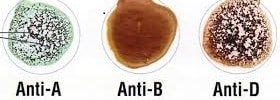
| A |
Not mandatory in emergency |
|
| B |
Donor serum tested against recipient packed cell |
|
| C |
Recipient serum tested against donor packed cell |
|
| D |
Involves visible agglutination |
All are true about Method used in Hematology shown in Photograph except
| A |
Not mandatory in emergency |
|
| B |
Donor serum tested against recipient packed cell |
|
| C |
Recipient serum tested against donor packed cell |
|
| D |
Involves visible agglutination |
Ans B is Donor serum tested against recipient packed cells
(Method shown: cross matching of blood groups)
Cross-matching (or crossmatching) blood, in transfusion medicine, refers to the test that is performed prior to a blood transfusion in order to determine if the donor’s blood is compatible with theblood of an intended recipient

