
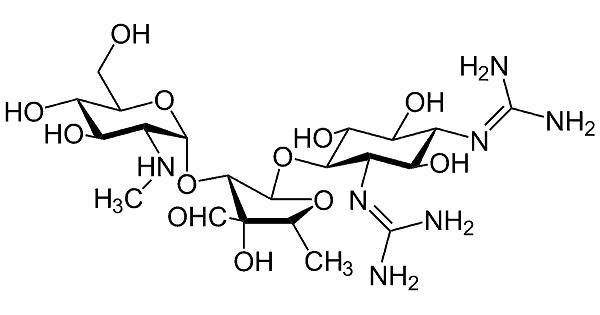
Aminoglycoside
| A | Aminoglycoside | |
| B | Penicillin | |
| C | Erythromycin | |
| D | Ampicillin |
| A | Aminoglycoside | |
| B | Penicillin | |
| C | Erythromycin | |
| D | Ampicillin |
Aminoglycosides cause non-oliguric renal failure. Penicillin causes proliferative glomerulonephritis with vasculitis. Ampicillin causes interstitial nephritis.
A 55 year old patient with disseminated tuberculosis is prescribed drugs. Which of the following might be seen in patient of TB, who has regularly been injecting intramuscular injection of streptomycin:
| A | Blindness | |
| B | Increased AST levels | |
| C | Impotence | |
| D | Deafness |
A 55 year old patient with disseminated tuberculosis is prescribed drugs. Which of the following might be seen in patient of TB, who has regularly been injecting intramuscular injection of streptomycin:
| A | Blindness | |
| B | Increased AST levels | |
| C | Impotence | |
| D | Deafness |
Deafness
| A | Penicillin | |
| B | Gentamycin | |
| C | Ciprofloxacin | |
| D | Amoxycillin |
| A | Penicillin | |
| B | Gentamycin | |
| C | Ciprofloxacin | |
| D | Amoxycillin |
Gentamycin
Which one of the following antibacterials should not be used with d-tubocurarine?
| A |
Norfloxacin |
|
| B |
Doxycycline |
|
| C |
Cefotaxime |
|
| D |
Streptomycin |
Which one of the following antibacterials should not be used with d-tubocurarine?
| A |
Norfloxacin |
|
| B |
Doxycycline |
|
| C |
Cefotaxime |
|
| D |
Streptomycin |
Use of Streptomycin along with competitive non depolarizing blockers like d-tubocurarine can potentiate its action and produce prolonged apnea.
It acts by reducing the release of acetylcholine from the prejunctional nerve endings by competing with calcium.
Therefore streptomycin should not be used with d-tubocurarine.
All of the following factors increase the risk of aminoglycoside renal toxicity, except:
| A |
Elderly person |
|
| B |
Hypokalemia |
|
| C |
Simultaneous use with penicillin |
|
| D |
Aminoglycoside administration in recent past |
All of the following factors increase the risk of aminoglycoside renal toxicity, except:
| A |
Elderly person |
|
| B |
Hypokalemia |
|
| C |
Simultaneous use with penicillin |
|
| D |
Aminoglycoside administration in recent past |
Administration of penicillin along with aminoglycoside does not increase the risk of aminoglycoside renal toxicity.
Aminoglycosides are highly effective against gram negative bacteria whereas penicillins are effective against gram positive bacteria.
Penicillins also increase the bactericidal activity of aminoglycosides.
Combination of penicillins/cephalosporins and aminoglycosides is the treatment of choice for pseudomonas infections.
Ref: The Spinal Cord Injured Patient By Bok Y. Lee, 2nd Edition, Page 82
A person on anti-tubercular drugs complained of deafness and tinnitus in one ear. Which of the following is the causative agent?
| A |
Streptomycin |
|
| B |
Isoniazid |
|
| C |
Ethambutol |
|
| D |
Rifampicin |
A person on anti-tubercular drugs complained of deafness and tinnitus in one ear. Which of the following is the causative agent?
| A |
Streptomycin |
|
| B |
Isoniazid |
|
| C |
Ethambutol |
|
| D |
Rifampicin |
Streptomycin is a tuberculocidal drug which is less effective than isoziazid or rifampicin. It is less commonly used as an antitubercular drug due to potential for nephrotoxicity and ototoxicity. It acts only on extracellular bacilli. It penetrates the tubercular cavities, but do not cross the CSF and has poor action in acidic medium.
Common side effects of anti tubercular drugs:
- Isoniazid: Peripheral neuritis, hepatitis.
- Rifampin: Hepatitis, respiratory syndrome, cutaneous syndrome, flu syndrome, orange red colured body secretions.
- Pyrazinamide: Hepatotoxicity, arthralgia, flushing, loss of diabetes control.
- Ethambutol: Loss of colour vision or visual acuity, hyperuricemia.
Which of the following is associated with Non oliguric renal failure?
| A |
Aminoglycoside toxicity |
|
| B |
Hypovolemia |
|
| C |
NSAIDS |
|
| D |
Post streptococcal glomerulonephritis |
Which of the following is associated with Non oliguric renal failure?
| A |
Aminoglycoside toxicity |
|
| B |
Hypovolemia |
|
| C |
NSAIDS |
|
| D |
Post streptococcal glomerulonephritis |
Nonoliguric AKI (i.e. Without a significant reduction in urine volume) accompanies 10-30% of courses of aminoglycoside antibiotics, even when plasma levels are in the therapeutic range. Aminoglycosides are freely filtered across the glomerulus and then accumulate within the renal cortex, where concentrations can greatly exceed those of the plasma. AKI typically manifests after 5-7 days of therapy and can present even after the drug has been discontinued. Hypomagnesemia is a common finding.
Which of the following organisms, when isolated in the blood, requires the synergistic activity of penicillin plus an aminoglycoside for appropriate therapy-
| A |
Enterococcus faecalis |
|
| B |
Staphylococcus aureus |
|
| C |
Str. pneumoniae |
|
| D |
Bacteroides fragilis |
Which of the following organisms, when isolated in the blood, requires the synergistic activity of penicillin plus an aminoglycoside for appropriate therapy-
| A |
Enterococcus faecalis |
|
| B |
Staphylococcus aureus |
|
| C |
Str. pneumoniae |
|
| D |
Bacteroides fragilis |
Ans. is ‘a’ i.e., Enterococcus faecalis
“Unlike streptococci, enterococci are not reliably killed by penicillin or ampicillin alone. Because of synergistic action of Penicillin and aminoglycoside against enterococci combination therapy is recommended “.
Which of the following drug(s) is/are used in treatment in plague –
| A |
Streptomycin |
|
| B |
Tetracycline |
|
| C |
Ciprofloxacin |
|
| D |
a and b |
Which of the following drug(s) is/are used in treatment in plague –
| A |
Streptomycin |
|
| B |
Tetracycline |
|
| C |
Ciprofloxacin |
|
| D |
a and b |
Ans. is ‘a’ i.e., Streptomycin; ‘b’ i.e., Tetracycline
|
Drugs used in plague |
||
|
For treatment |
|
For prophylaxis |
|
First line • Streptomycin |
• |
Tetracycline |
|
• Gentamycin |
• |
Doxycycline |
|
• Tetracycline |
• |
Cotrimoxazole |
|
• Doxycycline |
• |
Ciprofloracin |
|
• Chloramphenicol |
|
|
|
Other |
|
|
|
• Cotrimoxazole |
|
|
Treatment of Brucellosis –
| A |
Doxycycline |
|
| B |
Streptomycin |
|
| C |
Erythromycin |
|
| D |
a and b |
Treatment of Brucellosis –
| A |
Doxycycline |
|
| B |
Streptomycin |
|
| C |
Erythromycin |
|
| D |
a and b |
Ans. is ‘a’ i.e., Doxycycline; ‘b’ i.e., Streptomycin
Which of the following protein synthesis inhibitor are non‑plant toxin:
| A |
Streptomycin |
|
| B |
Abrin |
|
| C |
Ricin |
|
| D |
Emetine |
Which of the following protein synthesis inhibitor are non‑plant toxin:
| A |
Streptomycin |
|
| B |
Abrin |
|
| C |
Ricin |
|
| D |
Emetine |
A i.e. Streptomycin
Streptomycin single dose is more effective than multiple small doses because it is –
| A |
Concentration dependent lytic effect |
|
| B |
Longer half life |
|
| C |
Not dependent on renal clearance |
|
| D |
Tubular secretion and reabsorption is more |
Streptomycin single dose is more effective than multiple small doses because it is –
| A |
Concentration dependent lytic effect |
|
| B |
Longer half life |
|
| C |
Not dependent on renal clearance |
|
| D |
Tubular secretion and reabsorption is more |
Ans. is `a’ i.e., Concentration dependent lytic effect
Concentration dependent effect
o The outcome is related to the peak antibiotic concentration achieved at the site of infection in relation to the minimum inhibitory concentration.
o The killing effect of a drug is high when ratio of peak concentration to MIC is more.
o These drugs produce a prolonged inhibitory effect on bacterial multiplication (post antibiotic effect) which suppresses growth until the next dose is given.
o So, these drugs produce better action when used as a large single dose as compared to same daily dose divided into 2-3 times.
o Example – Aminoglycosides, quinolones.
Time-dependent effect
o Concentration should be kept above the MIC for a high proportion of the time between each dose, i.e. action depends on the length of time the concentration remains above the MIC.
o Examples are —> Macrolides & fi-lactams.
Which of the following drugs require dose adjustment in renal failure –
| A |
Cefoperazone |
|
| B |
Doxycycline |
|
| C |
Streptomycin |
|
| D |
Rifampicin |
Which of the following drugs require dose adjustment in renal failure –
| A |
Cefoperazone |
|
| B |
Doxycycline |
|
| C |
Streptomycin |
|
| D |
Rifampicin |
Ans. is ‘c’ i.e., Streptomycin
In treatment of pseudomonas infections, carbenicillin is frequently combined with –
| A |
Penicillin |
|
| B |
Gentamycin |
|
| C |
Ciprofloxacin |
|
| D |
Amoxycillin |
In treatment of pseudomonas infections, carbenicillin is frequently combined with –
| A |
Penicillin |
|
| B |
Gentamycin |
|
| C |
Ciprofloxacin |
|
| D |
Amoxycillin |
Ans. is ‘b’ i.e., Gentamycin
o For most of the infection of pseudomonas, treatment of choice is the combination of an antipseudomonal t3-lactam and an aminoglycoside.
Streptomycin is a?
| A |
Peptide |
|
| B |
Gycoside |
|
| C |
Phospholipid |
|
| D |
Glycolipid |
Streptomycin is a?
| A |
Peptide |
|
| B |
Gycoside |
|
| C |
Phospholipid |
|
| D |
Glycolipid |
Ans. is ‘b’ i.e., Gycoside
o Streptomycin is an amino-glycoside i.e. amino group is linked to aminosugar by glycoside bond.
Mechanism of action of streptomycin-
| A |
Inhibition of translation |
|
| B |
Inhibition of signal transduction |
|
| C |
Inhibition of citric acid cycle |
|
| D |
Inhibits mitochondria |
Mechanism of action of streptomycin-
| A |
Inhibition of translation |
|
| B |
Inhibition of signal transduction |
|
| C |
Inhibition of citric acid cycle |
|
| D |
Inhibits mitochondria |
Ans. is ‘a’ i.e., Inhibition of translation
o Streptomycin inhibit protein synthesis (translation).
Mechanism of action of aminoglycosides is ‑
| A |
Inhibition of protein synthesis |
|
| B |
Damage to cell membrane |
|
| C |
Coagulation of proteins |
|
| D |
Inhibition of cell wall synthesis |
Mechanism of action of aminoglycosides is ‑
| A |
Inhibition of protein synthesis |
|
| B |
Damage to cell membrane |
|
| C |
Coagulation of proteins |
|
| D |
Inhibition of cell wall synthesis |
Ans. is ‘a’ i.e., Inhibition of protein synthesis
Which of the following aminoglycosides is not available for parenteral use?
| A |
Sisomycin |
|
| B |
Amikacin |
|
| C |
Framycetin |
|
| D |
Gentamycin |
Which of the following aminoglycosides is not available for parenteral use?
| A |
Sisomycin |
|
| B |
Amikacin |
|
| C |
Framycetin |
|
| D |
Gentamycin |
Ans. is ‘c’ i.e., Framycetin
o Systemic aminoglycosides – Streptomycin, Amikacin, Gentamycin, Sisomicin, Kanamycin, Netilmicin.
o Topical aminoglycosides – Neomycin, Framycetin.
An aminoglycoside with an outstanding feature of being little or not affected by majority of inacti vating enzymes is-
| A |
Gentamycin |
|
| B |
Tobramycin |
|
| C |
Amikacin |
|
| D |
Sisomycin |
An aminoglycoside with an outstanding feature of being little or not affected by majority of inacti vating enzymes is-
| A |
Gentamycin |
|
| B |
Tobramycin |
|
| C |
Amikacin |
|
| D |
Sisomycin |
Ans. is ‘c’ i.e., Amikacin
Amikacin has widest spectrum of activity amongst aminoglycosides as it has resistance to bacterial aminoglycoside inactivating enzymes.
Which of the following drugs is most effective against an organism producing aminoglycoside inactivating enzymes?
| A |
Tobramycin |
|
| B |
Gentamicin |
|
| C |
Amikacin |
|
| D |
Streptomycin |
Which of the following drugs is most effective against an organism producing aminoglycoside inactivating enzymes?
| A |
Tobramycin |
|
| B |
Gentamicin |
|
| C |
Amikacin |
|
| D |
Streptomycin |
Ans. is ‘c’ i.e., Amikacin
Widest spectrum aminoglycoside is –
| A |
Streptomycin |
|
| B |
Amikacin |
|
| C |
Framycetin |
|
| D |
Netilmicin |
Widest spectrum aminoglycoside is –
| A |
Streptomycin |
|
| B |
Amikacin |
|
| C |
Framycetin |
|
| D |
Netilmicin |
Ans. is ‘b’ i.e., Amikacin
Aminoglycoside class of drugs causes hearing loss by damaging?
| A |
Inner hair cells of basal turn |
|
| B |
Outer hair cells of basal turn |
|
| C |
Inner hair cells of apical turn |
|
| D |
Outer hair cells of apical turn |
Aminoglycoside class of drugs causes hearing loss by damaging?
| A |
Inner hair cells of basal turn |
|
| B |
Outer hair cells of basal turn |
|
| C |
Inner hair cells of apical turn |
|
| D |
Outer hair cells of apical turn |
Ans. is ‘b’ i.e., Outer hair cells of basal turn
o Aminoglycosides affect exclusively outer hair cells, particularly of basal coil of cochlea.
Which of the following is a side effect of streptomycin?
| A |
Phototoxicity |
|
| B |
Hepatotoxicity |
|
| C |
Ototoxicity |
|
| D |
All of the above |
Which of the following is a side effect of streptomycin?
| A |
Phototoxicity |
|
| B |
Hepatotoxicity |
|
| C |
Ototoxicity |
|
| D |
All of the above |
Ans. is ‘c’ i.e., Ototoxicity
True about aminoglycoside are all except ‑
| A |
Are bacteriostatic |
|
| B |
Distributed only extracellularly |
|
| C |
Excreted unchanged in urine |
|
| D |
Teratogenic |
True about aminoglycoside are all except ‑
| A |
Are bacteriostatic |
|
| B |
Distributed only extracellularly |
|
| C |
Excreted unchanged in urine |
|
| D |
Teratogenic |
Ans. is ‘a’ i.e., are bacteriostatic
o Aminoglycosides are bactericidal antibiotics.
o They are distributed only extracellularly so the volume of distribution is nearly equal to the extracellular fluid volume. o They are not metabolized, they are excreted unchanged in urine.
o Aminoglycosides (streptomycin) should be avoided during pregnancy as they are teratogenic.
Highly vestibulotoxic drug is?
| A |
Cisplatin |
|
| B |
Streptomycin |
|
| C |
Cotrimoxazole |
|
| D |
Quinine |
Highly vestibulotoxic drug is?
| A |
Cisplatin |
|
| B |
Streptomycin |
|
| C |
Cotrimoxazole |
|
| D |
Quinine |
Ans. is ‘b’ i.e., Streptomycin
“Streptomycin is one of the most vestibulotoxic drug”.
Neurological transmission is affected by ‑
| A |
Sulfonamides |
|
| B |
Nitrofurantoin |
|
| C |
INH |
|
| D |
Streptomycin |
Neurological transmission is affected by ‑
| A |
Sulfonamides |
|
| B |
Nitrofurantoin |
|
| C |
INH |
|
| D |
Streptomycin |
Ans. is ‘d’ i.e., Streptomycin
o All aminoglycosides reduce Ach release from the motor nerve endings. They interfere with mobilization of centrally located synaptic vesicles to fuse with the terminal membrane (probably by antagonizing Ca2+) as well as decrease the sensitivity of the muscle end plates to Ach.
A person on anti-tubercular drugs complained of deafness and tinnitus in one ear. Drug implicated is?
| A |
Streptomycin |
|
| B |
Isoniazid |
|
| C |
Ethambutol |
|
| D |
Rifampicin |
A person on anti-tubercular drugs complained of deafness and tinnitus in one ear. Drug implicated is?
| A |
Streptomycin |
|
| B |
Isoniazid |
|
| C |
Ethambutol |
|
| D |
Rifampicin |
Ans. is ‘a’ i.e., Streptomycin
o Amongst the first line antitubercular drugs, streptomycin causes ototoxicity.
A 30 year old pregnant woman devolopes tuberculosis. Which of the following antitubercular drugs should not be used –
| A |
INH |
|
| B |
Rifampicin |
|
| C |
Streptomycin |
|
| D |
Ethambutol |
A 30 year old pregnant woman devolopes tuberculosis. Which of the following antitubercular drugs should not be used –
| A |
INH |
|
| B |
Rifampicin |
|
| C |
Streptomycin |
|
| D |
Ethambutol |
Ans. is ‘c’ i.e., Streptomycin
o Streptomycin is an aminoglycoside antibiotic contraindicated in pregnancy due to risk of fetal ototoxicity. o Recommended treatment in pregnancy is (2HRZ + 4HR) for 6 months by WHO and British Thoracic Society. o Ethambutol can be added during late but not early pregnancy.
o In India, treatment for pregnant women is 2HRE + 7 HR (Total 9 months).
First line ATT in children –
| A |
Streptomycin |
|
| B |
Pyrazinamide |
|
| C |
Ethionamide |
|
| D |
a and b |
First line ATT in children –
| A |
Streptomycin |
|
| B |
Pyrazinamide |
|
| C |
Ethionamide |
|
| D |
a and b |
Ans. is ‘a’ i.e., Streptomycin; ‘b’ i.e., Pyrazinamide
Antitubercular drugs used in children
First line drugs : Isoniazid, Rifampicin, Ethambutol, Streptomycin, Pyrazinamide
Second line drugs : Cycloserine, Ethionamide, PAS, Capreomycin, Kanamycin
Other drugs : Quinolones —> Ofloxacin, Rifamycin, Amikacin, Imipenem, Ampicillin
Drugs included in ATT for children –
| A |
Streptomycin |
|
| B |
Ethionamide |
|
| C |
Ethambutol |
|
| D |
All |
Drugs included in ATT for children –
| A |
Streptomycin |
|
| B |
Ethionamide |
|
| C |
Ethambutol |
|
| D |
All |
Ans. is ‘a’ i.e., Streptomycin; ‘b’ i.e., Ethionamide; ‘c’ i.e., Ethambutol
Streptomycin is useful in treatment of
| A |
Granuloma venerum |
|
| B |
LGV |
|
| C |
Syphillis |
|
| D |
Chancroid |
Streptomycin is useful in treatment of
| A |
Granuloma venerum |
|
| B |
LGV |
|
| C |
Syphillis |
|
| D |
Chancroid |
A i.e. Granuloma venerum
Non Oliguric Acute Renal Failure is typically associated with
| A |
Aminoglycoside toxicity |
|
| B |
Contrast Induced Nephrotoxity |
|
| C |
Hemolytic Uremic syndrome |
|
| D |
Glomerulonephritis |
Non Oliguric Acute Renal Failure is typically associated with
| A |
Aminoglycoside toxicity |
|
| B |
Contrast Induced Nephrotoxity |
|
| C |
Hemolytic Uremic syndrome |
|
| D |
Glomerulonephritis |
Answer is A (Hypernatremia):
Oliguric phase of ATN is asociated with Hyponatremia and not hypernatremia
Hyponatremia results from expansion of ECF volume due to dimnished water excretion and excessive administration of free water (volume overload)
Which antitubercular drug combination is safer in a patient who develops hepatitis white on ATT:
March 2005
| A |
Streptomycin+Isoniazid |
|
| B |
Streptomycin+Ethambutol |
|
| C |
Ethambutol+Isoniazid |
|
| D |
Ethambutol+Rifampicin |
Which antitubercular drug combination is safer in a patient who develops hepatitis white on ATT:
March 2005
| A |
Streptomycin+Isoniazid |
|
| B |
Streptomycin+Ethambutol |
|
| C |
Ethambutol+Isoniazid |
|
| D |
Ethambutol+Rifampicin |
Ans. B: Streptomycin+Ethambutol
Hepatitis is a major side effect of isoniazid, pyrazinamide and rifampicin.
In case hepatitis develops, all these drugs should be stopped and S+E may be started or continued.
When the reaction clears, the above drug is added one by one to identify the culprit, which should never be used again, while the others found safe should be continued.
It is best to avoid Pyrazinamide in patients who once developed hepatitis.
What is the most serious side effect of streptomycin:
September 2005
| A |
Hepatotoxicity |
|
| B |
Ototoxicity |
|
| C |
Ocular toxicity |
|
| D |
Hematological disturbances |
What is the most serious side effect of streptomycin:
September 2005
| A |
Hepatotoxicity |
|
| B |
Ototoxicity |
|
| C |
Ocular toxicity |
|
| D |
Hematological disturbances |
Ans. B: Ototoxicity
The side effects of streptomycin include fever, hives, rashes, nausea and vomiting.
Less common side effects include paresthesia of the face (Bell’s Palsy), anaphylaxis, exfoliative dermatitis, “lazy eye,” low white blood cell count, low platelet count, muscle weakness and angioneurotic edema.
Dangerous side effects include injury to the kidneys (nephrotoxicity), and nerve damage that can result in deafness (ototoxicity).
Gentamycin is not given orally because:
September 2005
| A |
Adverse effects on gastric mucosa |
|
| B |
Interferes with absorption of other drugs |
|
| C |
Rapidly destroyed by gastric acid |
|
| D |
Poor absorption |
Gentamycin is not given orally because:
September 2005
| A |
Adverse effects on gastric mucosa |
|
| B |
Interferes with absorption of other drugs |
|
| C |
Rapidly destroyed by gastric acid |
|
| D |
Poor absorption |
Ans. D: Poor absorption
Like all aminoglycosides, when gentamicin is given orally, it is not systemically active. This is because it is not absorbed to any appreciable extent from the small intestine. It is administered intravenously, intramuscularly or topically to treat infections.
Common properties of aminoglycoside antibiotics
- Distribute extracellularly, do not penetrate brain/ CSF
- Act by interfering with bacterial protein synthesis.
- Completely eliminated unchanged in the urine by glomerular filtration.
- Narrow margin of safety.
- Bactericidal and more active at alkaline pH.
- Ototoxicity and nephrotoxic
Drug which is never given by oral route:
March 2007
| A |
Erythromycin |
|
| B |
Ciprofloxacin |
|
| C |
Streptomycin |
|
| D |
Albendazole |
Drug which is never given by oral route:
March 2007
| A |
Erythromycin |
|
| B |
Ciprofloxacin |
|
| C |
Streptomycin |
|
| D |
Albendazole |
Ans. C: Streptomycin
Streptomycin is derived from the actinobacterium Streptomyces griseus.
Streptomycin stops bacterial growth by hurting cell membranes and inhibiting protein synthesis. Specifically, it binds to the 16S rRNA of the bacterial ribosome, interfering with the binding of formyl-methionyl-tRNA to the 30S subunit. This prevents initiation of protein synthesis. Streptomycin cannot be given orally, but must be administered by regular intramuscular injection.
Uses
- Tuberculosis in combination with other anti-TB drugs. It is not the first line treatment.
- Plague (Yersinia pestis) has historically been treated with it as the first line treatment.
- Infective endocarditis caused by enterococcus when the organism is not sensitive to Gentamicin
- Tularemia
A patient has serum creatinine of 150-300 micromol/L. Which of the following require dosage reduction:
March 2011
| A |
Ampicillin |
|
| B |
Isoniazid |
|
| C |
Gentamycin |
|
| D |
Penicillin |
A patient has serum creatinine of 150-300 micromol/L. Which of the following require dosage reduction:
March 2011
| A |
Ampicillin |
|
| B |
Isoniazid |
|
| C |
Gentamycin |
|
| D |
Penicillin |
Ans. C: Gentamycin
Drugs whose dosage are affected in mild renal insufficiency (GFR 20-50 mL/ min or serum creatinine 150-300 micromol/L) are: ACE inhibitors, Aminoglycosides, chlorpropamide, digoxin, fibrates, lithium and zidovudine
Irreversible hearing loss caused by ‑
| A |
Gentamycin |
|
| B |
Clarithromycin |
|
| C |
Both of the above |
|
| D |
None of the above |
Irreversible hearing loss caused by ‑
| A |
Gentamycin |
|
| B |
Clarithromycin |
|
| C |
Both of the above |
|
| D |
None of the above |
Ans. is ‘a’ i.e., Gentamycin
- Gentamycin is the most commonly used of the aminoglycosides. It produces vestibular toxicity and irreversible hearing loss.
- Clarithromycin is known to produce reversible hearing loss.
How will you decrease aminoglycoside toxicity‑
| A |
Total dose OD |
|
| B |
Total dose BD |
|
| C |
Low dose OD |
|
| D |
Low dose BD |
How will you decrease aminoglycoside toxicity‑
| A |
Total dose OD |
|
| B |
Total dose BD |
|
| C |
Low dose OD |
|
| D |
Low dose BD |
Ans. is ‘a’ i.e., High dose OD
Authortities recommend giving a single total daily dose regime for aminoglycosides for patients with normal renal function. This is based on the following considerations:
1) Aminoglycosides exert concentration dependent bactericidal action and a long post antibiotic effect, therefore higher plasma concentrations attained after the single daily dose will be equally or more effective than the divided doses.
2) With the single daily dose the plasma concentration will remain subthreshold for ototoxicity and nephrotoxicity for a longer period each day allowing washout of the drug from the endolymph and renal cortex, thus decreasing the toxic effects.
Which AKT drug avoided in pregnancy ‑
| A |
INH |
|
| B |
Rifampicin |
|
| C |
Streptomycin |
|
| D |
Ethambutol |
Which AKT drug avoided in pregnancy ‑
| A |
INH |
|
| B |
Rifampicin |
|
| C |
Streptomycin |
|
| D |
Ethambutol |
Ans. is ‘c’ i.e., Steptomycin
- Streptomycin is an aminoglycoside antibiotic contraindicated in pregnancy due to risk of fetal ototoxicity.
- Recommended treatment in pregnancy is (2HRZ + 4HR) for 6 months by WHO and British Thoracic Society.
- Ethambutol can be added during late but not early pregnancy.
- In India, treatment for pregnant women is 21-IRE + 7 HR (Total 9 months).
Drugs causing macular toxicity when given intravitreally‑
| A |
Gentamycin |
|
| B |
Vancomycin |
|
| C |
Dexamethasone |
|
| D |
Ceftazidime |
Drugs causing macular toxicity when given intravitreally‑
| A |
Gentamycin |
|
| B |
Vancomycin |
|
| C |
Dexamethasone |
|
| D |
Ceftazidime |
Ans. is ‘a’ i.e., Gentamycin
- Intravitreal aminoglycosides (gentamycin, amikacin) are a reported cause of macular toxicity.
- Aminoglycosides induced macular toxicity is thought to be partially due to the gravity-induced settling of drugs on the macula in supine position.
- This may result in a higher concentration of drug locally at the macula.

