
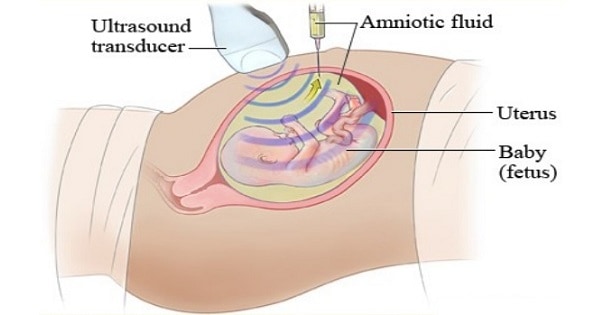
Amniocentesis
All of the following are indications for Anti D prophylaxis, EXCEPT:
| A |
Medical abortion for 63 days pregnancy |
|
| B |
Amniocentesis at 16 weeks |
|
| C |
Intrauterine transfusion at 28 weeks |
|
| D |
Manual removal of Placenta |
All of the following are indications for Anti D prophylaxis, EXCEPT:
| A |
Medical abortion for 63 days pregnancy |
|
| B |
Amniocentesis at 16 weeks |
|
| C |
Intrauterine transfusion at 28 weeks |
|
| D |
Manual removal of Placenta |
Anti D prophylaxis is not given after intrauterine transfusion. Intrauterine transfusion is done to prevent the fetus from dying.
If the hydropic fetus is too immature for early delivery, intrauterine transfusion is done.
Transfusion is done through intraperitoneal and intravascular routes.
This is performed using O-negative, cytomegalovirus negative, washed irradiated packed red cell. The volume to be transfused is roughly calculated by the formula: (weeks of gestation-20) multiplied by 10. Transfusion is repeated whenever fetal hemoglobin levels falls below 10gm/dl.
Ref: Manual of Neonatal Care By John P. Cloherty, 6th Edition, Pages 209-210 ; Textbook of Obstetrics By D.C.Dutta, 6th Edition, Page 334 ; Obstetrics and Gynaecology By Sarabatnam Arulkumaran, Page 68 ; COBGDT, 9th Edition, Page 299
Which is the MOST appropriate gestational age for performing amniocentesis?
| A |
10-12 weeks |
|
| B |
12-16 weeks |
|
| C |
20-25 weeks |
|
| D |
25-30 weeks |
Which is the MOST appropriate gestational age for performing amniocentesis?
| A |
10-12 weeks |
|
| B |
12-16 weeks |
|
| C |
20-25 weeks |
|
| D |
25-30 weeks |
Amniocentesis is ideally performed between 14-16weeks of gestation.
Early amniocentesis can be carried out at 12-14 weeks under ultrasonographic guidance.
The fetal cells so obtained are subjected for cytogenetic analysis.
Fetal fibroblasts and fluid for biochemistry are used for study.
Chorionic villus sampling : is carried out transcervically between 10 – 12 weeks and transabdominally from 10 weeks to term. Trophoblast cells are used for study.
Cordocentesis: Is done between 18-20 weeks of gestation. Fetal WBCs are used for study.
Ref: Textbook of Obstetrics By DC Dutta 6th edn page 107-8.
A 35 year old female, mother of a Down’s syndrome child, became pregnant. Amniocentesis is done to rule out Down’s syndrome in the second child. What is the appropriate time for doing amniocentesis?
| A |
4-6 |
|
| B |
8-12 |
|
| C |
12-17 |
|
| D |
20-28 |
A 35 year old female, mother of a Down’s syndrome child, became pregnant. Amniocentesis is done to rule out Down’s syndrome in the second child. What is the appropriate time for doing amniocentesis?
| A |
4-6 |
|
| B |
8-12 |
|
| C |
12-17 |
|
| D |
20-28 |
Amniocentesis generally is carried out at 15 to 17 weeks of gestation but can be offered earlier (12–14 weeks).
The underlying risk of amniocentesis when performed at 15 weeks of gestation and beyond is increased risk of miscarriage.
This risk is estimated at 1 in 200 (0.5%).
Ref: Manipalviratn S., Trivax B., Huang A. (2007). Chapter 5. Genetic Disorders & Sex Chromosome Abnormalities. In A.H. DeCherney, L. Nathan (Eds),CURRENT Diagnosis & Treatment Obstetrics & Gynecology, 10e.

DNA analysis of chorionic villus/amniocentesis is not likely to detect :
| A |
Taysach’s disease |
|
| B |
Hemophilia A |
|
| C |
Sickle cell disease |
|
| D |
Duchenne muscular dystrophy |
DNA analysis of chorionic villus/amniocentesis is not likely to detect :
| A |
Taysach’s disease |
|
| B |
Hemophilia A |
|
| C |
Sickle cell disease |
|
| D |
Duchenne muscular dystrophy |
Ans. is a i.e. Tay sachs disease
In chorionic villous biopsy, trophoblastic tissue is obtained from the chorionic villi. followed by biochemical or molecular (DNA) analysis of this tissue to diagnose various conditions.
Diagnostic chorionic villous biopsy
Conditions which require molecular or DNA analysis Conditions which require biochemical analysis
- Hemoglobinopathies tsickle cell disease) • Tay Sacn s disease
- Cystic fibrosis • Neimen pick disease
- Duchenne’s or Berkers muscular dystrophy • Gaucher’s disease
- Hemophilia A & B • Urea cycle defects
- Down syndrome • Amino acid disorder
- Congenital adrenal hyperplasia • Congenital adrenal hyperplasia
Thus for diagnosis of Tay Sach’s disease biochemical analysis of chorionic villous sample is done (not DNA analysis).
Note : Congenital adrenal hyperplasia can be diagnosed both by biochemical testing and DNA analysis.
A case of 35 week pregnancy with Hydramnios and marked respiratory distress is best treated by:
| A |
Intravenous frusemide |
|
| B |
Saline infusion |
|
| C |
Amniocentesis |
|
| D |
Artificial rupture of membranes |
A case of 35 week pregnancy with Hydramnios and marked respiratory distress is best treated by:
| A |
Intravenous frusemide |
|
| B |
Saline infusion |
|
| C |
Amniocentesis |
|
| D |
Artificial rupture of membranes |
Ans. is c i.e. Amniocentesis
The patient in the question has marked respiratory distress (i.e. it is a severe polyhydramnios and requires treatment) and gestational age is 35 weeks (i.e., fetal maturity is not yet achieved).
So our aim should be to relieve the distress of patient in hope of continuing the pregnancy till atleast 37 weeks.
Amniocentesis :
- The main aim of amniocentesis is to relieve maternal distress with the added advantage that lung maturity of fetus can be predicted by Lecithin / Sphingomyelin ratio in the expressed fluid.
- Slow decompression is done at the rate of 500 ml / hr.
- Maximum fluid removed is 1.5 — 2 litres.
Use of Indomethacin
|
Principle Dose Disadvantage : |
It decreases fetal urine production leading to amelioration of symptoms. 1.5 – 3 mg / kg / day It causes premature closure of fetal ductus arteriosus therefore, should not be used beyond 32 weeks of gestation (This option is not given, but even if it was given we could not have used it as gestational age given is 35 weeks). |
Neural tube defect is best detected by
| A |
USG |
|
| B |
Chromosomal analysis |
|
| C |
Amniocentesis |
|
| D |
Placentography |
Neural tube defect is best detected by
| A |
USG |
|
| B |
Chromosomal analysis |
|
| C |
Amniocentesis |
|
| D |
Placentography |
C i.e. Amniocentesis
Amniocentesis is early pregnancy for genetic disorders is a kind of –
| A |
Primordial prevention |
|
| B |
Primary prevention |
|
| C |
Secondary prevention |
|
| D |
Tertiary prevention |
Amniocentesis is early pregnancy for genetic disorders is a kind of –
| A |
Primordial prevention |
|
| B |
Primary prevention |
|
| C |
Secondary prevention |
|
| D |
Tertiary prevention |
Ans. is ‘c’ i.e., Secondary prevention
A 35 year old female with a previous history of birth of a child with Down’s syndrome, presents with 18 weeks Amenorrhoea. The Investigation of choice rule out Down’s syndrome in the present pregnancy is:
| A |
Triple test |
|
| B |
Amniocentesis |
|
| C |
Cordocentesis |
|
| D |
Chorionic villous biopsy |
The Answer is B (Amniocentesis) :
At 18 weeks of pregnancy the best confirmatory test available is amniocentesis
‘Triple test only gives a risk ratio. For confirmation of diagnosis, amniocentesis has to be done’ – Dutta

