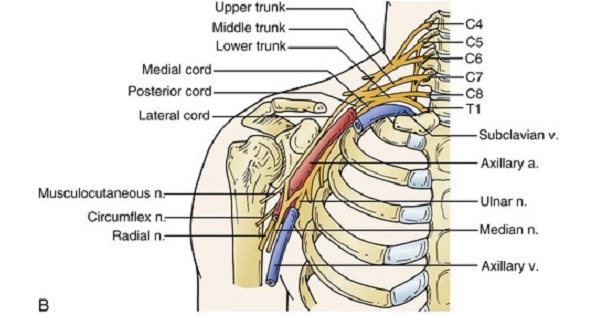
AXILLARY ARTERY
Axillary artery occlusion affects all EXCEPT:
| A |
Post circumflex humeral. |
|
| B |
Suprascapular artery |
|
| C |
Subscapular artery |
|
| D |
Superior thoracic artery |
Axillary artery occlusion affects all EXCEPT:
| A |
Post circumflex humeral. |
|
| B |
Suprascapular artery |
|
| C |
Subscapular artery |
|
| D |
Superior thoracic artery |
Suprascapular artery
“Suprascapular artery is a branch of thyrocervical trunk of the subclavian artery, not axillary artery”
Branches of axillary artery:
The branches of the axillary artery are superior thoracic, thoraco-acromial, lateral thoracic, subscapular, anterior and posterior circumflex humeral. The Suprascapular artery usually arises from the thyrocervical trunk of the subclavian artery
Cord of brachial plexus are named as per their relation with the axillary artery behind which muscle?
| A |
Deltoid |
|
| B |
Subclavius |
|
| C |
Teres major |
|
| D |
Pectoralis minor |
Cord of brachial plexus are named as per their relation with the axillary artery behind which muscle?
| A |
Deltoid |
|
| B |
Subclavius |
|
| C |
Teres major |
|
| D |
Pectoralis minor |
Pectoralis minor crosses in front of axillary artery and divides it into three parts. The anterior relation of each part are; First part lies behing the pectoralis major muscle, second part lies behind the pectoralis minor and major muscle and third part lies behind pectoralis major.
The cords of brachial plexus are named according to their relation with the second part of axillary artery, lateral cord runs lateral to the axillary artery, as well the medial and posterior cord lies medially and posterior to the axillary artery. Thus the muscle anteriorly to second part is pectoralis minor and major.
Which of the following is least likely to be involved in a collateral anastomosis which bypasses an obstruction of the first part of the axillary artery?
| A |
Suprascapular artery |
|
| B |
Subscapular Artery |
|
| C |
Dorsalscapular Artery |
|
| D |
Posterior humeral circumflex artery |
Which of the following is least likely to be involved in a collateral anastomosis which bypasses an obstruction of the first part of the axillary artery?
| A |
Suprascapular artery |
|
| B |
Subscapular Artery |
|
| C |
Dorsalscapular Artery |
|
| D |
Posterior humeral circumflex artery |
The suprascapular, dorsal scapular, subscapular, and scapular circumflex arteries participate in a potential collateral anastomoses around the scapula. The suprascapular and dorsal scapular arteries arise, directly or indirectly, from the subclavian artery while the subscapular and scapular circumflex arteries are from the third part of the axillary artery, thus providing a bypass for obstructions of the first or second parts of the axillary artery.
Which of the following artery is a branch of the first part of axillary artery?
| A |
Lateral thoracic artery |
|
| B |
Superior thoracic artery |
|
| C |
Subscapular artery |
|
| D |
Thoracoacromial artery |
Which of the following artery is a branch of the first part of axillary artery?
| A |
Lateral thoracic artery |
|
| B |
Superior thoracic artery |
|
| C |
Subscapular artery |
|
| D |
Thoracoacromial artery |
- Lateral thoracic artery
- Thoracoacromial artery
- Subscapular artery
- Anterior circumflex humeral artery
- Posterior circumflex humeral artery
Axillary artery is divided into 3 parts. Which of the following muscle divides axillary artery into 3 parts?
| A |
Teres major |
|
| B |
Teres minor |
|
| C |
Pectoralis major |
|
| D |
Pectoralis minor |
Axillary artery is divided into 3 parts. Which of the following muscle divides axillary artery into 3 parts?
| A |
Teres major |
|
| B |
Teres minor |
|
| C |
Pectoralis major |
|
| D |
Pectoralis minor |
- Superior thoracic artery
- Thoracoacromial artery
- Lateral thoracic artery
- Subscapular artery
- Anterior humeral circumflex artery
- Posterior humeral circumflex artery
Axillary artery give rise to 6 main branches. Which of the following is the largest branch of axillary artery?
| A |
Lateral thoracic artery |
|
| B |
Subscapular artery |
|
| C |
Superior thoracic artery |
|
| D |
Thoracoacromial artery |
Axillary artery give rise to 6 main branches. Which of the following is the largest branch of axillary artery?
| A |
Lateral thoracic artery |
|
| B |
Subscapular artery |
|
| C |
Superior thoracic artery |
|
| D |
Thoracoacromial artery |
A 42 year old man in Mumbai is being treated for Atrial Fibbrillation (AF). You suspect thromboembolism on further investigatins. Thromboembolism of axillary artery can affect all of the following vessels, EXCEPT:
| A |
Post circumflex humeral |
|
| B |
Suprascapular artery |
|
| C |
Subscapular artery |
|
| D |
Superior thoracic artery |
A 42 year old man in Mumbai is being treated for Atrial Fibbrillation (AF). You suspect thromboembolism on further investigatins. Thromboembolism of axillary artery can affect all of the following vessels, EXCEPT:
| A |
Post circumflex humeral |
|
| B |
Suprascapular artery |
|
| C |
Subscapular artery |
|
| D |
Superior thoracic artery |
Suprascapular artery is a branch of thyrocervical trunk of the subclavian artery, not axillary artery.
The axillary artery has several smaller branches.
First part (1 branch)
- Superior thoracic artery
Second part (2 branches)
- Thoraco-acromial artery
- Lateral thoracic artery
- Subscapular artery
- Anterior humeral circumflex artery
- Posterior humeral circumflex artery
In case of occlusion occurs at the 2nd part of Axillary artery, blood flow is maintained by collateral/ anastomosis between:
| A |
Anterior and posterior circumflex humoral artery |
|
| B |
Suprascapular and posterior circumflex artery |
|
| C |
Deep branch of the transverse cervical artery and Subscapular artery |
|
| D |
Anterior circumflex artery and subscapular artery |
In case of occlusion occurs at the 2nd part of Axillary artery, blood flow is maintained by collateral/ anastomosis between:
| A |
Anterior and posterior circumflex humoral artery |
|
| B |
Suprascapular and posterior circumflex artery |
|
| C |
Deep branch of the transverse cervical artery and Subscapular artery |
|
| D |
Anterior circumflex artery and subscapular artery |
C i.e., Deep branch of the transverse cervical artery and subscapular artery
Axillary artery is a continuation of subclavian artery from lateral border of 1st rib to lateral border of teres major muscle(2 after which it becomes brachial artery. Because of extensive collateral circulation between thyrocervical trunk of subclavian artery and subscapular artery, which is branch distal axillary artery. Ligation, thrombosis or trauma of axillary artery anywhere between origins of thyrocervical trunk & sub scapular arteries will not lead to compromise of flow to distal arm.