Deliriants: Cocaine
Which is not a feature of cocaine poisoning:
September 2011
| A |
Hallucination |
|
| B |
Agitation |
|
| C |
Hypothermia |
|
| D |
Stimulation of libido |
Which is not a feature of cocaine poisoning:
September 2011
| A |
Hallucination |
|
| B |
Agitation |
|
| C |
Hypothermia |
|
| D |
Stimulation of libido |
Ans. C: Hypothermia
Cocaine when ingested results in hyperthermia, hallucinations, euphoria and stimulation of libido Cocaine intoxication
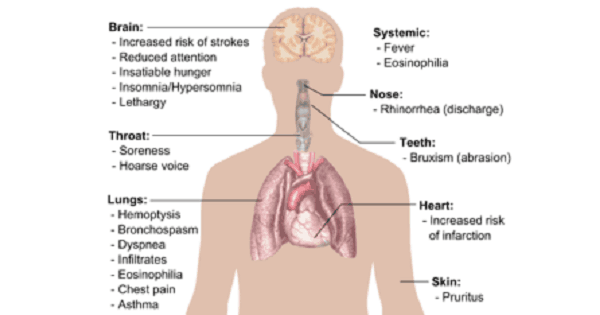
- With excessive or prolonged use, the drug can cause itching, tachcardia, hallucinations and paranoid delusions.
- Overdoses cause tachyarrythmias and a marked elevation of blood pressure, which can be life-threatening.
- Toxicity results in seizures, followed by respiratory and circulatory depression of medullar origin.
- This may lead to death from respiratory failure, stroke, or heart-failure.
- Cocaine is also highly pyrogenic, because the stimulation and increased muscular activity cause greater heat production.
- Heat loss is inhibited by the intense vasoconstriction.
- Cocaine-induced hyperthermia may cause muscle cell destruction and myoglobinuria resulting in renal failure.
- Emergency treatment often consists of administering a benzodiazepine sedation agent, such as diazepam to decrease the elevated heart rate and blood pressure.
- Physical cooling (ice, cold blankets, etc.) and paracetamol (acetaminophen) may be used to treat hyperthermia
- There is no officially approved specific antodote for cocaine overdose
- Cocaine’s primary acute effect on brain chemistry is to raise the amount of dopamine and serotonin in the nucleus accumbens (the pleasure center in the brain); this effect ceases, due to metabolism of cocaine to inactive compounds and particularly due to the depletion of the transmitter resources (tachyplaxis).
- This can be experienced acutely as feelings of depression, as a “crash” after the initial high.
True regarding cocaine are all, except:
JIPMER 13
| A |
Causes tachycardia and hypertension |
|
| B |
Half life is 3 h |
|
| C |
No antidote |
|
| D |
Can be taken by snorting |
True regarding cocaine are all, except:
JIPMER 13
| A |
Causes tachycardia and hypertension |
|
| B |
Half life is 3 h |
|
| C |
No antidote |
|
| D |
Can be taken by snorting |
Ans. Half life is 3 h
Speedball is cocaine mixed with:
NEET 13
| A |
Heroin |
|
| B |
Cannabis |
|
| C |
Amphetamine |
|
| D |
LSD |
Speedball is cocaine mixed with:
NEET 13
| A |
Heroin |
|
| B |
Cannabis |
|
| C |
Amphetamine |
|
| D |
LSD |
Ans. Heroin


Cocaine abuse is much similar to which abuse:
WB 07
| A |
Cannabis |
|
| B |
Nicotine |
|
| C |
Heroin |
|
| D |
Amphetamine |
Cocaine abuse is much similar to which abuse:
WB 07
| A |
Cannabis |
|
| B |
Nicotine |
|
| C |
Heroin |
|
| D |
Amphetamine |
Ans. Amphetamine
Cocaine withdrawal causes all except ‑
| A |
Dysphoria |
|
| B |
Fatigue |
|
| C |
Disturbed sleep |
|
| D |
Creeping bugs |
Cocaine withdrawal causes all except ‑
| A |
Dysphoria |
|
| B |
Fatigue |
|
| C |
Disturbed sleep |
|
| D |
Creeping bugs |
Ans. is ‘d’ i.e., Creeping bugs
Patients withdrawing from cocaine typically experience fatigue, dysphoria, dirturbed sleep, and some craving; some may experience depression”.___________ Kaplan & Saddock.
o Creeping bugs are seen in chronic cocaine abuse (not due to withdrawal).
Cocaine
- Cocaine is an alkaloid derived from the Coca bush, Erythrexylum CoCa. It was the first local anaesthetic which was used clinically. Toxicity of cocaine may be : ‑
A. Acute toxicity : – Acute cocaine intoxication is characterized by : ‑
- Sympathetic hyperactivity : – Tachycardia, hypertension, mydriasis, sweating, nausea & vomiting.
- Hypoinanic state : – Increased psychomotor activity, grandiosity, elation, hypervigilance, Increased speech output.
B. Chronic overuse : – Chronic overuse can cause : ‑
- Psychotic episodes (Cocaine psychosis) : Persecutory delusions with tactile hallucinations (formination). Tactile hallucinations are manifested as bugs crawling under the skin —) Cocaine bugs or magnan’s symptoms.
- Other : – Anxiety reaction, compulsive behavior, delirium and delusional disorders.
- Black pigmentation of tongue and teeth.
Drug used for cocaine withdrawal symptoms is-
| A |
Floxetine |
|
| B |
Lorazepam |
|
| C |
Phenobarbital |
|
| D |
No drug |
Drug used for cocaine withdrawal symptoms is-
| A |
Floxetine |
|
| B |
Lorazepam |
|
| C |
Phenobarbital |
|
| D |
No drug |
Ans. is ‘d’ i.e., No drug
- “Tolerance develops swiftly but there are no withdrawal symptoms. Treament, if needed, is symptomatic. Often no medicines are needed and the user can stop its use by himself when he is coerced to do so by the court or the employer” – Namboodiri
- “No pharmacological agents reliably reduce the intensity of withdrawal, but recovery over a weak or two is generally uneventful” – Kaplan & Saddock