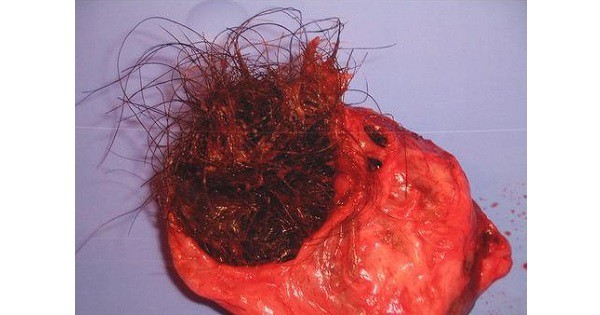
Dermoid Cyst
All of the following ovarian tumours usually occur bilaterally, except :
| A |
Metastatic mass |
|
| B |
Dysgerminoma |
|
| C |
Cyst adenoma of ovary |
|
| D |
Dermoid cyst |
All of the following ovarian tumours usually occur bilaterally, except :
| A |
Metastatic mass |
|
| B |
Dysgerminoma |
|
| C |
Cyst adenoma of ovary |
|
| D |
Dermoid cyst |
Ans. is d i.e. Dermoid cyst
“Dysgerminomas are the only germ cell malignancy with a significant rate of bilateral involvement 15 to 20%.
Remember : A “Funda”— Germ cell tumours are unilateral and maximum bilaterality is seen in dysgerminoma amongst germ cell tumour and that too only in 15 – 20% cases.
So, the other germ cell tumor will obivously be less bilateral therefore our answer is dermoid cyst.
A lady has ovarian mass, x-ray pelvis shows a radio-opaque shadow. The probable diagnosis is:
| A |
Mucinous cyst adenoma |
|
| B |
Serous cyst adenoma |
|
| C |
Dysgerminoma |
|
| D |
Dermoid cyst |
A lady has ovarian mass, x-ray pelvis shows a radio-opaque shadow. The probable diagnosis is:
| A |
Mucinous cyst adenoma |
|
| B |
Serous cyst adenoma |
|
| C |
Dysgerminoma |
|
| D |
Dermoid cyst |
Ans. is d i.e. Dermoid cyst
An ovarian mass with radio opaque shadow on X-ray points towards dermoid cyst as the diagnosis. Causes of Pelvic Calcification are :
- Fibroids : popcorn type
- Dermoid cyst : it is the commonest ovarian mass to calcify
- Other ovarian masses : cystadenoma / carcinoma, fibromas
- Pseudomyxoma peritonei
- Fallopian tube calcification (rare) : suggest TB
Uterine i.e. endometrial calcification from chronic endometritis.
Extra Edge : Dermoid cyst : • Dermoid cyst is a benign teratoma.
- Teratomas are the most common germ cell neoplasm. On the basis of maturity teratoma can be divided into :
a. Mature (Benign) teratoma = dermoid cyst
Most common benign tumour of ovary in reproductive age group.°
— Most common benign neoplasm diagnosed during pregnancy.°
— Bilateral in 10′;’0 to 15`’.0 of cases
— Characteristically they are unilocular cyst containing hair and cheesy sebaceous material, teeth, bones, ).1:40(18
thyroid tissue and cartilage.
— About 1% of the dermoids undergoes malignant transformation of one of the component element (e.g., thyroid carcinoma, melanoma, but most commonly squamous cell ca).
b. Immature (Malignant) teratoma
— Rare, mostly solid, differ from benign teratomas in the component tissue which resembles that observed in the fetus or embryo rather than mature adult tissue.
— Tumour occur chiefly in prepubertal adolescents and young women.
— Tumour grade is correlated with prognosis and extra-ovarian spread.
c. Monodermal or specialized teratomas = (Struma ovarii and carcinoid)
— Rare group of tumour, struma ovarii composed entirely of mature thyroid tissue which is hyperfunctional.
— Patients usually present with hyperthyroidism.
— Most of the tumours are innocent, but malignant thyroid tumour have been recorded.
Also Know :
- Dermoid cyst may attain a size of 20 cms.
- Lining epithelium is stratified squamous epithelium (if dermoid cyst undergoes malignant change – Squamous cell Ca is seen).
- Most common tissue element in dermoid cyst is Ectodermal.°
- It is the most common tumour to undergo torsion.°
- If hone or teeth are seen in X-ray in adenaxal mass, it is pathognomic.°
- Dermoid cyst frequently arise in association with mucinous cystadenoma :
— Age for combined tumour is 20 – 30 years.
Age for simple dermoid cyst is 40 – 50 years.
True about dermoid cyst of ovary :
| A |
It is teratoma |
|
| B |
Frequently undergo torsion |
|
| C |
X-ray is diagnostic |
|
| D |
All |
True about dermoid cyst of ovary :
| A |
It is teratoma |
|
| B |
Frequently undergo torsion |
|
| C |
X-ray is diagnostic |
|
| D |
All |
Ans. is a. b, and c i.e. It is teratoma; Frequently undergo torsion; X-ray is diagnostic; and Contains sebaceous material and hairs
Dermoid cyst (mature teratoma) :
- Most comon benign ovarian neoplasm.
- Mostly affect women of reproductive age group.
- Morphologically dermoid cyst is unilocular with smooth surface.
- On cross section — cysts are unilocular and typically contain are area of localised growth that prottectes into the cystic cavity called as Rokintansky protuberance / dermoid process.
- It contains sebaceous material and hair with teeth. bone, cartilage, thyroid tissue.
- If teeth or bone are seen in X-ray in adnexal mass, this finding is pathognomic for teratoma.
- Dermoid cyst are bilateral in 12% to 15% and frequently arise in association with mucinous cystadenomas.
Malignant change in a dermoid cyst occurs in 0.5 — 2% cases in patients > 40 years. Most common malignancy which develop is. squamous cell carcinoma.
Most common ovarian tumour in pregnancy is :
| A |
Mucinous cyst adenoma |
|
| B |
Dermoid cyst |
|
| C |
Metastasis |
|
| D |
Dysgerminoma |
Most common ovarian tumour in pregnancy is :
| A |
Mucinous cyst adenoma |
|
| B |
Dermoid cyst |
|
| C |
Metastasis |
|
| D |
Dysgerminoma |
Ans. is b i.e. Dermoid cyst
“Dysgerminomas are the most common malignant tumor diagnosed during pregnancy but overall most common is dermoid cyst.”
Most common tumour of ovary in pregnancy is serous cystadenoma but most cases remain undiagnosed, However, incidence of dermoid cyst increase two times in pregnancy and it becomes themost commonly diagnosed ovarian tumour during pregnancy.
In this question as serous cystadenoma is not in option, answer would be dermoid.
Which of the following ovarian tumor is most prone to undergo torsion during pregnancy :
| A |
Serous cystadenoma |
|
| B |
Mucinous cystadenoma |
|
| C |
Dermoid cyst |
|
| D |
Theca lutein cyst |
Which of the following ovarian tumor is most prone to undergo torsion during pregnancy :
| A |
Serous cystadenoma |
|
| B |
Mucinous cystadenoma |
|
| C |
Dermoid cyst |
|
| D |
Theca lutein cyst |
Ans. is c i.e. Dermoid cyst
“A benign cystic teratoma is the most common neoplasm to undergo torsion, and it to the M/C benign tumor diagnosed during pregnancy.”
A benign cystic teratoma is synonymous to dermoid cyst.
Remember :
- Most common ovarian tumour in pregnancy is serous cystadenoma but mostly remains undiagnosed.
- Incidence of dermoid cyst is increased two fold during pregnancy and it is the most common neoplasm diagnosed during pregnancy.
- Hingorani sign seen : – In ovarian tumor during pregnancy.
Trendelenburg’s position can elicit the groove between two separate swelling. Used to distinguish between ovarian tumour and fibroid.
Most common ovarian tumour to undergo torsion is :
| A |
Pseudomucinous cystadenoma |
|
| B |
Brenner’s tumour |
|
| C |
Adenomyoma |
|
| D |
Dermoid cyst |
Most common ovarian tumour to undergo torsion is :
| A |
Pseudomucinous cystadenoma |
|
| B |
Brenner’s tumour |
|
| C |
Adenomyoma |
|
| D |
Dermoid cyst |
Dermoid cyst
Commonest ovarian tumour associated with pregnancy is :
| A |
Mucinous cystadenoma |
|
| B |
Teratoma (Dermoid cyst) |
|
| C |
Brenner’s tumour |
|
| D |
Fibroma |
Commonest ovarian tumour associated with pregnancy is :
| A |
Mucinous cystadenoma |
|
| B |
Teratoma (Dermoid cyst) |
|
| C |
Brenner’s tumour |
|
| D |
Fibroma |
Teratoma (Dermoid cyst)
Dermoid cyst of ovary contains derivatives from:
| A |
Endoderm |
|
| B |
Mesoderm |
|
| C |
Ectoderm |
|
| D |
All |
Dermoid cyst of ovary contains derivatives from:
| A |
Endoderm |
|
| B |
Mesoderm |
|
| C |
Ectoderm |
|
| D |
All |
All
Most common ovarian tumour in pregnancy is :
| A |
Mucinus cyst adenoma |
|
| B |
Dermoid cyst |
|
| C |
Metastasis |
|
| D |
Dysgerminoma |
Most common ovarian tumour in pregnancy is :
| A |
Mucinus cyst adenoma |
|
| B |
Dermoid cyst |
|
| C |
Metastasis |
|
| D |
Dysgerminoma |
Dermoid cyst
Which is not true of dermoid cyst of ovary :
| A |
Commonly more than 10 cm |
|
| B |
Has sebaceous material |
|
| C |
Bilateral in 30% |
|
| D |
Option a and c |
Which is not true of dermoid cyst of ovary :
| A |
Commonly more than 10 cm |
|
| B |
Has sebaceous material |
|
| C |
Bilateral in 30% |
|
| D |
Option a and c |
Option c
Most common ovarian tumour to undergo torsion:
| A |
Pseudomucinous cystadenoma |
|
| B |
Papillary cystadenoma |
|
| C |
Dermoid cyst |
|
| D |
Mucinous cyst |
Most common ovarian tumour to undergo torsion:
| A |
Pseudomucinous cystadenoma |
|
| B |
Papillary cystadenoma |
|
| C |
Dermoid cyst |
|
| D |
Mucinous cyst |
Dermoid cyst
Which of the following ovarian tumor is most prone to undergo torsion during pregnancy?
| A |
Serous cystadenoma |
|
| B |
Mucinous cystadenoma |
|
| C |
Dermoid cyst |
|
| D |
Theca lutein cyst |
Which of the following ovarian tumor is most prone to undergo torsion during pregnancy?
| A |
Serous cystadenoma |
|
| B |
Mucinous cystadenoma |
|
| C |
Dermoid cyst |
|
| D |
Theca lutein cyst |
A mature cystic teratoma (Dermoid cyst) is one of the most common forms of ovarian neoplasm, are more likely to undergo torsion than other ovarian neoplasms, and that this tendency is increased in pregnancy.
Ref: Novak’s Gynaecology, 15th Edition, Page 426; Contemporary Obs/Gyn: Volume 37, Issue 1, 1992.
A patient at 8 weeks pregnancy is diagnosed to have dermoid cyst it should be removed at :
| A |
Immediately |
|
| B |
At 14-16 weeks |
|
| C |
Only when it undergoes torsion |
|
| D |
At term along with LSCS |
A patient at 8 weeks pregnancy is diagnosed to have dermoid cyst it should be removed at :
| A |
Immediately |
|
| B |
At 14-16 weeks |
|
| C |
Only when it undergoes torsion |
|
| D |
At term along with LSCS |
At 14-16 weeks
The dermoid cyst, diagnosed at 6 weeks of pregnancy, Best treatment modalities:
| A |
Removal LSCS along with removal of cyst |
|
| B |
Removal only when it undergoes torsion |
|
| C |
Remove immediately |
|
| D |
At 14-16 weeks of pregnancy |
The dermoid cyst, diagnosed at 6 weeks of pregnancy, Best treatment modalities:
| A |
Removal LSCS along with removal of cyst |
|
| B |
Removal only when it undergoes torsion |
|
| C |
Remove immediately |
|
| D |
At 14-16 weeks of pregnancy |
At 14-16 weeks of pregnancy
Dermoid cyst are commonly seen in:
September 2011
| A |
Finger |
|
| B |
Skin |
|
| C |
Skull |
|
| D |
Hip |
Dermoid cyst are commonly seen in:
September 2011
| A |
Finger |
|
| B |
Skin |
|
| C |
Skull |
|
| D |
Hip |
Ans. C: Skull
Dermoid cysts are included in group of swellings related to the supraorbital margin (skull)
They are usually external angular cysts although they may occur medially
Swellings of the skin:
Lipoma:
Universal tumour
– Slipping margin sign
– MC site is trunk
- Dercum’s disease: Muliple lipomata
- Cavernous hemangioma: Arises from veins
- Plxiform hamengioma: Arises from arteries
- Warts: Caused by human papilloma virus
- Marjolins ulcer: Squamous cell Ca
- Potts puffy tumour: Osteomyelitis of skull
- Rasp berry tumour: Adenoma of umbilicus
- Cavernous lympahngioma:
– Cystic hygroma
– Fluid filled lesions of lymphatic origin
– MC arises in neck
– Associated with Turners syndrome, trisomies, fetal alcohol syndrome
– rilliantly translucent
Positive cough impulse
– Excision is treatment of choice
- Cock’s peculiar tumour: Complication of sebaceous cyst/ retention cyst
- Rhinophyma/ potato nose: Acne rosacea
- Branchial cyst: Remnant of 201 branchial cleft
Most common orbital cyst in children-
| A |
Neuroenteric cyst |
|
| B |
Dermoid cyst |
|
| C |
Lymphoma |
|
| D |
Clobomatous cyst |
Most common orbital cyst in children-
| A |
Neuroenteric cyst |
|
| B |
Dermoid cyst |
|
| C |
Lymphoma |
|
| D |
Clobomatous cyst |
Ans. is ‘b’ i.e., Dermoid cyst
Epidermal dermoid cyst (dermoid) is by for the most common orbital cystic lesion in children, accounting for over 40% of all orbital lesions of childhood and for 89% of all orbital cystic lesions of childhood that come to biopsy or surgical removal.
Most important secondary cyst is a mucocele that can occur in children with cystic fibrosis.
Cut-section of Ovary as seen in Photograph indicates

| A |
Serous cyst adenoma |
|
| B |
PCOD |
|
| C |
Dermoid cyst |
|
| D |
Chocolate cyst |
Cut-section of Ovary as seen in Photograph indicates
| A |
Serous cyst adenoma |
|
| B |
PCOD |
|
| C |
Dermoid cyst |
|
| D |
Chocolate cyst |
Ans:C.)Dermoid cyst
Histology of Dermoid Cyst
- The lining is typically a keratinizing squamous epithelium .The hallmark of these cysts is the presence of pilosebaceous structures in the cyst wall .Hair shafts are often found within the cyst .