
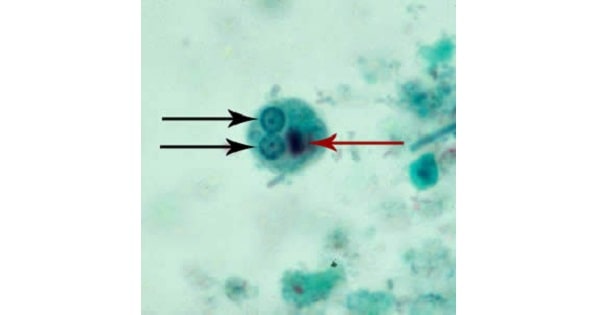
Entamoeba Histolytica: Clinical Manifestations
The main reservoir for entamoeba histolytica is
| A |
Man |
|
| B |
Dirty water |
|
| C |
Soil |
|
| D |
Ponds |
The main reservoir for entamoeba histolytica is
| A |
Man |
|
| B |
Dirty water |
|
| C |
Soil |
|
| D |
Ponds |
Ans. is `a’ i.e., Man
Amoebiasis is transmitted by all except-
| A |
Cockroach |
|
| B |
Faeco oral |
|
| C |
Vertical transmission |
|
| D |
Oro- rectal |
Amoebiasis is transmitted by all except-
| A |
Cockroach |
|
| B |
Faeco oral |
|
| C |
Vertical transmission |
|
| D |
Oro- rectal |
Ans. is ‘c’ i.e., Vertical transmission
. The cystic form (cyst) is the infective form of E. histolytica.
. Most of transmission are :-
i) Feco oral route :‑
– This may readily take place through intake of contaminate water or food.
– Amoebiasis occur when parasites are taken in by the mouth.
ii) Sexual transmission :‑
– Sexual transmission by oral- rectal contact is also recognised. In developing countries transmission of E. histolytica mainly occurs as a result of low standards of hygiene but in western countries where the incidence of amoebiasis is low, transmission by sexual contact is important.
iii) Transmission through vectors ( Parija 3rd/e p 39) :
– Vectors such as flies, cockroaches and rodents are capable of carrying cysts and contaminated food & drink.
Commonest site of extraintestinal amoebiasis is ‑
| A |
Brain |
|
| B |
Liver |
|
| C |
Spleen |
|
| D |
Lungs |
Commonest site of extraintestinal amoebiasis is ‑
| A |
Brain |
|
| B |
Liver |
|
| C |
Spleen |
|
| D |
Lungs |
Ans. is ‘b’ i.e., Liver
Liver abscess is the most common extra-intestinal manifestation of amoebiasis.
Regarding cutaneous amoebiasis which is not true ‑
| A |
It is a spreading necrotising |
|
| B |
Rapid improvement with anti-amoebic treatment occurs |
|
| C |
Can occur in the perianal region |
|
| D |
The infection reaches the skin through the blood stream |
Regarding cutaneous amoebiasis which is not true ‑
| A |
It is a spreading necrotising |
|
| B |
Rapid improvement with anti-amoebic treatment occurs |
|
| C |
Can occur in the perianal region |
|
| D |
The infection reaches the skin through the blood stream |
Ans. is ‘d’ i.e., The infection reaches the skin through the blood stream
. Skin is involved directly over the region adjoining a visceral lesion, such as, in the areas of drainage of liver abscess or colostomy wound, in the sites of ruptured appendicular and peri-colic abscesses.
. Extensive necrosis and sloughing of the skin and subcutaneous tissues are caused by the trophozoites of E. histolytica.
. Granulomatous ulceration and granulomatous mass may occur in the peri-anal region.
Commonest site of amoebiasis in the gut –
| A |
Ileum |
|
| B |
Caecum |
|
| C |
Ascending colon |
|
| D |
b and c |
Commonest site of amoebiasis in the gut –
| A |
Ileum |
|
| B |
Caecum |
|
| C |
Ascending colon |
|
| D |
b and c |
Ans. is ‘b’ i.e., Caecum & ‘c’ i.e., Ascending colon
- E. histolytica forms flask shaped ulcers.
o Amebiasis most frequently involves the cecum and ascending colon, followed in order by the sigmoid, rectum, and appendix.
Which of the following is not true about amoebiasis‑
| A |
ALA in 10% causes in tropics |
|
| B |
Portal system efficient filter |
|
| C |
Abscess due to suppuration |
|
| D |
Abscess wall good for culture |
Which of the following is not true about amoebiasis‑
| A |
ALA in 10% causes in tropics |
|
| B |
Portal system efficient filter |
|
| C |
Abscess due to suppuration |
|
| D |
Abscess wall good for culture |
Ans. is ‘c’ i.e., Abscess due to suppuration
Amebic liver abscess
o Pus in amoebic liver abscess is not due to suppuration, but is a mixture of sloughed liver tissue and blood. o It is chocolate brown in colour and thick in consistency (anchovy sauce pus)
o In the tropics 2-10% of the individuals infected with entamoeba histolytica suffer from hepatic complications. The trophozoites are carried from the large intestine to the liver by portal vein. In the liver the capillary system acts as efficient filter and holds these parasites.
o In case of amoebic liver abscess the diagnostic aspiration is done from the abscess wall because the trophozoites are confined to the periphery.
Characteristic feature of amoebic ulcer –
| A |
Flask shaped |
|
| B |
Undermined edges |
|
| C |
Rolled up edge |
|
| D |
a and b |
Characteristic feature of amoebic ulcer –
| A |
Flask shaped |
|
| B |
Undermined edges |
|
| C |
Rolled up edge |
|
| D |
a and b |
Ans. is ‘a’ i.e., Flask shaped; ‘b’ i.e., Undermined edges
o Amebiasis most frequently involves the cecum and ascending colon, followed in order by the sigmoid, rectum and appendix.
o The ulcerative lesions develop undermining of margins of the ulcer due to lytic action of the trophozoites.
o Ulcer has a flask shaped with a narrow neck and broad base.
True about amoebic liver abscess –
| A |
Frequently associated with diarrhea at presentation |
|
| B |
Most common in right lobe liver |
|
| C |
Can rupture into pleural cavity |
|
| D |
b and c |
True about amoebic liver abscess –
| A |
Frequently associated with diarrhea at presentation |
|
| B |
Most common in right lobe liver |
|
| C |
Can rupture into pleural cavity |
|
| D |
b and c |
Answer is ‘b’ Most common in right lobe liver; ‘c’ Can rupture into pleural cavity
Amoebic Liver abscess
- Caused by Entamoeba histolytica whose cysts are acquired through the feco-oral route and their trophozoites reach the liver through portal venous system.
- Like pyogenic abscess they are also common in rt. lobe of liver.
- Clinical Picture
– the typical clinical picture is of a patient 20-40 yrs of age who has travelled to an endemic area, presents with fever, chills, anorexia, rt. upper quadrant pain.
– although liver abscess results from an obligatory colonic infection, a recent history of diarrhoea is uncommon.
– jaundice is rare. (c.f. in pyogenic abscess jaundice is seen in —25% of pts.)
- Liver function tests may show mild abnormalities, hyperbilirubinemia is uncommon.
- CT > U/S are the mainstay of investigation.
- Diagnosis is confirmed by serological tests (enzyme immuno assay) for antiamoebic antibodies.
- Cultures of amoebic abscess are usually negative.
- Treatment
- Metronidazole is the mainstay of t/t and is curative in over 90% of patients.(other nitroimidazoles i.e. secnidazole, tinidazole, are also effective)
- Therapeutic needle aspiration is avoided. Done only when
– pt. fails to respond to metronidazole
– high risk of rupture
– abscess secondarily infected with pyogenic organism.
- Complications may occur uncommonly; these are
– rupture into the peritoneum, pleural cavity or pericardium.
All are true about amoebic liver abscess except:
| A |
More common in females |
|
| B |
More common in left lobe of liver |
|
| C |
Metronidazole is mainstay of treatment |
|
| D |
a and b |
All are true about amoebic liver abscess except:
| A |
More common in females |
|
| B |
More common in left lobe of liver |
|
| C |
Metronidazole is mainstay of treatment |
|
| D |
a and b |
Ans is a i.e. More common in females & b i.e. More common in left lobe of liver
Which one of the following is not correct with regard to amoebic liver abscess-
| A |
Its usual occurrence is in the right lobe |
|
| B |
Patient is toxic |
|
| C |
Surgical drainage is always indicated |
|
| D |
c and b |
Which one of the following is not correct with regard to amoebic liver abscess-
| A |
Its usual occurrence is in the right lobe |
|
| B |
Patient is toxic |
|
| C |
Surgical drainage is always indicated |
|
| D |
c and b |
Ans. is ‘c>b’ i.e., Surgical drainage is always indicated > Patient is toxic.
Most common cause of amoebic lung abscess is :
| A |
Aspiration |
|
| B |
Direct spread from liver |
|
| C |
Hematogenous spread from liver |
|
| D |
Hematogenous spread from gut |
Most common cause of amoebic lung abscess is :
| A |
Aspiration |
|
| B |
Direct spread from liver |
|
| C |
Hematogenous spread from liver |
|
| D |
Hematogenous spread from gut |
Answer is B (Direct spread from liver):
An amoebic lung abscess is almost always secondary to spread from the liver.
Extraintestinal infection by E. histolytica most often involves the liver. Further involvement most commonly leads to Amoebic lung abscess.
Infact pleuropulmonary involvement (Lung): is the most frequent complication of Amoebic liver abscess.
Remember:
Most common cause of a lung abscess is – ‘Aspiration’. However this holds true for pyogenic (bacterial lung abscess)
Most common site of abscess formation due to amoeba is:
September 2005
| A |
Lungs |
|
| B |
Liver |
|
| C |
Kidney |
|
| D |
Brain |
Most common site of abscess formation due to amoeba is:
September 2005
| A |
Lungs |
|
| B |
Liver |
|
| C |
Kidney |
|
| D |
Brain |
Ans. B: Liver
Amebic liver abscess is the most frequent extraintestinal manifestation of Entamoeba histolytica infection. This infection is caused by the protozoa E histolytica, which ascends the portal venous system. Amebic liver abscess is an important cause of space-occupying lesions of the liver, mainly in developing countries
E histolytica exists in 2 forms. The cyst stage is the infective form, and the trophozoite stage causes invasive disease. People who chronically carry E histolytica shed cysts in their feces; these cysts are transmitted primarily by food and water contamination. Cysts are resistant to gastric acid, but the wall is broken down by trypsin in the small intestine. Trophozoites are released and colonize the cecum. To initiate symptomatic infection, E histolytica trophozoites present in the lumen must adhere to the underlying mucosa and penetrate the mucosal layer.
Liver involvement occurs following invasion of E histolytica into mesenteric venules. Amebae then enter the portal circulation and travel to the liver where they typically form large abscesses.
The abscess contains acellular proteinaceous debris, which is thought to be a consequence of induced apoptosis and is surrounded by a rim of amebic trophozoites invading the tissue.
The right lobe of the liver is more commonly affected than the left lobe. This has been attributed to the fact that the right lobe portal laminar blood flow is supplied predominantly by the superior mesenteric vein, whereas the left lobe portal blood flow is supplied by the splenic vein.
Amoebic liver abscess ruptures most commonly into which cavity:
September 2009
| A |
Peritoneal |
|
| B |
Pleural |
|
| C |
Pericardial |
|
| D |
None of the above |
Amoebic liver abscess ruptures most commonly into which cavity:
September 2009
| A |
Peritoneal |
|
| B |
Pleural |
|
| C |
Pericardial |
|
| D |
None of the above |
Ans. B: Pleural
Pleuropulmonary infection is the most common complication.
Mechanisms of infection include development of a sympathetic serous effusion; rupture of a liver abscess into the chest cavity, leading to empyema; or hematogenous spread, resulting in parenchymal infection.
Cardiac involvement results following the rupture of an abscess involving the left lobe of the liver. It usually is associated with very high mortality.
Intraperitoneal rupture occurs in 2-7% of patients. Left lobe abscesses are more likely to progress to rupture because of their later clinical presentation
Investigation of choice for amoebic liver abscess:
March 2012
| A |
Demonstration of parasites in stool |
|
| B |
Serum Entamoeba antibodies |
|
| C |
Aspiration of cyst fluid |
|
| D |
X-ray abdomen |
Investigation of choice for amoebic liver abscess:
March 2012
| A |
Demonstration of parasites in stool |
|
| B |
Serum Entamoeba antibodies |
|
| C |
Aspiration of cyst fluid |
|
| D |
X-ray abdomen |
Ans: B i.e. Serum Entamoeba antibodies
Diagnosis of amoebic liver disease
- Analysis of serum for Entamoeba antibodies by immunoassay carries 99% sensitivity and more than 90% specificity, and is more accurate than stool analysis in amoebic liver disease
- Diagnosis may depend on cyst aspiration revealing the classic anchovy sauce appearance of the cyst fluid
All are true about Amoebic liver abscess except:
March 2007
| A |
Common site is right posterosuperior part of liver |
|
| B |
Alcoholics are susceptible to develop amoebic liver abscess |
|
| C |
Anchovy sauce pus |
|
| D |
Fever is the most common sign |
All are true about Amoebic liver abscess except:
March 2007
| A |
Common site is right posterosuperior part of liver |
|
| B |
Alcoholics are susceptible to develop amoebic liver abscess |
|
| C |
Anchovy sauce pus |
|
| D |
Fever is the most common sign |
Ans. B: Alcoholics are susceptible to develop amoebic liver abscess
Amebic liver abscess is the most frequent extraintestinal manifestation of Entamoeba histolytica infection. This infection is caused by the protozoa Ehistolytica, which ascends the portal venous system.
The right lobe (posterior superior quadrant) of the liver is more commonly affected than the left lobe. This has been attributed to the fact that the right lobe is supplied predominantly by the superior mesenteric vein, whereas the left lobe is supplied by the splenic vein.
Histologic Findings of abscess
The abscess contains acellular proteinaceous debris and is surrounded by a rim of amebic trophozoites invading tissue. The abscess contains a chocolate-colored fluid that resembles anchovy paste and consists predominantly of necrotic hepatocytes.
Complications
- Pleuropulmonary infection is the most common complication.
- Cardiac involvement results following the rupture of an abscess involving the left lobe of the liver. It usually is associated with very high mortality.
- Intraperitoneal rupture occurs in 2-7% of patients. Left lobe abscesses are more likely to progress to rupture because of their later clinical presentation.
- Bacterial superinfection can occur.

