FACIAL (VII) NERVE
Terminal branches of facial nerve are all EXCEPT:
| A |
Mandibular nerve |
|
| B |
Marginal branch |
|
| C |
Temporal |
|
| D |
Cervical |
Terminal branches of facial nerve are all EXCEPT:
| A |
Mandibular nerve |
|
| B |
Marginal branch |
|
| C |
Temporal |
|
| D |
Cervical |
After it gives off the posterior auricular nerve, the facial nerve divides within the parotid gland into its terminal branches. The terminal branches are;
- Temporal
- Zygomatic
- Buccal
- Marginal (along the mandible)
- Cervical
(A traditional mnemonic device for the five terminal branches of the facial nerve is, “Ten Zebras Bit My Cat”)
Branch of facial nerve passing through petrotympanic fissure is:
| A |
Chorda Tympani |
|
| B |
Stapedial nerve |
|
| C |
Greater petrosal nerve |
|
| D |
Posterior auricular nerve |
Branch of facial nerve passing through petrotympanic fissure is:
| A |
Chorda Tympani |
|
| B |
Stapedial nerve |
|
| C |
Greater petrosal nerve |
|
| D |
Posterior auricular nerve |
The arrangement of Branches of Facial nerve after exiting from Parotid gland is given the name as
| A |
Pes Cavus |
|
| B |
Panniculosus carnosus |
|
| C |
Pes Anserinus |
|
| D |
Genu |
The arrangement of Branches of Facial nerve after exiting from Parotid gland is given the name as
| A |
Pes Cavus |
|
| B |
Panniculosus carnosus |
|
| C |
Pes Anserinus |
|
| D |
Genu |
All of the following are TRUE about the middle ear, EXCEPT:
| A |
The joints between ossicles are synovial |
|
| B |
The chorda tympani nerve is related to the lateral wall |
|
| C |
The facial nerve passes in a canal situated in the medial and anterior walls |
|
| D |
The auditory tube connects the nasopharynx with the anterior wall |
All of the following are TRUE about the middle ear, EXCEPT:
| A |
The joints between ossicles are synovial |
|
| B |
The chorda tympani nerve is related to the lateral wall |
|
| C |
The facial nerve passes in a canal situated in the medial and anterior walls |
|
| D |
The auditory tube connects the nasopharynx with the anterior wall |
The facial nerve passes in a canal situated in the posterior and medial walls of the middle ear. It is not associated with the anterior wall.
All of the following glands are supplied by the facial nerve, EXCEPT?
| A |
Nasal glands |
|
| B |
Lacrimal gland |
|
| C |
Parotid gland |
|
| D |
Submandibular gland |
All of the following glands are supplied by the facial nerve, EXCEPT?
| A |
Nasal glands |
|
| B |
Lacrimal gland |
|
| C |
Parotid gland |
|
| D |
Submandibular gland |
Parotid glandreceives parasympathetic innervations from glossopharyngeal nerve and not facial nerve.
The following statements concerning chorda tympani nerve are true except that it?
| A |
Carries secretomotor fibers to submandibular gland |
|
| B |
Joins lingual nerve in infratemporal fossa |
|
| C |
Is a branch of facial nerve |
|
| D |
Contains postganglionic parasympathetic fibers |
The following statements concerning chorda tympani nerve are true except that it?
| A |
Carries secretomotor fibers to submandibular gland |
|
| B |
Joins lingual nerve in infratemporal fossa |
|
| C |
Is a branch of facial nerve |
|
| D |
Contains postganglionic parasympathetic fibers |
Chorda tympani nerve contains preganglionic parasympathetic fibers, not parasympathetic fibers. It synapses in the submandibular ganglion.
Which of the given nerve carries taste sensation from anterior two third of tongue?
| A |
Facial nerve |
|
| B |
Glossopharyngeal nerve |
|
| C |
Lingual nerve |
|
| D |
Vagus nerve |
Which of the given nerve carries taste sensation from anterior two third of tongue?
| A |
Facial nerve |
|
| B |
Glossopharyngeal nerve |
|
| C |
Lingual nerve |
|
| D |
Vagus nerve |
Taste sensation from anterior two third ( fungiform , filiform papillae ) of the tongue is carried by chorda tympani nerve . Chorda tmpani nerve lies within the lingual nerve upto the infratemporal fossa. In the infratemporal fossa chorda tympani comes out of the lingual nerve and enters the pterotympanic fissure to join the facial nerve.
TRUE/FALSE regarding blood supply of facial nerve is/are?
1. Ascending Pharyngeal artery
2. Greater palatine artery
3. Middle meningeal artery
4. Labyrinthine branch of ethmoidal artery
5. Stylomastoid branch of occipital artery
| A |
1,2,3 true & 4,5 false |
|
| B |
1, 2 false & 3,4,5 true |
|
| C |
2,4 false & 1,3,5 true |
|
| D |
All true |
TRUE/FALSE regarding blood supply of facial nerve is/are?
1. Ascending Pharyngeal artery
2. Greater palatine artery
3. Middle meningeal artery
4. Labyrinthine branch of ethmoidal artery
5. Stylomastoid branch of occipital artery
| A |
1,2,3 true & 4,5 false |
|
| B |
1, 2 false & 3,4,5 true |
|
| C |
2,4 false & 1,3,5 true |
|
| D |
All true |
Blood supply of facial nerve:
Arterial supply:
In Canal:
1. Superficial petrosal (branch of middle meningeal artery)
2. Stylomastoid (branch of posterior auricular or occipital artery)
Extracranially:
1. Stylomastoid (branch of posterior auricular or occipital artery)
2. Superficial temporal, transverse facial and tympanic (branch of ascending pharyngeal artery)
Venous drainage:
1. Venae comitantes of superficial petrosal and stylomastoid arteries.
The facial nerve supplies motor fibers to which of the following muscles?
| A |
Stapedius |
|
| B |
Mylohyoid |
|
| C |
Anterior belly of the digastric |
|
| D |
Geniohyoid |
The facial nerve supplies motor fibers to which of the following muscles?
| A |
Stapedius |
|
| B |
Mylohyoid |
|
| C |
Anterior belly of the digastric |
|
| D |
Geniohyoid |
The facial nerve innervates muscles that develop from the second branchial arch, which includes the stapedius. This muscle is important in dampening loud sounds and is located in the middle ear cavity.
Which of the following muscles are innervated by facial nerve?
| A |
Risorius, Anterior belly of digastric, Zygomaticus |
|
| B |
Anterior belly of digastric, Lateral pterygoid, Auricular muscles |
|
| C |
Zygomaticus, Risorius, Auricular muscles |
|
| D |
Auricular muscles, Risorius, Lateral pterygoid |
Which of the following muscles are innervated by facial nerve?
| A |
Risorius, Anterior belly of digastric, Zygomaticus |
|
| B |
Anterior belly of digastric, Lateral pterygoid, Auricular muscles |
|
| C |
Zygomaticus, Risorius, Auricular muscles |
|
| D |
Auricular muscles, Risorius, Lateral pterygoid |
- Risorius: is a dilator muscle of the lip and supplied by facial nerve.
- Zygomaticus major and minor (Dilator muscle of the lip) are supplied by the facial nerve.
- Auricularis anterior, superior and posterior are supplied by the facial nerve.
- Infact, all facial muscles (including muscle of the scalp, muscle of auricle, muscle of eyelid, muscle of nose, muscle around the mouth and muscle of the neck) are supplied by the facial nerve (motor supply). The trigeminal nerve is the chief sensory nerve of the face.
Note:
- “Anterior belly of the digastric is supplied by the nerve to mylohyoid whereas posterior belly is supplied by the facial nerve”.
- “Muscles of the mastication (lateral pterygoid, medial pterygoid, masseter and temporalis) are supplied by the mandibular division of trigeminal nerve”.
The Chorda tympani nerve arises from which of the following cranial nerve?
| A |
The vagus nerve |
|
| B |
The trigeminal nerve |
|
| C |
The glossopharyngeal nerve |
|
| D |
The facial nerve |
The Chorda tympani nerve arises from which of the following cranial nerve?
| A |
The vagus nerve |
|
| B |
The trigeminal nerve |
|
| C |
The glossopharyngeal nerve |
|
| D |
The facial nerve |
Chorda tympani is a mixed nerve which arises from the vertical segment of the facial nerve about 6mm above the stylomastoid foramen. It carries taste sensations from the anterior two third of the tongue and carries preganglionic secretomotor fibers.
|
In facial canal |
Nerve to stapedius
Chorda tympani
|
|
Just outside stylomastoid foramen |
Posterior auricular nerve
To posterior belly of digastric
To stylohyoid foramen
|
|
On face |
Temporal
Zygomatic
Buccal
Marginal mandibular
cervical
|
Facial nerve is a derivative of which of the following branchial arch?
| A |
First arch |
|
| B |
Second arch |
|
| C |
Third arch |
|
| D |
Fourth arch |
Facial nerve is a derivative of which of the following branchial arch?
| A |
First arch |
|
| B |
Second arch |
|
| C |
Third arch |
|
| D |
Fourth arch |
Facial nerve is a derivative of second branchial arch. Muscles of facial expression derived from it are buccinator, auricularis, frontalis, platysma, orbicularis oris and orbicularis oculi. Additional muscles supplied by it are stapedius, stylohyoid, and posterior belly of digastric.
|
Branchial arch |
Cranial nerve |
Muscles |
|
First mandibular |
Trigeminal |
Muscles of mastication: masseter, temporalis, medial and lateral pterygoid. Additional muscles: mylohyoid, anterior belly of digastric, tensor tympani, tensor veli palatini |
|
Third |
Glossopharyngeal |
Stylopharyngeus |
|
Fourth and sixth |
Superior laryngeal, recurrent laryngeal branches of vagus |
Pharyngeal and laryngeal muscles: cricothyroid, levator veli palatini, constrictors of pharynx, intrinsic muscles of larynx |
Ref: Neuroscience for the Study of Communicative Disorders By Subhash Chandra Bhatnagar page 279.
Blood supply of facial nerve is/are
| A |
Ascending pharyngeal artery |
|
| B |
Middle meningeal artery |
|
| C |
Stylomastoid branch of occipital artery |
|
| D |
All |
Blood supply of facial nerve is/are
| A |
Ascending pharyngeal artery |
|
| B |
Middle meningeal artery |
|
| C |
Stylomastoid branch of occipital artery |
|
| D |
All |
A , B, C i.e. Ascending pharyngeal artery, Middle meningeal artery, Stylomastoid branch of occipital artery
The sensory supply of the palate is through all of the following, except :
| A |
Facial nerve |
|
| B |
Hypoglossal nerve |
|
| C |
Glossopharyngeal nerve |
|
| D |
Maxillary division of trigeminal nerve |
The sensory supply of the palate is through all of the following, except :
| A |
Facial nerve |
|
| B |
Hypoglossal nerve |
|
| C |
Glossopharyngeal nerve |
|
| D |
Maxillary division of trigeminal nerve |
B i.e. Hypoglossal nerve
Which of the following is/are branch of facial nerve:
| A |
Chorda tympani |
|
| B |
Greater petrosal nerve |
|
| C |
Zygomatic nerve |
|
| D |
All |
Which of the following is/are branch of facial nerve:
| A |
Chorda tympani |
|
| B |
Greater petrosal nerve |
|
| C |
Zygomatic nerve |
|
| D |
All |
A i.e. Chorda tympani; B i.e. Greater petrosal nerve; C i.e. Zygomatic nerve
Branch of facial nerve in facial canal
| A |
Greater petrosal nerve |
|
| B |
Nerve to Stapedius |
|
| C |
Chordatympani |
|
| D |
All |
Branch of facial nerve in facial canal
| A |
Greater petrosal nerve |
|
| B |
Nerve to Stapedius |
|
| C |
Chordatympani |
|
| D |
All |
A. i.e. Greater petrosal nerve; C. i.e. Chorda tympani; B . i.e. N. to stapedius
All the muscles of the face are supplied by facial nerve except :
| A |
Levator anguli oris |
|
| B |
Corrugator supercilli |
|
| C |
Leavator palpebrae superioris |
|
| D |
Risorius |
All the muscles of the face are supplied by facial nerve except :
| A |
Levator anguli oris |
|
| B |
Corrugator supercilli |
|
| C |
Leavator palpebrae superioris |
|
| D |
Risorius |
C i.e. Levator palpebrae superioris
Posterior belly of digastric is supplied by‑
| A |
Mandibular nerve |
|
| B |
Hypoglosal nerve |
|
| C |
Accessory nerve |
|
| D |
Facial nerve |
Posterior belly of digastric is supplied by‑
| A |
Mandibular nerve |
|
| B |
Hypoglosal nerve |
|
| C |
Accessory nerve |
|
| D |
Facial nerve |
D i.e. Facial nerve
Which one of the following is a branch of the Facial nerve‑
| A |
Deep petrosal nerve |
|
| B |
Lesser superficial petrosal nerve |
|
| C |
External petrosal nerve |
|
| D |
Greater superficial petrosal nerve |
Which one of the following is a branch of the Facial nerve‑
| A |
Deep petrosal nerve |
|
| B |
Lesser superficial petrosal nerve |
|
| C |
External petrosal nerve |
|
| D |
Greater superficial petrosal nerve |
D i.e. Greater superficial petrosal nerve
First branch of facial nerve is:
| A |
Chorda tympani |
|
| B |
Nerve to stapedius |
|
| C |
Lesser superficial petrosal N |
|
| D |
Greater superficial petrosal N |
First branch of facial nerve is:
| A |
Chorda tympani |
|
| B |
Nerve to stapedius |
|
| C |
Lesser superficial petrosal N |
|
| D |
Greater superficial petrosal N |
D. i.e. Greater Superficial petrosal nerve
Sensory fibres from the taste buds in the bard and soft palate travel along:
| A |
Trigeminal nerve |
|
| B |
Facial nerve |
|
| C |
Glossopharynegeal nerve |
|
| D |
Vagus nerve |
Sensory fibres from the taste buds in the bard and soft palate travel along:
| A |
Trigeminal nerve |
|
| B |
Facial nerve |
|
| C |
Glossopharynegeal nerve |
|
| D |
Vagus nerve |
B i.e. Facial nerve
Correct statement(s) about tongue is/are:
| A |
Facial nerve supplies fungi from papillae |
|
| B |
Glossopharyngeal nerve supplies circumvallate papillae |
|
| C |
Genioglossus is the safety muscle |
|
| D |
All |
Correct statement(s) about tongue is/are:
| A |
Facial nerve supplies fungi from papillae |
|
| B |
Glossopharyngeal nerve supplies circumvallate papillae |
|
| C |
Genioglossus is the safety muscle |
|
| D |
All |
Ans. A i.e. Facial nerve supplies fungi from papillae; B i.e. Glossopharyngeal nerve supplies circumvallate papillae ; C i.e. Genioglossus is the safety muscle
– anterior 2/3 of tongue is supplied by chorda tympani branch of facial nerveQ (carrying taste sensation) & lingual nerveQ (carrying general sensation); posterior 1/3 of tongue is supplied by glossopharyngeal nerveQ (carrying taste & general sensation both); and posterior most tongue in the region of valleculae is supplied by internal laryngeal branch of vagus nerveQ
– Except palatoglossus (extrinsic muscle) all muscles of tongue (i.e. all intrinsic muscles eg bilateral superior & inferior longitudinal, transverse & vertical and 3 pairs of extrinsic muscles i.e. genioglossus, hypoglossus & styloglossus/ chondroglossus) are supplied by lzypoglossal nerveQ
Hypoglossal nerve has only motor (but no sensory) supply to tongueQ, so injury to it can not lead to loss of taste or general sensationQ. Injury to hypoglossal nerve present with pure motor tongue features such as ipsilateral muscular
All of the following nerves supply auricle and extrernal meatus except:
| A |
Trigeminal nerve |
|
| B |
Glossopharyngeal nerve |
|
| C |
Facial nerve |
|
| D |
Vagus nerve |
All of the following nerves supply auricle and extrernal meatus except:
| A |
Trigeminal nerve |
|
| B |
Glossopharyngeal nerve |
|
| C |
Facial nerve |
|
| D |
Vagus nerve |
Stapedius is supplied by:
| A |
Maxillary nerve |
|
| B |
Facial nerve |
|
| C |
Auditory nerve |
|
| D |
Mandibular disese |
Stapedius is supplied by:
| A |
Maxillary nerve |
|
| B |
Facial nerve |
|
| C |
Auditory nerve |
|
| D |
Mandibular disese |
First branch of the facial nerve is:
| A |
Greater petrosal nerve |
|
| B |
Lesser petrosal nerve |
|
| C |
Chorda-tympani nerve |
|
| D |
Nerve to the stapedius |
First branch of the facial nerve is:
| A |
Greater petrosal nerve |
|
| B |
Lesser petrosal nerve |
|
| C |
Chorda-tympani nerve |
|
| D |
Nerve to the stapedius |
Greater superficial petrosal nerve: It is the first branch and arises from geniculate ganglion (i.e. first genu).
It joins the deep petrosal nerve to form vidian nerve (nerve to pterygoid canal) and carries secretomotor fibres to the lacrimal gland, nasal gland, Palate gland and pharyngeal gland.
All the following muscle are innervated by the facial nerve except:
| A |
Occipito-frontalis |
|
| B |
Anterior belly of digastric |
|
| C |
Risorius |
|
| D |
Procerus |
All the following muscle are innervated by the facial nerve except:
| A |
Occipito-frontalis |
|
| B |
Anterior belly of digastric |
|
| C |
Risorius |
|
| D |
Procerus |
Facial Nerve Supplies
Facial muscles except levator palpebrae Superioris (Which is supplied by 3rd nerve).
- Posterior belly of Digastric
- Stapedius
- Auricular muscles
- Occipto Frontalis
- Platysma
- Stylohyoid
All of the following are related to facial nerve except:
| A |
Maxillary processes |
|
| B |
Posterior belly of digastric muscle |
|
| C |
Stylomastoid foramen |
|
| D |
Parotid gland |
All of the following are related to facial nerve except:
| A |
Maxillary processes |
|
| B |
Posterior belly of digastric muscle |
|
| C |
Stylomastoid foramen |
|
| D |
Parotid gland |
Ans: A i.e. Maxillary processes
Three processes of maxilla are:
i) The frontal process, which is directed upwards,
ii) The zygomatic process, which articulates with zygomatic bone and
iii) The alveolar process, which bears socket for upper teeth
- The digastric branch of facial nerve is short and supplies posterior belly of digastric
- The facial nerve leaves the skull by passing through the stylomastoid foramen
- Behind the neck of the mandible, facial nerve divides into its 5 terminal branches which emerge along the anterior border of parotid gland
As such, no relation of facial nerve with maxillary process has been mentioned
The facial nerve controls all of the following functions except:
| A |
Intensity of the sound reaching the ear |
|
| B |
Lacrimation |
|
| C |
Salivation |
|
| D |
Swallowing |
The facial nerve controls all of the following functions except:
| A |
Intensity of the sound reaching the ear |
|
| B |
Lacrimation |
|
| C |
Salivation |
|
| D |
Swallowing |
- Facial Nerve descends in the posterior wall of the middle ear, behind the pyramid, and emerges through the stylomastoid foramen into the neck.
- The greater petrosal nerve arises from the facial nerve at the geniculate ganglion.
- It contains secretomotor (parasympathetic) fibers to the lacrimal gland, submandibular and sublingual salivary glands, and the glands of the nose,the palate and the pharynx
- The nerve is joined by the deep petrosal nerve from the sympathetic plexus and forms the nerve of the pterygoid canal which ends in the pterygopalatine ganglion.
- The nerve to the stapedius arises from the facial nerve which supplies the muscle within the pyramid.
- The chorda tympani arises from the facial nerve just above the stylomastoid foramen. The nerve leaves the middle ear through the petrotympanic fissure and enters the infratemporal fossa, where it joins the lingual nerve. The chorda tympani contains taste fibers from the mucous membrane covering the anterior two thirds of the tongue (not the vallate papillae) and the floor of the mouth.
Facial nerve does not supply which structure of theface:
| A |
Auricular muscle |
|
| B |
Posterior belly of diagastric muscle |
|
| C |
Parotid gland |
|
| D |
Submandibular gland |
Facial nerve does not supply which structure of theface:
| A |
Auricular muscle |
|
| B |
Posterior belly of diagastric muscle |
|
| C |
Parotid gland |
|
| D |
Submandibular gland |
Parotid gland
What is the Nerve Supply of the Muscle marked A in the Diagram ?
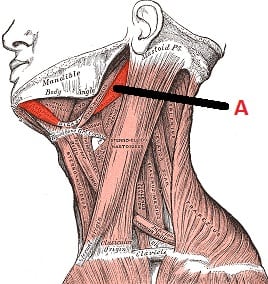
| A |
Facial Nerve |
|
| B |
Hypoglossal nerve |
|
| C |
Inferior Alveolar Nerve |
|
| D |
None of the Above |
What is the Nerve Supply of the Muscle marked A in the Diagram ?
| A |
Facial Nerve |
|
| B |
Hypoglossal nerve |
|
| C |
Inferior Alveolar Nerve |
|
| D |
None of the Above |
The Muscle Marked is Posterior Belly of Diagastric Muscle and Supplied by Facial Nerve
The Anterior Belly is supplied by Inferior Alveolar Nerve
Posterior belly of digastric is supplied by
| A |
Facial nerve |
|
| B |
Mandibular nerve |
|
| C |
Glossopharyndeal nerve |
|
| D |
Trochlear nerve |
Posterior belly of digastric is supplied by
| A |
Facial nerve |
|
| B |
Mandibular nerve |
|
| C |
Glossopharyndeal nerve |
|
| D |
Trochlear nerve |
Ans. is `a’ i.e., Facial nerve
Muscle of fascial expression, which is not supplied by facial nerve ‑
| A |
Orbicularis oris |
|
| B |
Orbicularis oculi |
|
| C |
Frontalis |
|
| D |
Levator palpebrae superioris |
Muscle of fascial expression, which is not supplied by facial nerve ‑
| A |
Orbicularis oris |
|
| B |
Orbicularis oculi |
|
| C |
Frontalis |
|
| D |
Levator palpebrae superioris |
Ans. is ‘d’ i.e., Levator palpebrae superioris
Nerve supply of face
- Each half of the face is supplied by fourteen nerves, one is motor and the rest are sensory.
- Motor supply is derived from facial (7″) nerve which supplies all facial muscles except levator palpeprae sperioris, which is supplied by sympathetic fibers and 3rd cranial nerve.
- Eleven sensosry nerves are derived from branches of trigeminal (5th) nerve and only two sensory are derived from great auricular nerve and transverse (anterior) cutaneous nerve of neck.
The nerve supply of the muscle marked by an arrow in the picture below is?
| A |
Buccal and Zygomatic branches of the facial nerve. |
|
| B |
Buccal |
|
| C |
Zygomatic |
|
| D |
None of the above. |
The nerve supply of the muscle marked by an arrow in the picture below is?
| A |
Buccal and Zygomatic branches of the facial nerve. |
|
| B |
Buccal |
|
| C |
Zygomatic |
|
| D |
None of the above. |
Ans;A).Facial nerve (buccal & zygomatic branch)
The muscle marked by an arrow represents Zygomaticus major.
Zygomaticus major
- It is a muscle of facial expression which draws the angle of the mouth superiorly and posteriorly to allow one to smile.
- Like all muscles of facial expression, the zygomatic major is innervated by the facial nerve (the seventh cranial nerve), more specifically, the buccal and zygomatic branches of the facial nerve.