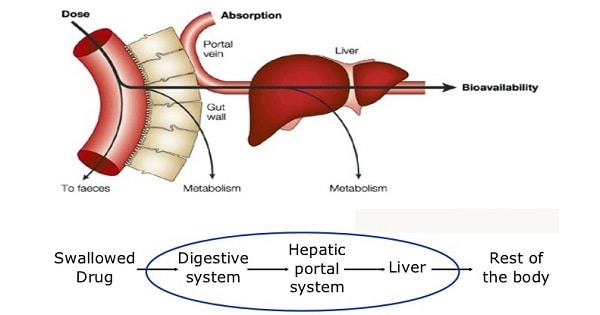
First pass metabolism
A drug administered through which of the following routes undergo high first pass metabolism?
| A |
Oral |
|
| B |
Sublingual |
|
| C |
I.V |
|
| D |
I.M |
A drug administered through which of the following routes undergo high first pass metabolism?
| A |
Oral |
|
| B |
Sublingual |
|
| C |
I.V |
|
| D |
I.M |
First pass metabolism refers to metabolism of a drug during its passage from the site of absorption into the systemic circulation.
Drugs administered through the oral route undergo high first pass metabolism since it is exposed to drug metabolizing enzymes in the intestinal wall and liver.
Reference:
Essentials of Medical Pharmacology by K D Tripathi 5th edition page 25.
Causes for less bioavailability –
| A |
High first pass metabolism |
|
| B |
Increased absorption |
|
| C |
IV drug administration |
|
| D |
High solubility |
Causes for less bioavailability –
| A |
High first pass metabolism |
|
| B |
Increased absorption |
|
| C |
IV drug administration |
|
| D |
High solubility |
Ans. is ‘a’ i.e., High first pass metabolism
o Causes for less bioavailability.
Incomplete absorption
o High first pass metabolism.
About other options
- Increased absorption increases bioavailability.
o I.V. administration has 100% bioavailahi I ity.
- High lipid solubility causes more absorption and better bioavailability.
The bioavailability of the drug depends upon –
| A |
First pass metabolism |
|
| B |
Second pass metabolism |
|
| C |
Volume of distribution |
|
| D |
Excretion |
The bioavailability of the drug depends upon –
| A |
First pass metabolism |
|
| B |
Second pass metabolism |
|
| C |
Volume of distribution |
|
| D |
Excretion |
Ans. is ‘a’ i.e., First pass metabolism
Bioavilability depends on :
i) Extent of absorption.
it) First pass metabolism.
High first pass metabolism is seen in –
| A |
Lignocaine |
|
| B |
Propranolol |
|
| C |
Salbutamol |
|
| D |
All |
High first pass metabolism is seen in –
| A |
Lignocaine |
|
| B |
Propranolol |
|
| C |
Salbutamol |
|
| D |
All |
Ans. is ‘a’ i.e., Lignocaine; ‘b’ i.e., Propranolol; ‘c’ i.e., Salbutamol
The Nitrate which does not undergo first pass metabolism is –
| A |
Isosorbide mononitrate |
|
| B |
Nitroglycerine |
|
| C |
Pentaerythritol tetranitrate |
|
| D |
Isosorbide dinitrate |
The Nitrate which does not undergo first pass metabolism is –
| A |
Isosorbide mononitrate |
|
| B |
Nitroglycerine |
|
| C |
Pentaerythritol tetranitrate |
|
| D |
Isosorbide dinitrate |
Ans. is ‘a’ i.e., Isosorbide mononitrate
o “All nitrates except isosorbide mononitrate undergo extensive but variable first pass metabolism in liver”.
First pass metabolism is maximum with which route:
September 2005
| A |
Oral |
|
| B |
Subcutaneous |
|
| C |
Rectal |
|
| D |
Sublingual |
First pass metabolism is maximum with which route:
September 2005
| A |
Oral |
|
| B |
Subcutaneous |
|
| C |
Rectal |
|
| D |
Sublingual |
Ans. A: Oral
The first-pass effect/first-pass metabolism/presystemic metabolism is a phenomenon of drug metabolism whereby the concentration of a drug is greatly reduced before it reaches the systemic circulation.
It is the fraction of lost drug during the process of absorption which is generally related to the liver and gut wall. Notable drugs that experience a significant first-pass effect are Imipramine, Propranolol, and Lidocaine.
After a drug is swallowed, it is absorbed by the digestive system and enters the hepatic portal system. It is carried through the portal vein into the liver before it reaches the rest of the body. The liver metabolizes many drugs, sometimes to such an extent that only a small amount of active drug emerges from the liver to the rest of the circulatory system. This first pass through the liver thus greatly reduces the bioavailability of the drug.
Routes of administration like suppository/rectal, intravenous, intramuscular, inhalational aerosol and sublingual avoid the first-pass effect because they allow drugs to be absorbed directly into the systemic circulation. The four primary systems that affect the first pass effect of a drug are the enzymes of the gastrointestinal lumen, gut wall enzymes, bacterial enzymes, and hepatic enzymes.
True about propranalol is ‑
| A |
Metabolism of propranolol is not dependent on the hepatic blood flow |
|
| B |
Undergoes extensive first pass metabolism |
|
| C |
Hydroxylated product of propranolol has alpha blocking property |
|
| D |
Propranolol is lipophobic |
True about propranalol is ‑
| A |
Metabolism of propranolol is not dependent on the hepatic blood flow |
|
| B |
Undergoes extensive first pass metabolism |
|
| C |
Hydroxylated product of propranolol has alpha blocking property |
|
| D |
Propranolol is lipophobic |
Ans. is ‘b’ i.e., Undergoes extensive first pass metabolism
Propranolol metabolism
- It is well absorbed after oral administration.
- It has low bioavailability due to high first pass metabolism in liver.
- It is lipophilic and easily penetrates into brain.
- Metabolism of propranolol is dependent on the hepatic blood flow.
- Bioavailability of propranolol is increased when it is taken with food. o Hydroxylated product of propranolol has beta blocking activity.
- Metabolites are excreted in urine mostly as glucuronides.
- More than 90% of propranolol is bound to plasma proteins.
All are true for sublingual route except ‑
| A |
Escape first pass metabolism |
|
| B |
All drugs can be given |
|
| C |
Action can be terminated any time |
|
| D |
Rapid absorption |
All are true for sublingual route except ‑
| A |
Escape first pass metabolism |
|
| B |
All drugs can be given |
|
| C |
Action can be terminated any time |
|
| D |
Rapid absorption |
Ans. is ‘b’ i.e., All drugs can be given
Sublingual route of administration
- The tablet or pellet containing the drug is placed under the tongue or crushed in the mouth and spread over the buccal mucosa.
- Only the lipid soluble and non-irritating drugs can be administered by this route
- Absoption is rapid and action can be produced in minutes
- Action can be easily terminated by spitting the drug after the desired effect is achieved.
- Liver is bypassed with this route, thus the drugs with high first pass metabolism can be easily given by this route.
- Drugs given by this route are: GTN, buprenorphine, desamino-oxytocin.
All are true for this route od drug administration except ‑

| A |
Escape first pass metabolism |
|
| B |
All drugs can be given |
|
| C |
Action can be terminated any time |
|
| D |
Rapid absorption |
All are true for this route od drug administration except ‑
| A |
Escape first pass metabolism |
|
| B |
All drugs can be given |
|
| C |
Action can be terminated any time |
|
| D |
Rapid absorption |
Ans: B.) All drugs can be given
The route of drug administration as shown in the image is the Sublingual route.
Sublingual route of administration
- The tablet or pellet containing the drug is placed under the tongue or crushed in the mouth and spread over the buccal mucosa.
- Only the lipid-soluble and non-irritating drugs can be administered by this route.
- For the sublingual route of administration, the drug should have high lipid solubility and also should be soluble in aqueous buccal fluids i.e. biphasic solubility of the drug is necessary for absorption.
- Absorption is rapid and action can be produced in minutes
- Action can be easily terminated by spitting the drug after the desired effect is achieved.
- The liver is bypassed with this route, thus the drugs with high first-pass metabolism can be easily given by this route.
- All drugs can’t be given by sublingual route.
- Drugs designed for sublingual administration, include some of the cardiovascular drugs, steroids, barbiturates, benzodiazepines, opioid analgesics with poor gastrointestinal bioavailability, enzymes and few vitamins and minerals.
All are true about lidocaine except
| A |
It acts on sodium channels in both active and inactive state |
|
| B |
It is most cardiotoxic local anesthetic |
|
| C |
It is given IV in cardiac arrhythmias |
|
| D |
Extensive first pass metabolism |
All are true about lidocaine except
| A |
It acts on sodium channels in both active and inactive state |
|
| B |
It is most cardiotoxic local anesthetic |
|
| C |
It is given IV in cardiac arrhythmias |
|
| D |
Extensive first pass metabolism |
Ans. b. It is most cardiotoxic local anesthetic
All have high first pass metabolism except ‑
| A |
Lidocaine |
|
| B |
Propranolol |
|
| C |
Theophylline |
|
| D |
Morphine |
All have high first pass metabolism except ‑
| A |
Lidocaine |
|
| B |
Propranolol |
|
| C |
Theophylline |
|
| D |
Morphine |
Ans. is ‘c’ i.e., Theophylline
- Important drugs with high hepatic extraction ratio (with high hepatic first pass metabolism)
Propranolol (13 blockers) Salbutamol Pethidine Theophylline
Isoprenaline Verapamil Nitroglycerine Lignocaine
Methyltestosterone Hydrocortisone TCA (imipramine) Testosterone
All have high first pass metabolism except ‑
| A |
Lidocaine |
|
| B |
Propranolol |
|
| C |
Theophylline |
|
| D |
Morphine |
All have high first pass metabolism except ‑
| A |
Lidocaine |
|
| B |
Propranolol |
|
| C |
Theophylline |
|
| D |
Morphine |
Ans. is ‘c’ i.e., Theophylline