
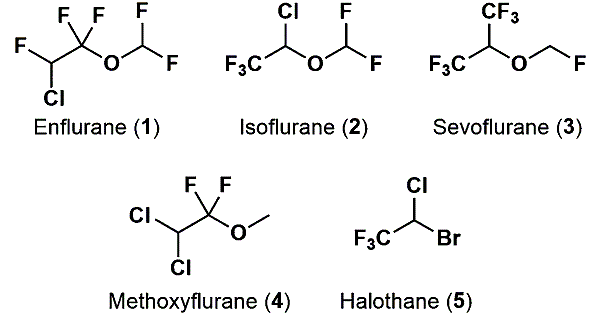
FLOURINATED ANESTHETICS – COMPILATION
MAC of desflurane is –
| A |
1.15 |
|
| B |
2 |
|
| C |
4 |
|
| D |
6 |
MAC of desflurane is –
| A |
1.15 |
|
| B |
2 |
|
| C |
4 |
|
| D |
6 |
Ans. is ‘d’ i.e., 6
Methoxyflurane (MAC = 0.16 %)> Trilene (MAC = 0.2%)> Halothane (MAC = 0.74%)> Chloroform (MAC = 0.8 %) > Isoflurane (MAC = 1.15 %) > Enflurane (MAC= 1.68%) > Ether (MAC = 1.92 %) > Sevoflurane (MAC = 2.0 %) > Desflurane (MAC = 6.0%)> Cyclopropane (MAC = 9.2%) > N20 (MAC 104%).
Which of the following should be considered as the cause of generalized convulsions 20 minutes postoperatively ?
| A |
Halothane |
|
| B |
Enflurane |
|
| C |
Isoflurane |
|
| D |
Sevoflurane |
Which of the following should be considered as the cause of generalized convulsions 20 minutes postoperatively ?
| A |
Halothane |
|
| B |
Enflurane |
|
| C |
Isoflurane |
|
| D |
Sevoflurane |
Ans. is ‘b’ i.e., Enflurane
Enflurane is known to produce seizures.
Inhalation agent incompatable with sodaline
| A |
Isoflurane |
|
| B |
Trichloro Ethylene |
|
| C |
Methoxy flurane |
|
| D |
Enflurane |
Inhalation agent incompatable with sodaline
| A |
Isoflurane |
|
| B |
Trichloro Ethylene |
|
| C |
Methoxy flurane |
|
| D |
Enflurane |
B i.e. Trichloro ethylene
Sodalime with trilene forms phosgene (neurotoxic) gas.Q So this combination is contraindicated.
Sodalime is a mixture of 94% (Ca(OH)2 + 5% NaOH as catalyst + 1% KOHQ; with granule size of 4-8 meshQ. It should not be used with :
The drier the sodalime, the more likely it will degrade & absorb volatile anesthetics. It produces compound A with sevofluraneQ (clinically significant) and carbon monoxide with desflurane, isoflurane & enflurane (clinically insignificant). However, desflurarte can be broken down to CO by dry barium hydroxide lime to such an extent that it is capable of causing clinically significant CO poisoning.

Which of the following inhalational agent is contraindicated in a patient with history of epilepsy;
| A |
lsoflurance |
|
| B |
Enflurane |
|
| C |
Halothane |
|
| D |
Sevoflurane |
Which of the following inhalational agent is contraindicated in a patient with history of epilepsy;
| A |
lsoflurance |
|
| B |
Enflurane |
|
| C |
Halothane |
|
| D |
Sevoflurane |
B i.e. Enflurane
Which of the following statements regard-ing desflurane is correct?
| A |
It causes severe myocardial depression |
|
| B |
It is a structural analogue of isoflurane |
|
| C |
It has vary high blood and tissue gas partition coefficients |
|
| D |
It is metabolically unstable |
Which of the following statements regard-ing desflurane is correct?
| A |
It causes severe myocardial depression |
|
| B |
It is a structural analogue of isoflurane |
|
| C |
It has vary high blood and tissue gas partition coefficients |
|
| D |
It is metabolically unstable |
B i.e. It is a structural analogue of isoflurane
Desflurane’s structure is very similar to that of isoflurane. The only difference is substitution of a fluride atom for isofluranes chlorine atom. Q
Which of following is/are false:
| A |
Enflurane interacts with sodalime |
|
| B |
Sevoflurane causes seizures |
|
| C |
Rapid recovery from propofol |
|
| D |
All |
Which of following is/are false:
| A |
Enflurane interacts with sodalime |
|
| B |
Sevoflurane causes seizures |
|
| C |
Rapid recovery from propofol |
|
| D |
All |
B i.e. Sevoflurane causes seizures, C i.e. Rapid recovery from propofol >> A i.e. Enflurane interacts with sodalime
MAC (minimal alveolar concentration) is the best measure of anesthetic potencyQ.
Sevoflurane has anticonvulsant propertiesQ with no excitatory phenomenon, no increase in CBF or intracranial pressure. Muscle tone is reduced, potentiating nondepolarizing muscle relaxants. Cerebral 02 demand is decreased.
Sevoflurane, isoflurane & desflurane have anticonvulsant propertiesQ. Whereas, the main disadvantage of enflurane is that it often causes epileptiform EEG changesQ (more commonly during hypocapnia) that may persist for several weeks. Cerebral blood flow is doubled at MAC 1 and convulsionsQ occur at MAC2, so it should be used with extreme caution (or avoided) in patients with h/o epilepsy. Muscle relaxation is greater with enflurane than with halothane or isoflurane, enhancing the action of nondepolarizing relaxants.
Enflurane interacts with sodalime but produce clinically insignificant amount of carbonmonooxide. Propofol has smooth & rapid induction and rapid recoveryQ.
Ketamine is a noncompetitive NMDA (glutamate) receptor antagonistQ and does not act on GABA-A receptor.
Following will be the choice of anaesthesia in an infected tooth posted for extraction:
| A |
Local block with lignocaine |
|
| B |
Local block with lignocaine and adrenaline |
|
| C |
Isoflurane |
|
| D |
Enflurane |
Following will be the choice of anaesthesia in an infected tooth posted for extraction:
| A |
Local block with lignocaine |
|
| B |
Local block with lignocaine and adrenaline |
|
| C |
Isoflurane |
|
| D |
Enflurane |
D i.e. Enflurane
“General anaesthesia is indicated in case of acute infection when LA may not be effective because of the local change in pH and there is a risk of spreading infecton”.Q
Anaesthesia in Dental Extraction
Local anesthesia would be adequate except in few situations as –
– inability to tolerate dental treatment using LA (especially children).
– failure of previous attempt to treat under LA.
– patients with special needs or disability which make it impossible to sit still (e.g. uncontrolled movements).
– allergy to LA
– acute infection when local anesthesia may not be affective because of the local change in pHQ and there is risk of spreading infection.
Enflurane is most suitable inhalational agent for dental anesthesia with fewer irritant propertiesQ than isoflurane and a short recovery time. Isoflurane is widely used in contemporary practice, but is not recommended for dental surgery in spontaneously breathing patients as it is irritant and is associated with coughing, salivation, and desaturation.
Which one of the following is not a greenhouse gas?
| A |
Carbon monoxide |
|
| B |
Methane |
|
| C |
Nitrous oxide |
|
| D |
Water vapour |
Which one of the following is not a greenhouse gas?
| A |
Carbon monoxide |
|
| B |
Methane |
|
| C |
Nitrous oxide |
|
| D |
Water vapour |
Ans. is ‘a’ i.e., Carbon monoxide
Inhalational agent of choice for neurosurgery ‑
| A |
Halothane |
|
| B |
Enflurane |
|
| C |
Isoflurane |
|
| D |
N20 |
Inhalational agent of choice for neurosurgery ‑
| A |
Halothane |
|
| B |
Enflurane |
|
| C |
Isoflurane |
|
| D |
N20 |
Ans. is ‘c’ i.e., Isoflurane
Anaesthetic agents of choice for vaous conditions Day care :
|
Ischemic heart disease : Congenital heart disease Left to right shunt : Right to left shunt : CHF : Shock To produce delibrate hypotenion Epilepsy : For electroconvulsive therapy : Thyrotoxicosis : Cardiac surgery : Neurosurgery :
|
Propofol Etomidate Isoflurane Ketamine Ketamine Ketamine Isoflurane Thiopentone Methohexitone Thiopentone Isoflurane Isoflurane
|
Which one of the following inhalational anesthetics is most likely to cause fluoride ion nephrotoxicity ?
| A |
Methooxyflurane |
|
| B |
Enflurane |
|
| C |
Halothane |
|
| D |
Isoflurane |
Which one of the following inhalational anesthetics is most likely to cause fluoride ion nephrotoxicity ?
| A |
Methooxyflurane |
|
| B |
Enflurane |
|
| C |
Halothane |
|
| D |
Isoflurane |
Ans. is ‘a’ i.e., Methooxyflurane
o All inhalational agents depress renal function by decreasing the renal blood flow. Direct toxicity is caused by fluorinated compounds due to production of Inorganic fluoride (F-).
| Agent |
Fluoride level produced |
| Methoxyflurane o Sevoflurane
Enflurane Isoflurane Halothane Desflurane |
50-80 mm (maximum)
30 – 50 mm 20 – 25 mm 4 – 8 mm Produces only in anaerobic conditions Nil (minimal) |
- nal threshold beyond which fluoride levels are toxic is 50 mm. Methoxyflurane is most nephrotoxic —> Causes high output (Polyuric) renal failure. Desflurane has no nephrotoxicity.
- evoflurane & enflurane does not cause renal toxicity in normal person, but should be avoided in renal diseases.
Which anaesthetic drug contributes to green house effect‑
| A |
Enflurane |
|
| B |
Desflurane |
|
| C |
Sevoflurane |
|
| D |
Halothane |
Which anaesthetic drug contributes to green house effect‑
| A |
Enflurane |
|
| B |
Desflurane |
|
| C |
Sevoflurane |
|
| D |
Halothane |
Ans. is ‘b’ i.e., Desflurane
Fastest induction and recovery is seen with ‑
| A |
Desflurane |
|
| B |
N,0 |
|
| C |
Halothane |
|
| D |
Enflurane |
Fastest induction and recovery is seen with ‑
| A |
Desflurane |
|
| B |
N,0 |
|
| C |
Halothane |
|
| D |
Enflurane |
Ans. is ‘a’ i.e., Desflurane
- decreasing order (Increasing order of B : G partition coefficient and blood solubility) : –
|
Desflurane (0.42)Q > Cyclopropane (0.44) > N20 (0.47) > Sevoflurane (0.69)Q > Isoflurane (1.38) > Enflurane (1.8) > Halothane (2.4) > Chloroform (8) > Trilene (9) > Ether (12) > Methoxyflurane (15)Q. |
Smooth induction is seen by –
| A |
Ether |
|
| B |
Halothane |
|
| C |
Isoflurane |
|
| D |
Enflurane |
Smooth induction is seen by –
| A |
Ether |
|
| B |
Halothane |
|
| C |
Isoflurane |
|
| D |
Enflurane |
Ans. is ‘c’ i.e., Isoflurane
Induction by inhalation agents
Unpleasant Intermediate Smooth
Ether Halothane Isoflurane
En flurane Desflurane
Sevoflurane
Nitrous oxide
Which of the following fluorinated agent does not produce fluoride to produce toxicity ‑
| A |
Sevoflurane |
|
| B |
Methoxyflurane |
|
| C |
Desflurane |
|
| D |
Enflurane |
Which of the following fluorinated agent does not produce fluoride to produce toxicity ‑
| A |
Sevoflurane |
|
| B |
Methoxyflurane |
|
| C |
Desflurane |
|
| D |
Enflurane |
Ans. is ‘c’ i.e., Desflurane

