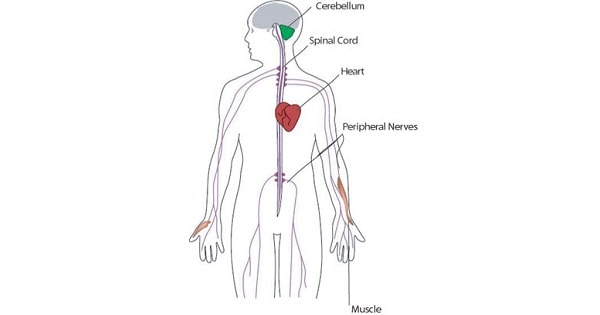
Friedrich’s Ataxia
A 64 year old man begins to show behavioral changes and irritability, and is found wandering in the park near his home. On neurological examination, there is evidence of mild aphasia and cognitive dysfunction, but motor function is preserved. CT scan of the head demonstrates selective atrophy of the cortex of the frontal lobes. Which of the following is the most likely diagnosis?
| A |
Alzheimer’s disease |
|
| B |
Friedreich’s ataxia |
|
| C |
Huntington’s disease |
|
| D |
Pick’s disease |
A 64 year old man begins to show behavioral changes and irritability, and is found wandering in the park near his home. On neurological examination, there is evidence of mild aphasia and cognitive dysfunction, but motor function is preserved. CT scan of the head demonstrates selective atrophy of the cortex of the frontal lobes. Which of the following is the most likely diagnosis?
| A |
Alzheimer’s disease |
|
| B |
Friedreich’s ataxia |
|
| C |
Huntington’s disease |
|
| D |
Pick’s disease |
Friedreich’s ataxia is caused due to triplet repeats of:
| A |
AGG |
|
| B |
GAA |
|
| C |
UAA |
|
| D |
AUG |
Friedreich’s ataxia is caused due to triplet repeats of:
| A |
AGG |
|
| B |
GAA |
|
| C |
UAA |
|
| D |
AUG |
A 50 year old driver, suffering from diabetes since 5 years, who consumes alcohol 30 g/day IS complaining of progressive ataxia. Clinical examination revealed extensor plantar response and position sense deficits. Detailed evaluation showed evidence of cardiomyopathy, scoliosis, foot deformities and optic atrophy. He is probably suffering from:
| A |
Friedreich’s ataxia |
|
| B |
Episodic ataxia |
|
| C |
Ataxia telangiectasia |
|
| D |
Baltic myoclonus |
A 50 year old driver, suffering from diabetes since 5 years, who consumes alcohol 30 g/day IS complaining of progressive ataxia. Clinical examination revealed extensor plantar response and position sense deficits. Detailed evaluation showed evidence of cardiomyopathy, scoliosis, foot deformities and optic atrophy. He is probably suffering from:
| A |
Friedreich’s ataxia |
|
| B |
Episodic ataxia |
|
| C |
Ataxia telangiectasia |
|
| D |
Baltic myoclonus |
| Friedreich’s ataxia (autosomal recessive) | Ataxia, areflexia, extensor plantar responses, position sense deficits, cardiomyopathy, diabetes mellitus, scoliosis, foot deformities; optic atrophy; late-onset form, as late as 50 years with preserved deep tendon reflexes, slower progression, reduced skeletal deformities, associated with an intermediate number of GAA repeats and missense mutations in one allele of frataxin; genetic testing available |
Ref: Harrisons Principles of Internal Medicine, 18th Edition
A 12-year-old boy presents to the Outpatient department with history of progressively increasing difficulty in walking and frequent falls. Physical examination reveals an ataxic gait and nystagmus. All deep tendon reflexes were observed to be absent while the plantar response was ‘Extensor’. What is the most likely diagnosis?
| A |
Friedreich’s Ataxia |
|
| B |
Subacute Combined Degeneration of Cord (SACD) |
|
| C |
Becker’s Muscular Dystrophy |
|
| D |
Tabes Dorsalis |
A 12-year-old boy presents to the Outpatient department with history of progressively increasing difficulty in walking and frequent falls. Physical examination reveals an ataxic gait and nystagmus. All deep tendon reflexes were observed to be absent while the plantar response was ‘Extensor’. What is the most likely diagnosis?
| A |
Friedreich’s Ataxia |
|
| B |
Subacute Combined Degeneration of Cord (SACD) |
|
| C |
Becker’s Muscular Dystrophy |
|
| D |
Tabes Dorsalis |
Answer is A (Friedreich’s Ataxia):
Friedreich’s Ataxia
- Most common form of Inherited Ataxiae
- Autosomal Recessive inheritances
- Caused by an Unstable mutation on chromosomal
- Mutated gene is called Frataxin
- Onset between age of 2 and 25 years
Examination
- Extensor Plantar Response with absence of Deep Tendon Reflexes
- Normal Tone in trunk and extremities
- Weakness (greater distally than proximally)
- Loss of vibration and joint position sense
- Nystagmus, Dysarthria, Dysmetria Titubation, Ataxia.
- vitamin B12 deficiency
- spinal postero-lateral column degeneration
- bilateral, usually symmetrical posterior column loss
- joint position & vibration loss ,ataxic gait ,positive Romberg sign ,upper motor neurone signs in the legs usually exaggerated, but occasionally absent, knee reflexes clonus, up-going plantars but, absent ankle reflexes reflexes may be diminished or absent due to sensory dysfunction
- associated findings i. optic atrophy ii. peripheral sensory neuropathy iii. dementia
- RX B12 & folate.
Tabes dorsalis
- It is also known as syphilitic myelopathy, is a slow degeneration (specifically, demyelination) of the neural tracts primarily in the dorsal columns (posterior columns) of the spinal cord & dorsal roots.
- Signs and symptoms may not appear for decades after the initial infection and include weakness, diminished reflexes, paresthesias (shooting and burning pains, pricking sensations, and formication), hypoesthesias (abnormally diminished cutaneous, especially tactile, sensory modalities), tabetic gait (locomotor ataxia), progressive degeneration of the joints, loss of coordination, episodes of intense pain and disturbed sensation (including glossodynia), personality changes, urinary incontinence, dementia, deafness, visual impairment, positive Romberg’s test, and impaired response to light (Argyll Robertson pupil).
- The skeletal musculature is hypotonic due to destruction of the sensory limb of the spindle reflex.
- The deep tendon reflexes are also diminished or absent; for example, the “knee jerk” or patellar reflex may be lacking (Westphal’s sign).
Becker muscular dystrophy
- It is an X-linked recessive inherited disorder characterized by slowly progressive muscle weakness of the legs and pelvis. It is a type of dystrophinopathy.
- This is caused by mutations in the dystrophin gene, which encodes the protein dystrophin.
- Some symptoms consistent with Becker muscular dystrophy are:
- Muscle weakness, slowly progressive difficulty walking
- Severe upper extremity muscle weakness.
- Toe-walking
- Use of Gower’s Maneuver to get up from floor.
- Difficulty breathing
- Skeletal deformities, chest and back (scoliosis)
- Pseudohypertrophy of calf muscles
- Muscle cramps
- Heart muscle problems
- Elevated Creatine kinase levels in blood
Features of Friedreich’s Ataxia include all of the following except:
| A |
Progressive weakness |
|
| B |
Absent lower limb reflexes |
|
| C |
Increased tone in lower limbs |
|
| D |
Extensor plantar Response |
Features of Friedreich’s Ataxia include all of the following except:
| A |
Progressive weakness |
|
| B |
Absent lower limb reflexes |
|
| C |
Increased tone in lower limbs |
|
| D |
Extensor plantar Response |
Answer is C (Increased tone in lower limbs):
Despite pyramidal tract involvement, muscle tone in Friedreich’s ataxia is usually normal or decreased
Which of the following regions of the spinal cord is involved first in Friedreich’s Ataxia:
| A |
Dorsal Root ganglion |
|
| B |
Spinal tracts |
|
| C |
Peripheral nerve |
|
| D |
Cerebellum |
Which of the following regions of the spinal cord is involved first in Friedreich’s Ataxia:
| A |
Dorsal Root ganglion |
|
| B |
Spinal tracts |
|
| C |
Peripheral nerve |
|
| D |
Cerebellum |
Answer is A (Dorsal Root Ganglion):
The first pathological changes in Friedreich’s ataxia are thought to occur in the dorsal root ganglia with loss of large sensory neurons
Ref: Clinical Neurology by Goetz.